

This is an edition of Time-Travel Thursdays, a journey through The Atlantic’s archives to contextualize the present. Sign up here.
Exactly 39 years after Julia Ward Howe’s “Battle Hymn of the Republic” was first published in The Atlantic, Mark Twain scratched out a new version. “Battle Hymn,” which Twain considered “beautiful and sublime,” was in need of revision. In 1901, the United States was entering the third year of a war to establish colonial rule in the Philippines, and Howe’s rousing vision of a sacred national struggle didn’t quite fit the moment. “Mine eyes have seen the orgy of the launching of the Sword,” Twain began. “He is searching out the hoardings where the stranger’s wealth is stored.” The rest of the verses deal in similar substitutions: a bandit gospel for a fiery gospel; instead of truth and God, lust and greed go marching on.
Twain’s satire worked because it exposed the hypocrisies of America’s first embrace of an overseas empire at the turn of the 20th century. Advocates of intervention spoke confidently of spreading democracy; Twain and other anti-imperialists answered by holding those professed ideals up against the anti-democratic reality of conquest and violence. This pattern of argument would persist through the Iraq War. The guiding questions were always around what we really believed we were doing in other countries—spreading democracy, or simply exploiting people and advancing our interests? With this weekend’s ouster of Nicolás Maduro from Venezuela, America has crossed into a new era, in which leaders no longer bother with the pretense.
Twain and the anti-imperialists were processing what seemed like a profound turn in American history. Prior conquest of North America was the real beginning of American imperialism, and the overthrow of the Hawaiian monarchy in 1893 anticipated advances in the Pacific. But the Spanish-American War of 1898—what the Atlantic editor Walter Hines Page deemed “a necessary act of surgery for the health of civilization”—commenced a new phase of overseas empire. The United States made Cuba something of a protectorate, formally annexed Hawaii, and added Puerto Rico, Guam, and the Philippines as part of the Spanish-American War peace treaty.
For the champions of empire, 1898 presented a kind of deliverance. Americans would take their rightful place on the global stage alongside the Europeans, bringing democracy, civilization, commerce, and Christianity with them. White American men, thought to have become feminized and overcivilized by domestic comforts, could redeem themselves in the process of occupying their new colonial possessions. American workers of all kinds would be rescued from what many believed to be the dangers of excessive production, with ready markets for their goods beyond American borders. God “has marked us as his chosen people, henceforth to lead in the regeneration of the world,” Senator Albert Beveridge of Indiana boasted. “We are trustees of the world’s progress, guardians of its righteous peace.”
The reality on the ground did not match the rhetoric, particularly in the Philippines. Purchased for $20 million from Spain in the peace proceedings, the archipelago promised access to the Chinese market—and a laboratory for a benevolent theory of American empire. “If we can benefit those remote peoples,” President William McKinley had asked, “who will object?” But his promise that “our priceless principles undergo no change under a tropical sun” did not survive the Pacific crossing. American forces worked to crush something they knew well—a popular uprising against colonial rule. The methods the army employed were brutal, including a water torture and rounding suspected rural insurgents into concentration camps—a tactic practiced by the Spanish in Cuba that had helped galvanize American support for war there.
Twain was horrified by the violence, but he was particularly enraged about the redemptive rhetoric that cloaked it. “We have gone there to conquer, not to redeem,” he told a reporter in 1900. His many subsequent published writings opposing American imperialism (as well as his version of the “Battle Hymn,” which he did not publish but was found written into a book he owned) were works of bitter satire highlighting the disconnect between the reality of conquest and the language of redemption. In “To the Person Sitting in Darkness,” Twain extracted what he called “the Actual Thing”—war, violence, greed exploitation—from the “outside cover” of the “Blessings of Civilization.” The United States had become “yet another Civilized Power, with its banner of the Prince of Peace in one hand and its loot-basket and its butcher-knife in the other.”
The anti-imperialist movement that Twain joined was a motley gathering of both moral idealists and virulent racists who scorned even association with nonwhite people, much less their elevation. But insofar as Twain’s satire worked, it did so because it presumed that American ideals mattered—and that their violation did too. Even those who were less concerned about the violence or the fate of nonwhite people could note the disconnect between America as an anticolonial nation practicing colonialism. During the 1900 presidential election, Democratic candidate William Jennings Bryan responded to Republican censure of his anti-imperial stance with the suggestion that they extend their censure to Patrick Henry, George Washington, Thomas Jefferson, and Abraham Lincoln.
Neither Twain nor Jennings Bryan stopped the drift toward overseas intervention that had begun in 1898. Theodore Roosevelt, elevated to the vice presidency by the spectacle of his famous charge up San Juan Hill in Cuba, would tender an even more forceful expression of American power after he became president. Such expressions would only grow through the remainder of the century. But even the most strident interventionists felt compelled to temper their justifications with the language of anti-imperialism. “We don’t seek empires,” Defense Secretary Donald Rumsfeld said a few months into the second Iraq War. “We’re not imperialistic. We never have been.”
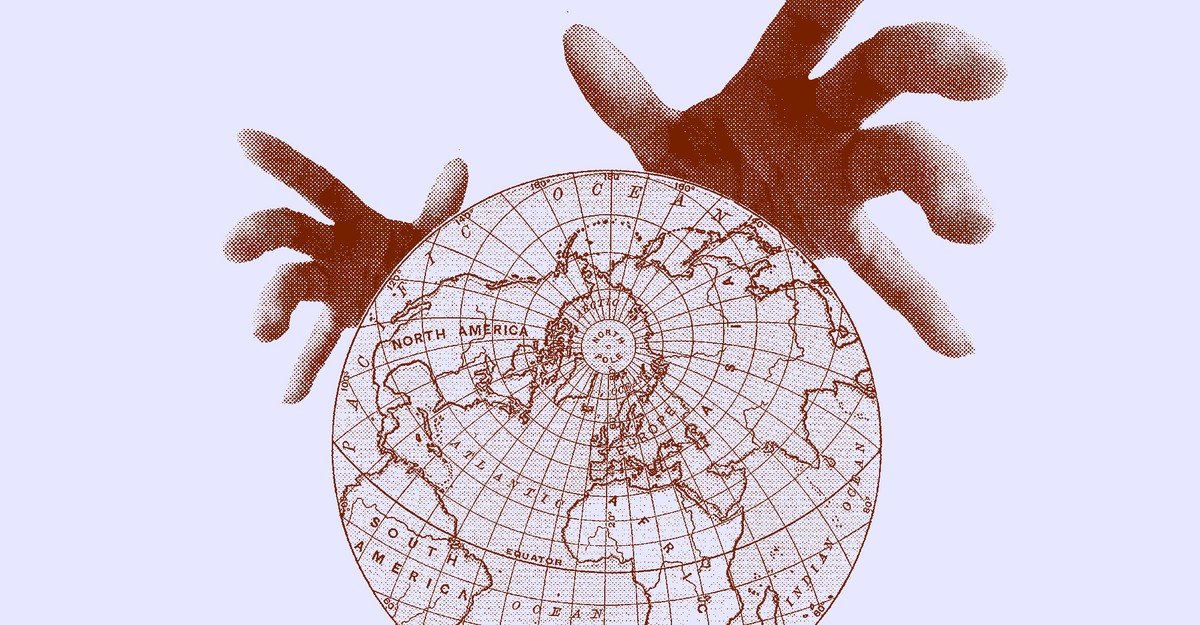
President Trump and his administration have upended this American tradition of claiming, however hypocritically, that foreign intervention is not about power or profit. In the days since Maduro’s capture, the president has repeatedly bragged about being “in charge” of Venezuela, and suggested that the U.S. might run the country for years. He has openly explained that his priority is taking control of the country’s oil business to make the U.S. wealthier (a plan that’s not economically sound, as my colleague Jonathan Chait points out). Earlier this week, the State Department’s social-media account shared a post reading “THIS IS OUR HEMISPHERE,” while Representative Andy Ogles, a Tennessee Republican, repeated the boast in a television interview on Wednesday: “We are the dominant predator force in the Western hemisphere.”
The absence of urgency to empower the democratic opposition, or even to pay lip service to the goal of restoring liberal democracy within the country, marks a new form of American intervention abroad. To this administration, the show of force is a good in itself—no pandering to ideals required. With America’s goals so clearly laid out, it’s not clear what good satire might do, or how much use Mark Twain might be now. The administration’s posturing suggests that even the oil might be beside the point. The most valuable resource has perhaps already been extracted: the spectacle of power itself.
