

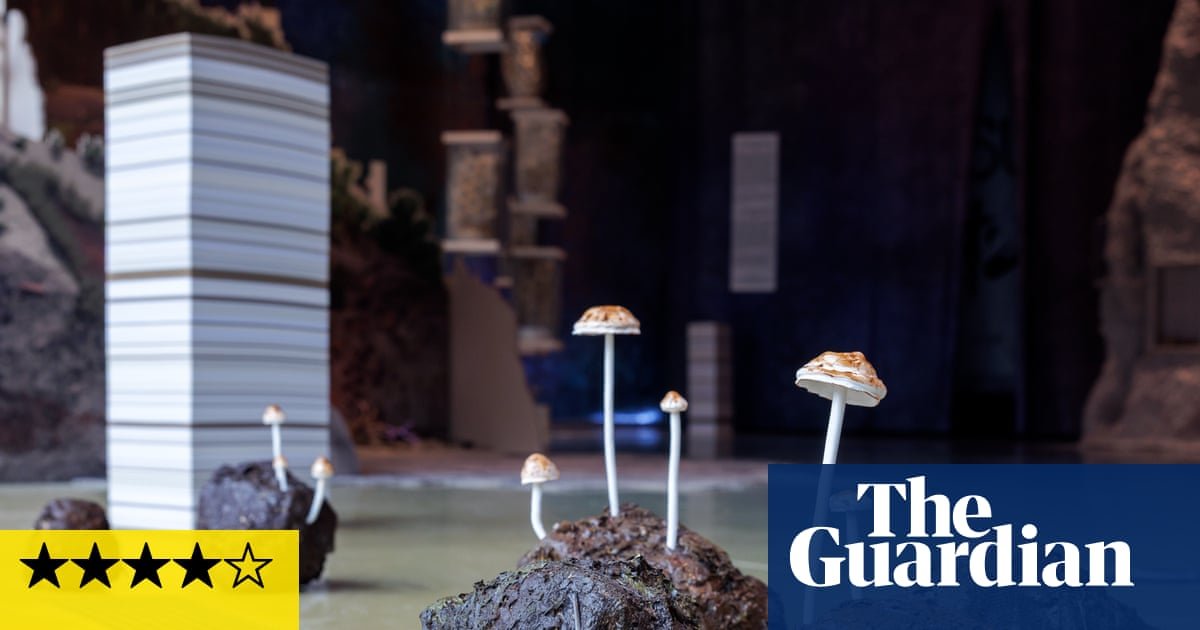
Sylvia Plath’s poem Mushrooms is a sinister paean to the natural world. Her observations on fungi are freighted with foreboding, noting how “very / Whitely, discreetly, / Very quietly” they “Take hold on the loam, / Acquire the air”. The poem ends: “We shall by morning, / Inherit the earth. / Our foot’s in the door.”
Plath’s ominous ode from 1959 forms the opening salvo in an exhibition dedicated to fungi’s creepy omniscience. Far from merely getting a foot in the door, the door has been blasted off its hinges by fungi’s preternatural capacity to reproduce, spread, evolve – and annihilate. How they thrive with a perverse intensity on discarded, dead and dying things, impelling the cycle of decay and regrowth. As coprophiliacs, necrophiliacs and silent assassins, they are legion, and have been around for over a billion years.
They crawl into hospital beds – and from there into our lungs
Featuring installations, films and soundscapes confected by a range of artists, Fungi: Anarchist Designers is a Dantean journey through the many circles of fungal hell, contrived to convey their terrifying ubiquity and resilience. A timelapse film of the aptly named basket stinkhorn, burgeoning from fleshy phallus into a perforated umbrella, sets the tone. The stinkhorn emits the smell of rotting flesh to attract flies, which feast on it and disperse its spores.
“Fungi refuse the commands of human masters and to abide by human standards of propriety,” say the exhibition’s curators, anthropologist Anna Lowenhaupt Tsing and architect and artist Feifei Zhou. “They latch on to our worst habits, turning industrial trade into continent killing machines. They leap into commercial agriculture, wiping out vast fields. They crawl into hospital beds and from there into our lungs. We cannot ignore them.”
Ninety extinctions and counting … the tombstone for frog species. Photograph: Aad Hoogendoorn
The exhibition is not about fungi’s increasing role as a passive building material or product, exemplified by the rise of mycelium panels. Instead, its focus is on “anti-design”, highlighting their role as “co-designers of the world”, outwitting it and bending it to their will.
From the sea to the stratosphere, fungi’s domain is vast. Taxonomically, it encompasses more than two million organisms, from microscopic yeasts, moulds and mildews to lichens and mushrooms, some laced with psychotropic properties or lethal toxins. Amanita phalloides, or death cap, is the principal culprit in most human deaths from mushroom poisoning, including the Holy Roman Emperor Charles VI in 1740. Now globally established, through the cultivation of non-native tree species, the prevalence of the death cap illustrates the unintended consequences of humans tampering with nature.
Fungi thrive on our venality and shortsightedness. Monocultural forests and crop plantations, reductively cultivated for profit, are grist to their mill. The genetic sameness of industrially farmed commodities such as sweetcorn, bananas and coffee makes them especially vulnerable to fungal attack. Capable of ripping through conifer plantations, heterobasidion root rot is one of the most feared diseases. Its balefully destructive impact is crystallised in a multimedia installation by forest pathologist Matteo Garbelotto and artist Kyriaki Goni, entitled: “We shall by morning, inherit the earth” after Plath’s chilling poem.
‘We cannot ignore them’ … Fungi: Anarchist Designers. Photograph: Aad Hoogendoorn
Plants and trees are not the only victims of fungi’s advances. A giant “tombstone” is inscribed with the names of assorted frog species rendered extinct by a microscopic fungus. Accompanying it is a magnified image of a fungal tube piercing the skin of a corroboree frog. It might look innocuous, but, to date, more than 90 amphibian species have been wiped out and many are still endangered.
Aficionados of The Last of Us will be familiar with how humanity has been reduced to mushroom-headed monstrosities through the cordyceps virus, based on an all too real type of parasitic fungi that infects insects, controls their brains, and then erupts from the host’s corpse as fungal stalks to spread its spores, an exquisitely horrific conjunction of death and sex.
Humans are, indeed, susceptible to fungal infections, mainly of the prosaic kind that favour warm, moist crevices and a lack of personal hygiene. But more sinister invaders are always lurking. A mock-up of a hospital bed bay forms an impromptu shrine to the multi drug-resistant candida auris, which spreads through hospitals and can be deadly, killing as many as one in three patients who contact it.
Yet fungi’s nihilistic propensities are underscored by a curiously compelling beauty. Historic architectural drawings from the Nieuwe Instituut’s archive are shown floridly mottled with fungal discoloration, like Rorschach inkblots, while Japanese artist Hajime Imamura creates “mycelial sculptures” as thin, intertwined coils, draped probingly across a ceiling.
Hajime Imamura’s ‘mycelial sculptures’ in Fungi: Anarchist Designers. Photograph: Aad Hoogendoorn
Lizan Freijsen’s “tufted floor objects” (ie rugs) resemble patches of dry rot, a fungus that thrives in damp houses and wooden ships. Originally, it was confined to a corner of the Himalayas, but has since made its way around the world through the conduits of colonial trade. Michael Poulsen’s towering, stalagmite-like model of a termite mound spotlights the symbiosis between fungi and termites; the fungi break down plant cell walls to provide food for the insects.
After Hiroshima was obliterated by an atomic bomb, one of the first living things to emerge from the devastated landscape was the matsutake mushroom, traditionally fetishised by the Japanese as a gourmet delicacy. Shiho Satsuka and Liu Yi’s lyrical animated film illuminates the relationship between the matsutake and Japanese pine forests, showing how fungi can make places habitable for trees in terrain disturbed by the impact of people, earthquakes or war.
Actual living fungi make an appearance in “architecture must rot”, an installation exploring how materials – in this case, plywood cocoons in sealed terraria – are broken down and transfigured by fungal growth. In re-imagining decay as a positive, ecologically beneficial mechanism, it questions the fiction of architecture’s physical permanence (in reality, all buildings have finite lifespans) and how fungi might mediate processes of transformation and regeneration.
The Dantean journey culminates in a corridor of manifestos urging us to rethink how we live with the more-than-human world, and to envisage futures shaped by negotiation and interdependence. Enlivened by a wealth of detail, most of it deliciously disquieting, this atmospheric and engrossing exhibition ensures you’ll never look at a mushroom in the same way again. Humanity, beware: “Our foot’s in the door.”
At Nieuwe Instituut, Rotterdam, until 8 August
