

In the tiny seaside village of Pacific Grove, California, there’s no escaping the monarch butterfly.
Here, butterfly murals abound: one splashes across the side of a hotel, another adorns a school. As for local businesses, there’s the Monarch Pub, the Butterfly Grove Inn, even Monarch Knitting (a local yarn shop). And every fall, the small city hosts a butterfly parade, where local elementary school children dress up in butterfly costumes. The city’s municipal code even declares it an unlawful act to “molest or interfere” with monarchs in any way, with a possible fine of $1,000.
After all, Pacific Grove is better known by its other, self-given nickname: “Butterfly Town, U.S.A.”
But Butterfly Town, and the rest of California, has a problem. The species behind the fanfare is disappearing at an alarming rate, amid rampant pesticide use, habitat loss, extreme weather and the climate crisis. The stakes are dire; monarch populations in the western US have plummeted by more than 99% since the 1980s.
If nothing changes, experts fear the western monarchs have a nearly 100% chance of extinction by 2080.
“It’s important to recognize that Butterfly Town is about living creatures that need our help, not just orange-and-black merchandise,” stressed Natalie Johnston, the education manager at the Pacific Grove Museum of Natural History, who also runs the museum’s monarch programs.
Pacific Grove has long been an official “overwintering” resting site for monarch butterflies, which flock from the Pacific north-west down to the California coast every late fall and winter on their annual migration route. In years past, tens of thousands of monarchs have taken shelter in the town’s designated monarch sanctuary, amassing around the branches of trees in huge clumps and bursting through the air in giant orange clouds.
One week in December 2022, volunteers counted nearly 16,000 butterflies sheltering within Pacific Grove’s sanctuary. But this year, on a similar December week, the butterfly count there was 107.
In Pacific Grove, it’s unlawful to ‘molest or interfere’ with monarchs in any way. The fine for breaking that law was upped from $500 to $1,000. Photograph: Amanda Ulrich
For many biologists, monarchs serve as a canary in the coal mine for environmental impacts to come, especially for other pollinators.
“They are one of the best-studied butterflies,” said Emma Pelton, senior conservation biologist for the nonprofit Xerces Society for Invertebrate Conservation. “So the more we know about them, and the more we understand all the threats they face, that’s a direct correlation to the threats that these other butterflies and other insects face.”
Although the US Fish and Wildlife Service proposed that the entire monarch species, including populations in the east and west, be formally listed as threatened under the Endangered Species Act, the Department of the Interior has delayed making a decision on that listing.
Still, all hope is not yet lost for Butterfly Town. Johnston, from the natural history museum, and a band of other staff and volunteers are fighting for the namesake invertebrates by diligently tracking their numbers and calling for their protection.
We continue to lose sites, and we continue to have a lack of meaningful legal protection for the vast majority of themEmma Pelton
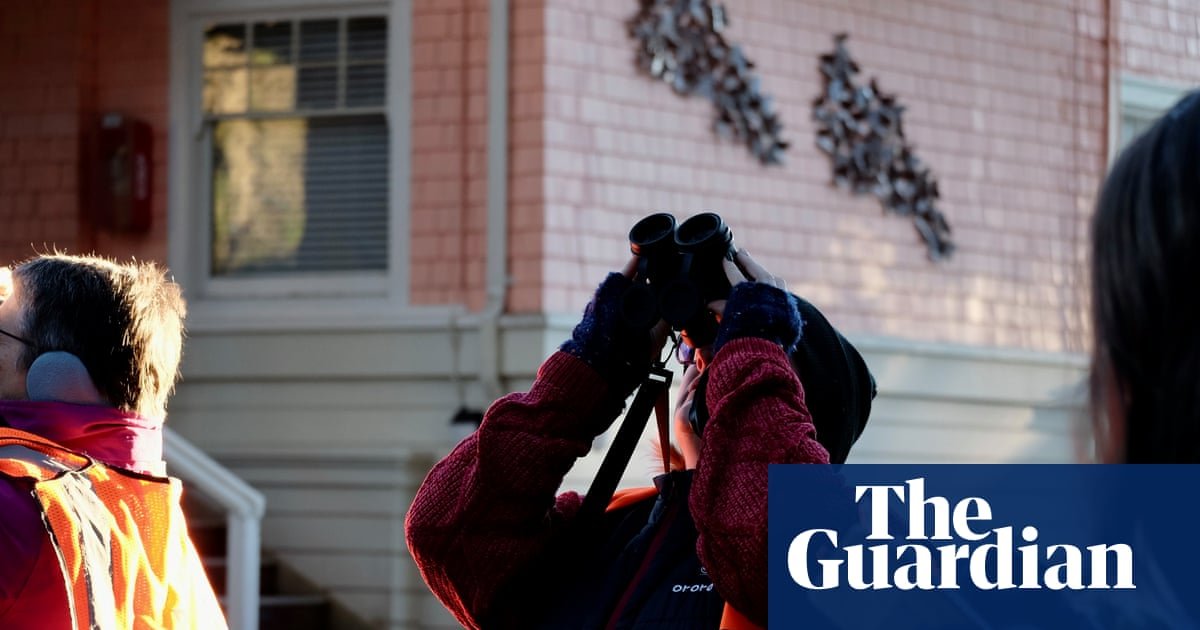
On a recent brisk December morning, Johnston and four volunteer “citizen scientists” gathered outside the city’s small monarch sanctuary, bundled up in hats and gloves, for their weekly butterfly count. Up and down the state, researchers rely on citizen scientists to collect real-time data, helping them to get a true sense of where the monarch population stands.
One butterfly counter and docent for the history museum, Kat Morgan, described herself as “a data geek”. Part of the appeal of the butterfly count, she said, is to be able to contextualize current numbers within broader patterns and trends.
“My job is to help people fall in love with the butterflies, or fall deeper in love, so that they’ll take action,” she said.
Equipped with binoculars, clipboards and small green laser pointers (to aid in counting), the volunteer group set out into the wooded, roughly three-acre preserve.
Inside the sanctuary, butterflies hung from the branches of eucalyptus trees in shadow, like a darkened chandelier, occasionally flitting into the sunlight in sudden brilliant color. The volunteers were largely quiet as they peered upwards, squinting into their binoculars. The Pacific Ocean thudded dully in the distance.
When monarchs cluster in big groups, volunteers are able to count them by estimating the general density of the butterflies and how many are typically in one area. But when they’re more scattered, like this December morning, the volunteers count each flattened set of wings they see.
Signs celebrating the monarch butterfly are everywhere in Pacific Grove. Photograph: Amanda Ulrich
The monarchs’ presence here at all, year after year, has a somewhat mysterious quality to it; because migrating monarchs have a lifespan of just nine months or less, each wave of butterflies that arrives to Pacific Grove has never been there before. Scientists still don’t understand how, exactly, they know which tiny plot of land and specific tree to fly to, hundreds of miles south from where they started their journey.
Near the top of one eucalyptus, the volunteer group spied a solid bunch of nestling monarchs. One person counted 27 butterflies, another 28. Johnston checked the butterfly tally on her clipboard.
“If we do in fact have 28, that makes this our highest count of the year,” she reported.
After another beat of counting, another volunteer agreed with the higher number: “28!”
“Yay!” Johnston cheered, encouraging them along.
The volunteers’ final tally of the morning was 226 butterflies: A very far cry from the huge counts of years past, but better than every other week of the 2025 season in Pacific Grove. It’s anyone’s guess, the volunteers said, why this particular weekly count may have been different. The numbers fluctuate, and there could always be butterflies the volunteers don’t spot.
On a broader scale, the reasons why monarch counts have plunged in the last 50 years are more obvious.
Starting in the 80s, frenzied coastal development across the state likely sparked some of the major drop-offs, Pelton said. Even the Pacific Grove sanctuary today, she pointed out, is a “green space in a sea of houses”.
“That’s the same for so many of these core overwintering sites,” she said. “We lose sites every year. We continue to lose sites, and we continue to have a lack of meaningful legal protection for the vast majority of them.”
The climate crisis is also driving some of the decline. This winter may prove to be the second or third-lowest count of western monarchs on record, the Xerces Society reported in early December, partially due to a warmer summer and drought conditions across the west.
“Now climate change might be like the straw that breaks the camel’s back,” Pelton said. “But there are these other root causes that, thankfully, we can probably address more easily than climate change in the very near term, such as reducing our pesticide use.”
There’s something about monarch butterflies that seems to resonate … Natalie Johnston
Pesticides have been a particularly glaring issue in Pacific Grove. In early 2024, Butterfly Town was the center of a monarch “mass mortality event” after hundreds of butterflies were exposed to pesticides and died.
Johnston and the other volunteers still remember stumbling upon the dying butterflies on a private property just off the sanctuary grounds: seeing them convulse in clumps on the ground for days. Several volunteers still can’t bear to look at the photos and videos from those days, or read about any of the scientific findings. Witnessing the impacts of pesticides in real-time – “the convulsions, the seizures” – was horrific, Johnston said.
A total of 15 different pesticides were found in the butterflies’ systems, a new study reported this year. County officials and the study’s authors, including Pelton, weren’t able to pinpoint the specific source, but determined that the toxins could have come from an unreported or untraceable residential or commercial use in Pacific Grove. Aside from pesticides used in large-scale farming operations, simple residential use of the household products can be a huge threat to monarchs – and homeowners don’t have to report using them.
To many, the whole 2024 saga ended up feeling like an unsolved murder investigation.
“There were dead bodies,” Pelton said, “but no weapon, no perpetrator.”
Butterflies hang from a eucalyptus tree in the Pacific Grove Monarch Sanctuary. Photograph: Amanda Ulrich
The mass die-off did, however, spark a wider conversation in Pacific Grove about pesticides, including seemingly benign ones labeled as “organic”, which homeowners may not realize are harmful to monarchs as they fly across the city before landing in the sanctuary. Johnston started knocking on neighbors’ doors and handing out brochures about how to maintain their properties with butterflies in mind, like planting flowering, native plants and avoiding pesticides.
“Monarch butterflies depend on you!” the brochures implored.
Luckily, for now, Butterfly Town is still flush with monarch enthusiasts. People eagerly impart their own personal meanings onto butterflies, Johnston said. Visitors to the sanctuary will often tell her they love the species because of its strength – they weigh less than a paper clip, but can fly more than 100 miles in a day – or because of its transformation from lowly caterpillar to winged beauty.
Whatever the reason, in Pacific Grove the butterflies carry weight.
“They’re harmless and they’re beautiful,” Johnston said. “There’s something about monarch butterflies that seems to resonate with everybody.”
