

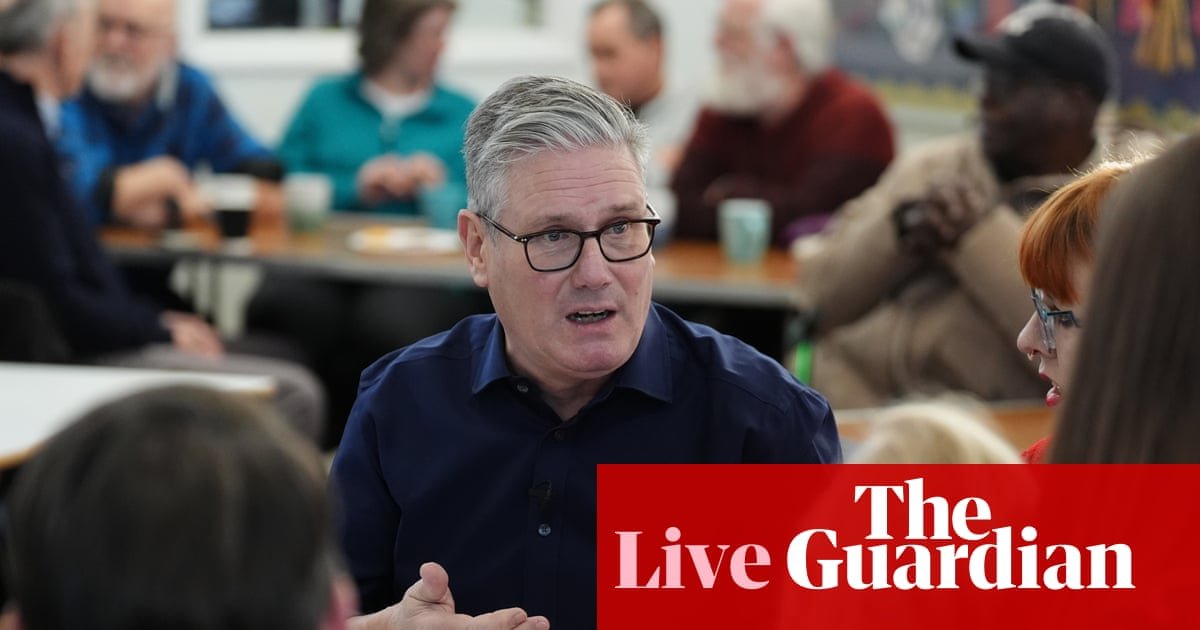
No 10 suggests UK would not vote for UN security council resolution condemning US arrest of Maduro
The Downing Street lobby briefing was mostly taken up with questions about Venezuela. Here are the main points.
The PM’s spokesperson did not contest the Times report claiming that, if the UN security council votes on a resolution criticising the US intervention in Venezuela, the UK will abstain. (See 12.11pm.) The spokesperson confirmed that Yvette Cooper, the foreign secretary, will make a statement to MPs this afternoon about Venezuela and he suggested she would cover this point in her statement.
The spokesperson claimed it was “hypothetical” to suggest, as Emily Thornberry did in her Westminter Hour interview, that the US move would encourage China or Russia to topple leaders that they don’t like. Asked if Thornberry had a point, the spokesperson said:
I don’t think it’s massively helpful to get into hypothetical scenarios or make comparisons. We respect international law, and we expect countries to do the same.
The spokesperson also declined to comment on Trump’s suggestions that he might seek to topple the regimes in power in Cuba or in Colombia. Asked about these countries, the spokesperson said these were “hypotheticial scenarios”. When it was pointed out that Trump’s threats to these countries go beyond the hypothetical, the spokesperson replied:
The UK’s position on this is clear. We respect international law and any soveriegn state that recognises international law must set out the legal basis for its decisions and actions. That is for the US to speak to.
The spokesperson said that Cooper reiterated the UK’s support for international law when she spoke to Marco Rubio, her US counterpart, last night.
But the spokesperson would not say whether or not the government thinks the US did break international law. Asked about this, the spokesperson referred to what Mike Tapp, the migration minister, said this morning about the need for the US to justify its decision. (See 9.56am.) Asked again what the government thought, the spokesperson also said that there is a long-standing principle that governments don’t publish their internal legal advice. Asked if there were any circumstances in which kidnapping the head of state of another country could be legal, the spokesperson said:
We have long supported the transition of power away from Maduro. He’s an illegitimate president. We shed no tears about the end of his rule in Venezuela.
The spokesperson repeated what Keir Starmer said this morning about the future of Greenland being a matter for Greenland and Denmark, not Trump. (See 12pm.) But he said Nato countries agreed that they faced a threat from Russia in the Arctic. Nato was stepping up to respond, he said.
The spokesperson would not say whether the UK would withhold intelligence from the US if it had concerns about the Americans breaking international law. Asked about this, he just said he would not comment on intelligence matters.
Share
Updated at 08.07 EST
Key events
Show key events only
Please turn on JavaScript to use this feature
Swinney says he ‘cannot see’ how Maduro arrest complied with international law
John Swinney, Scotland’s first minister, has said he does think the US arrest of Nicolás Maduro was a breach of international law.
Speaking at the SNP event in Glasgow this morning, Swinney said:
I am deeply concerned at the situation which has unfolded in Venezuela.
There is no doubt that the Maduro regime was an illegitimate and authoritarian regime.
However, I am clear that all nations must abide by the international, rules-based system.
Having listened carefully to what has been said by the United States administration in recent days, I cannot see how international law has been respected here.
Share
Ed Davey, the Lib Dem leader, has welcomed Keir Starmer’s comments about Greenland. (See 12pm.) He posted this response on social media.
About time.
Let’s hope this is the start of Keir Starmer standing up for Britain and our allies when it really matters.
Share
Do MPs have any real influence over foreign policy?
A reader asks:
What realistic control does parliament have over foreign policy? Does it have any at all?
I know parliament now votes on war but that’s only a convention not a law. What about everything else? Treaties are a power reserved for the prime minister but can parliament affect their contents in any meaningful way? Is foreign policy democratically accountable?
Good question. And broadly you are right. Much foreign policy does not involve legislation, but does involve the exercise of prerogative powers (where ministers can take decisions at will on the grounds that they are acting on behalf of the king). Keir Starmer did propose before the election legislating to ensure that MPs would always have a vote on going to war, but that seems less of a priority now. MPs do vote on treaties, under the Constitutional Reform and Governance Act 2010 (Crag). But, even here, their powers are limited; they can’t rewrite treaties, only delay their implementation a bit.
But it would be a mistake to assume this means prime ministers can do what they want in foreign policy. As ever, they are constrained to an extent by what their MPs and ministers will tolerate. Of the 10 post-war prime ministers who left office not because of an election defeat but for another reason, half of them were forced out largely or in part because of foreign policy. They were: Eden (Suez), Thatcher (Europe), Blair (Gaza – Labour MPs thought he was too supportive of Israel in the 2006 conflict), Cameron (Brexit) and May (Brexit).
Share
The latest episode of our Politics Weekly UK podcast is out. Pippa Crerar and Kiran Stacey are discussing Keir Starmer’s reticence when it comes to criticising Donald Trump’s flouting of international law.
Share
The Commons statement from Yvette Cooper, the foreign secretary, won’t start until around 5.30pm. That is because there will be three urgent questions first.
3.30pm: Victoria Atkins, the shadow environment secretary, asks a UQ on the farm inheritance tax U-turn announced just before Christmas.
Around 4.15pm: Robert Jenrick, the shadow justice secretary, asks a UQ on the two dangerous offenders absconding from HMP Leyhill on New Year’s Day.
Around 5pm: James Cartlidge, the shadow defence secretary, asks a UQ on the Northern Ireland Troubles bill.
Share
No 10 suggests UK would not vote for UN security council resolution condemning US arrest of Maduro
The Downing Street lobby briefing was mostly taken up with questions about Venezuela. Here are the main points.
The PM’s spokesperson did not contest the Times report claiming that, if the UN security council votes on a resolution criticising the US intervention in Venezuela, the UK will abstain. (See 12.11pm.) The spokesperson confirmed that Yvette Cooper, the foreign secretary, will make a statement to MPs this afternoon about Venezuela and he suggested she would cover this point in her statement.
The spokesperson claimed it was “hypothetical” to suggest, as Emily Thornberry did in her Westminter Hour interview, that the US move would encourage China or Russia to topple leaders that they don’t like. Asked if Thornberry had a point, the spokesperson said:
I don’t think it’s massively helpful to get into hypothetical scenarios or make comparisons. We respect international law, and we expect countries to do the same.
The spokesperson also declined to comment on Trump’s suggestions that he might seek to topple the regimes in power in Cuba or in Colombia. Asked about these countries, the spokesperson said these were “hypotheticial scenarios”. When it was pointed out that Trump’s threats to these countries go beyond the hypothetical, the spokesperson replied:
The UK’s position on this is clear. We respect international law and any soveriegn state that recognises international law must set out the legal basis for its decisions and actions. That is for the US to speak to.
The spokesperson said that Cooper reiterated the UK’s support for international law when she spoke to Marco Rubio, her US counterpart, last night.
But the spokesperson would not say whether or not the government thinks the US did break international law. Asked about this, the spokesperson referred to what Mike Tapp, the migration minister, said this morning about the need for the US to justify its decision. (See 9.56am.) Asked again what the government thought, the spokesperson also said that there is a long-standing principle that governments don’t publish their internal legal advice. Asked if there were any circumstances in which kidnapping the head of state of another country could be legal, the spokesperson said:
We have long supported the transition of power away from Maduro. He’s an illegitimate president. We shed no tears about the end of his rule in Venezuela.
The spokesperson repeated what Keir Starmer said this morning about the future of Greenland being a matter for Greenland and Denmark, not Trump. (See 12pm.) But he said Nato countries agreed that they faced a threat from Russia in the Arctic. Nato was stepping up to respond, he said.
The spokesperson would not say whether the UK would withhold intelligence from the US if it had concerns about the Americans breaking international law. Asked about this, he just said he would not comment on intelligence matters.
Share
Updated at 08.07 EST
UK will abstain if UN security council has to vote on resolution criticising US arrest of Manduro, report claims
The UK will abstain at the United Nations security council if it it asked to vote on a resolution criticising the US arrest of Nicolás Maduro, the Venezuelan president, Steven Swinford from the Times reports. Swinford says:
Britain will refrain from criticising the US over the capture of Maduro amid concerns about angering Donald Trump
The UK will not make any assessment on whether the action is lawful. If the issue is pushed to a vote at the UN Security Council the UK will abstain
The view is that it is not for the UK to make a judgement on a unilateral action by the US which the government knew nothing about in advance The government is concerned that doing so would risk jeopardising relations with the US at a critical time, particularly on the future of Ukraine
A senior government source said: ‘This was a decision by the US. It is not for us make a judgment on whether it was lawful’
Share
Updated at 07.23 EST
Starmer says international law ‘really important’, but won’t say if he thinks Trump has complied with it
Speaking to reporters this morning, Keir Starmer said Nicolás Maduro, who was president of Venezuela until he was arrested by the Americans on Saturday and taken to a US jail, was not a legitimate ruler. He said:
What’s happened here in Venezuela is obviously really important. We have long championed a peaceful transition to democracy, because the president was illegitimate.
Asked if he thought US had breached international law when it seized Maduro, Starmer declined to say.
But he said international law would have to be the the “anchor” for the future of Venezuela. He told reporters:
International law is really important. It’s the framework, and it’s for the US to set out its justifications for the actions that it’s taken. But it is a complicated situation. It remains a complicated situation. The most important thing is stability and that peaceful transition to democracy …
I think the vast majority of Labour MPs would say that they want to see democracy in Venezuela. That is hugely important.
Share
Starmer says Greenland and Denmark must decide future of Greenland, not Trump
At the weekend Mette Frederiksen, the Danish prime minister, said Donald Trump has no right to annex Greenland.
Asked about her comments today, Keir Starmer said:
Well, I stand with her, and she’s right about the future of Greenland.
In a separate question, Starmer was asked if he agreed with calls from the Danes for the US president to stop proposing American annexation of the island. He replied:
Yes. Greenland and the Kingdom of Denmark are to decide the future of Greenland, and only Greenland and the Kingdom of Denmark.
Denmark is a close ally in Europe, it is a Nato ally, and it’s very important the future of Greenland is, as I say, for the Kingdom of Denmark, and for Greenland, and only for Greenland and the Kingdom of Denmark.
Keir Starmer speaking to the media at an event in Reading this morning. Photograph: WPA/Getty ImagesShare
Starmer backs Danish PM in saying Trump has no right to any claim over Greenland
Keir Starmer has said he “stands” with Denmark after Donald Trump threatened to annex Greenland, adding that Danish Prime Minister Mette Frederiksen was “right” to refuse the US president any claim to the territory, PA Media reports.
I will post the full quotes when I get them.
Share
John Swinney insists SNP majority would be mandate for new independence referendum at campaign launch
Libby Brooks
Libby Brooks is the Guardian’s Scotland correspondent.
The SNP struck a determinedly optimistic note at their Holyrood elections campaign launch in Glasgow’s west end this morning.
Successive candidates referenced a “year of opportunity”, “hope” and “a positive vision for the future” – all based on the promise of independence.
The party leadership is urging Scots to vote for a majority of SNP MSPs in May, which they argue will create an unarguable momentum for a second referendum on independence, no matter how vehemently the UK government insists it won’t happen.
The SNP leader and first minister, John Swinney, contrasted this hopeful mood with a UK “lurching to the right” and a UK government “evermore distant from offering solutions to Scotland’s challenges”.
Swinney insisted that his strategy “couldn’t be clearer” that a second referendum “flows from” a SNP Holyrood majority. It’s a “fundamental democratic principle” that the people of Scotland should be allowed to decide their own future, with a precedent of the 2011 election and the subsequent 2014 referendum, he said.
But this still doesn’t address the fact that successive UK governments have said they won’t grant Holyrood the powers to hold another vote – a roadblock that Swinney offers no route around and renders this morning’s optimum pretty empty.
Here is a clip from Swinney’s speech.
Share
Minister accused of ‘cowardice’ after declining TV interviewer’s challenge to say Trump should not invade Greenland
Donald Trump’s decision to get rid of the Venezuelan president using military force has renewed fears that Greenland is next on his acquisition list.
On Saturday Katie Miller, a rightwing podcaster married to Stephen Miller, Trump’s deputy chief of staff, posted this on X.
On Sky News this morning Sophy Ridge, the presenter, repeatedly tried to get Mike Tapp, the migration minister doing interviews on behalf of the government this morning, to say that annexing Greenland would be unacceptable. In line with Keir Starmer’s thinking on the importance of not upsetting Trump (see 10.28am), Tapp talked about “careful diplomatic conversations” and pointed out that the US and Denmark, which has sovereignty over Greenland, are both Nato members.
Here is the clip.
If Donald Trump moves on Greenland will you condemn it?
“We’re not going to give a running commentary”
“You can’t say Donald Trump shouldn’t invade Greenland?”
“Diplomacy is delicate, which means we’re not here to give a running commentary in the news”pic.twitter.com/pKsJUldRHs
— Sophy Ridge (@SophyRidgeSky) January 5, 2026
Matt Vickers, a Conservative home affairs spokesperson, was also interviewed Sky New this morning, and he too refused to explicitly say that the US should not invade Greenland.
Caroline Lucas, the former Green MP, posted this comment on Tapp’s interview, accusing him of “craven cowardice”.
OMG – just unbelievable – it really shouldn’t be a difficult question. What on earth has happened to the Labour Party, to international law and frankly to any kind of moral compass? Such craven cowardice is deeply dangerous
Share
Updated at 07.24 EST
Britain will be ‘turning corner’ in 2026 on cost of living, Starmer claims
Keir Starmer has delivered his ‘cost of living’ message (see 9.56am) at an event at a community centre in Berkshire. According to the PA Media report, he said that the UK would be “turning a corner” in 2026 on this issue.
He said:
It’s really good to be able to come here and speak to you. I’m acutely aware that there are a lot of things going on in the world at the moment, particularly you will see some things this weekend.
But I always remind myself that, for you and millions of people across this country, what matters more than anything is the cost of living, is actually being able to pay bills, making sure that ends meet at the end of the month, and that we’re driving down all those things that cause people a lot of anxiety when they feel they can’t pay the bills.
2026 is the year that we’re going to be turning a corner where – when we say we want national renewal of the country, and we do – it becomes a reality, and people begin to feel the difference in their pockets, in the ability to pay the bill.
That’s why we say we are turning a corner into 2026.
Keir Starmer at the Emmer Green Youth and Community Centre in Reading, Berkshire, this morning. Photograph: Jonathan Brady/PAShare
Kemi Badenoch was interviewed on ITV’s Good Morning Britain this morning. On Saturday, like Keir Starmer, she said she wanted to wait before passing judgment on the US decision to seize the Venezuelan president. This morning she was still sitting on the fence, refusing to say whether she supported or opposed the US operation. But she did describe it as “unorthodox”.
When it was put to her that Margaret Thatcher criticised the US invasion of Grenada in 1983, Badenoch suggested that Thatcher was right to do so, but that this intervention was different.
Share
How Starmer suggested criticising Trump over legality of Venezuala raid would not be in ‘national interest’
In his long interview with the BBC’s Laura Kuenssberg yesterday, Keir Starmer was asked repeatedly about why he was unwilling to condemn the extradition of Nicolás Maduro when it was evidently against international law.
Starmer described himself as “a lifelong advocate of international law and the importance of compliance with international law”, but said that he wanted to get “all the material facts” and establish “the full picture” before he passed comment on the legality of what happened.
But Kuenssberg continued to press him on this, pointing out that all the key facts were already available. At that point Starmer came close to admitting that he did not want to criticise Trump because he judged that was not in the national interest. He said:
The relationship between the US and the UK is one of the closest relationships in the world. It is vitally important for our defence, for our security, for our intelligence. It is my responsibility to make sure that relationship works, as the prime minister of this country, working with the president of the United States …
We do have differences of views on various things but, on the other hand, I constantly remind myself that, 24/7, our defence, our security, and our intelligence relationship with the US matters probably more than any other relationship we’ve got in the world, and it would not be in our national interest to weaken that in any way.
Share
Venezuela attack could embolden China and Russia, says Emily Thornberry
The lack of western condemnation of the US military intervention in Venezuela could embolden China and Russia to take similar action against other countries, Emily Thornberry, the Labour chair of the foreign affairs committee, said in her Westminster Hour interview last night. Peter Walker has the story.
Share
Minister rejects claims government refusing to call Maduro extradition illegal to avoid upsetting Trump
Good morning. Before Christmas, Keir Starmer was planning to use the first week back after the holiday recess to highlight what the government is doing to bring down the cost of living. He set out this case yesterday in an article in the Sunday Times, where he referenced measures including the budget plan to cut energy bills by £150 on average. Unfortunately, Starmer’s cost of living PR blitz has been blown out of the news agenda by Donald Trump, and his entirely different different approach to the problem of ensuring his voters get access to cheap energy.
No one in mainstream UK politics seems to be very keen on adopting the Trump approach – which is probably good news for Norway.
But there is an intense debate under way about what the UK government should be willing to say about Trump’s decision to abduct Nicolás Maduro, the Venezuelan leader, and replace him with someone expected to be more compliant with US demands, particularly in relation to the country’s oil industry.
Keir Starmer has declined to criticise the American intervention, and the government has dodged questions about whether or not it viewed what happened as legal. Last night all EU states apart from Hungary issued a joint statement which, while not overtly critical, did stress the value of international law, and by implication accuse Trump of ignoring it. It said:
The European Union calls for calm and restraint by all actors, to avoid escalation and to ensure a peaceful solution to the crisis.
The EU recalls that, under all circumstances, the principles of international law and the UN charter must be upheld. Members of the United Nations security council have a particular responsibility to uphold those principles, as a pillar of the international security architecture.
Mike Tapp, the migration minister, was doing an interview round this morning and, on the Today programme, when asked if Starmer was refusing to say the Maduro extradition broke international law because he was afraid of upsetting Trump, Tapp replied:
Absolutely not. The British government is, and will, be in conversations with the Americans. And it’s for the Americans to lay out the legal basis for the action that they’ve taken. And we’re also talking with close allies looking at the legal aspect of this.
But last night, in an interviews on the BBC’s Westminster Hour, Emily Thornberry, the chair of the Commons foreign affairs committee (and a former shadow attorney general), said she was very concerned about the way Trump seems to think, like Russia’s Vladimir Putin and China’s Xi Jinping, that he could do what he wanted in his sphere of influence.
Asked about Starmer declining to say that Trump was in breach of international law, Thornberry said, because the PM was in government, he had to weigh up “a number of considerations”. But she was in a different position because she was not a minister, she said. She went on:
In the end there is no getting away from it. This is not a legal action.
[Starmer] may well want to hear what the justification is from the American government. I can get in front of that and say I literally cannot think of anything that could be a proper justification.
Here is the agenda for the day.
10am: John Swinney, the Scottish first minister and SNP leader, gives a speech in Glasgow. The Scottish Labour leader, Anas Sarwar, and Scottish Conservative leader, Russell Findlay, are also giving speeches, at 10.30am and 1pm respectively. All the leaders are looking ahead to the Holyrood elections in May.
Morning: Keir Starmer is on a visit in Berkshire where he is due to speak to the media.
11.30am: Downing Street holds a lobby briefing.
2.30pm: Shabana Mahmood, the home secretary, takes questions in the Commons.
After 3.30pm: Yvette Cooper, the foreign secretary, is expected to give a statement to MPs about Venezuela.
If you want to contact me, please post a message below the line when comments are open (normally between 10am and 3pm at the moment), or message me on social media. I can’t read all the messages BTL, but if you put “Andrew” in a message aimed at me, I am more likely to see it because I search for posts containing that word.
If you want to flag something up urgently, it is best to use social media. You can reach me on Bluesky at @andrewsparrowgdn.bsky.social. The Guardian has given up posting from its official accounts on X, but individual Guardian journalists are there, I still have my account, and if you message me there at @AndrewSparrow, I will see it and respond if necessary.
I find it very helpful when readers point out mistakes, even minor typos. No error is too small to correct. And I find your questions very interesting too. I can’t promise to reply to them all, but I will try to reply to as many as I can, either BTL or sometimes in the blog.
Share
Updated at 05.09 EST
