

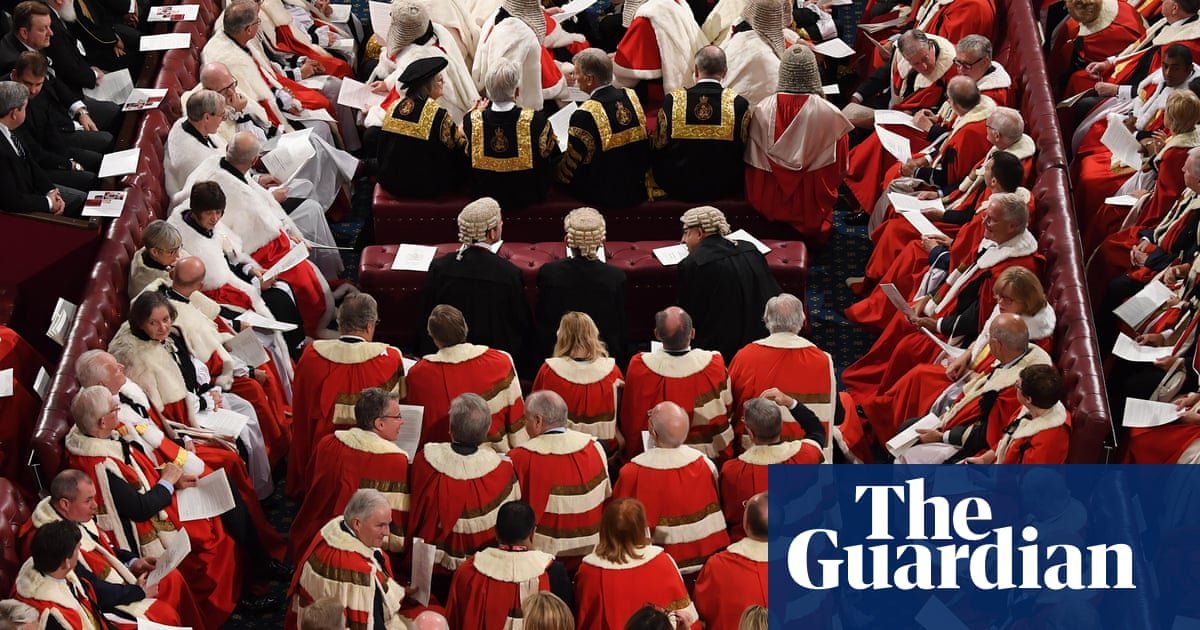
Dining in the House of Lords canteen just after Labour came to power, one Labour adviser found themselves sitting opposite two Tory peers.
In particular, the pair were fuming about the forthcoming abolition of hereditary peers. Both agreed, the adviser said, that there should be a deliberate strategy to undermine the government on all its legislation, to slow down debate, and to push the new Lords leader, Angela Smith, to ask No 10 for concessions.
Another recalled a Tory peer gleefully telling the new Labour Lords appointees: “We are going to grind you down.”
Even with an enormous majority in the Commons, Labour has seemed to struggle to pass much of its programme. But by far the hardest slog has been in the Lords.
Labour may yet be on course for a record number of defeats for any governing party, although the parliamentary session has been longer than normal.
Already Labour has faced 111 defeats, with at least four more months to go. The record is 128 defeats for the Conservatives, under Boris Johnson during the 2021-22 session.
Labour peers said virtually every bill had been slowed down, from key manifesto pledges on water regulation to rail nationalisation, Great British Energy and the football regulator. The employment rights bill was repeatedly rejected, even after a major concession.
Amendments are being “de-grouped” at late stages into smaller groups of one or two, meaning debates last hours longer. “Each time it is more or less the same people,” one Labour peer said. “Former Tory MPs, making the same kind of speeches over and over again.”
“The usual channels are not operating,” another Labour peer said. “The conventions do not apply. It’s essentially a particular group of former Tory MPs who act like they are still in the Commons but actually have more power to cause disruption, because they can intervene, they can try to adjourn, they can push anything to a vote, they basically don’t give a fuck about how the Lords normally operates.”
Alice Lilly, a senior researcher at the Institute for Government, said the figures did show a House of Lords that was inflicting more and more defeats on the government, but that that was a growing trend, including when the Tories were in power.
“The figures do create this picture of the Lords as being a bit more assertive, and that doesn’t necessarily mean that governments aren’t getting their way,” she said. “The government made concessions on the day-one rights for the employment rights bill, but also, that was a choice.”
In reality – apart from the employment rights bill where the government conceded on day-one rights in order to get the bill passed faster – there have been few bills where the Lords have directly forced concessions.
Still, the disruption has convinced some to think more radically about what reforms might be needed.
Paul Nowak, the TUC general secretary, said that although he expected peers to fight the employment rights bill, “it felt to me absolutely untenable that you had unelected peers holding up what was a clear manifesto commitment from a government that won a majority of 170 seats.
“I do think it raises real questions. I think it speaks to the arrogance on those benches, to be honest with you.”
Whips have noticed that the numbers they would expect for a vote are now far higher. The Conservatives can turn out about 180 peers for votes, with Labour able to muster about 140.
Among the Labour whips, peers are now running a rota to keep far larger numbers in the house because of the risk of Conservatives calling for adjournment. “It erodes good will because you have to keep people hanging around,” one said.
Another peer said they had noticed a decisive shift in the way parliament operated since Labour won its majority.
“I think we had a rose-tinted view. We usually played ball in opposition, especially on manifesto stuff,” they said. “It will make a difference to our numbers for sure when the hereditaries go in May. But it won’t be enough.”
Most peers who spoke to the Guardian said the manifesto pledge to abolish hereditary peers, which will see all remaining 92 hereditary members leave at the end of the parliament, had been the moment the Conservatives decided to no longer abide by conventions.
Half of those due to be expelled sit on the Tory benches. Most of the others are crossbench and just four are Labour. Every stage of the bill to abolish hereditary peers Lords has resulted in considerable disruption in the Lords, as well as demands in private meetings for compensation for removed peers.
During the first vote on hereditary peers, a sponsor spent £20,000 to hire the Lords’ Cholmondeley Room for dinner and drinks to keep peers on the estate to vote it down.
“There is something quite perverse about claiming that you are defending the hereditary peers because you care just so much about the sanctity of the Lords and then doing all these kind of dirty tricks,” one peer said.
But several pointed out that the Conservatives had done little to protect the departing peers. “If Kemi Badenoch really cared about the hereditary peers then she would have used her own slots to convert some of them into life peers but she did not,” one Lords source said.
Because of the multiple revolts, Labour has done what it criticised the Conservatives for doing: giving peerages to close allies, from former advisers to union officials, and staff members, some of whom needed cover for an awkward departure.
They include Starmer’s ousted chief of staff Sue Gray, his former spokesperson Matthew Doyle, Rachel Reeves’s senior staffer Katie Martin, and Liz Lloyd, who worked under Starmer and Tony Blair in the No 10 policy unit.
“We could be giving them to much better people,” one senior Labour source grumbled. “I’m not sure why we are handing them out as consolation prizes to former advisers.”
But in No 10, there was recognition that the peerages list had to match the vigour of the new Tory peers – many of them recently departed MPs – who wanted to be fulltime legislators. “We need the political people in there who can make it their job,” one senior source said.
Once the latest additions to the Lords are counted, the Conservatives will still have significantly more peers – 285 to Labour’s 234. But there are others who the Tories can often count on, including some crossbenchers. Whips say the Tories can bolster their numbers by another 15-20 on crunch votes.
The Liberal Democrats, who will have 78 peers, have often voted against the government, including on employment rights. But the Tories will lose 44 hereditary peers at the end of the session in May.
“The Tories went ballistic when we only offered them three,” one government source said. “But the idea is try to build towards parity.”
Some peers argue that a more activist House of Lords has been necessary because of the sheer number of bills that arrive from the Commons in an imperfect condition, with new MPs seemingly less concerned with their job as legislators and more with directly representing their constituents or campaigning on their own interests.
“The Commons bills have been rushed through,” one peer said. “They are not fit for purpose.”
On the assisted dying bill, one of the most controversial bills of the parliament which has faced significant disruption in the Lords, opponents have made the case that because it is a private member’s bill, it has not had the kind of consultative process it needs. More than 1,000 amendments have been submitted.
But its supporters believe there is a core group of hardline peers who oppose the principle and are using procedural tactics to talk out the bill, which will fall if it is not passed at the end of the session. Seven of the most vocal opponents to the bill have put forward more than 600 amendments between them.
In the new year, the campaign group Unlock Democracy will turn its focus to Lords reform and says it will put the spotlight on a small number of influential peers who it believes are blocking the bill’s progress. While the group does not take a position on the issue of assisted dying, it says it is fundamentally a democratic issue.
Its chief executive, Tom Brake, a former Lib Dem MP, said the “glacial progress” of both the assisted dying bill and the hereditary peers bill “make an incontrovertible case for radical reform of the House of Lords. This must go far beyond a retirement age and participation test and tightening up appointments.”
Things are unlikely to get easier for Labour as it pursues those further changes. Last week Lady Smith announced that a committee will consider the next stage of reform promised by Labour in its manifesto: a retirement age of 80 plus potentially mandating how often peers must be present and engage in parliament.
The committee, featuring four Labour and four Tory peers, plus two Liberal Democrats and two crossbenchers, will consider the plans over the next six months.
Lilly said the new generation of peers might arguably be making a case for reform “in the way they don’t intend to”. But she said that ultimately the elected government was getting its way, and that the disruption should raise questions for governments about the state of legislation arriving from the Commons.
“We’ve seen the government using framework bills, where they’re basically introducing a bill to parliament before they’ve properly figured out the actual details of it, and they’re asking parliament to pass it and then fill in the details later with secondary legislation.
“I think there’s always a question now for governments: if we’re seeing the Lords being more assertive, have you got the plans in place to deal with that?”
