

We are repeatedly sold a painfully two-dimensional picture of the motivations of those seeking shelter in Britain. According to this picture, migrants are eager to experience the benefits of our society, but they are also out to undermine it, because they come from cultures whose values are dramatically different from our own. Think of the ongoing “grooming gangs” scandal: an undeniably appalling series of events, institutional failures and victim-blaming that has been transformed into a narrative that suggests any “alien” is likely to be a sexual predator, since their predatory behaviour is a direct consequence of their religious and cultural background.
So often, all we are allowed to know about asylum seekers is that they are asking – with irritating persistence – for a place in our social fabric, as if they have no world of their own, no cultural hinterland, no really recognisable human values aside from mysterious and dangerous belief systems. This explains why there is now a feverish pressure to instantly reveal the ethnicity of any suspect in a major crime of unprovoked violence – as with the Cambridgeshire train attack (where, confusingly, it transpired that the hero of the day was a man of north African background), or the tabloid habit of illustrating stories about migrants with images of young men, usually of Middle Eastern appearance.
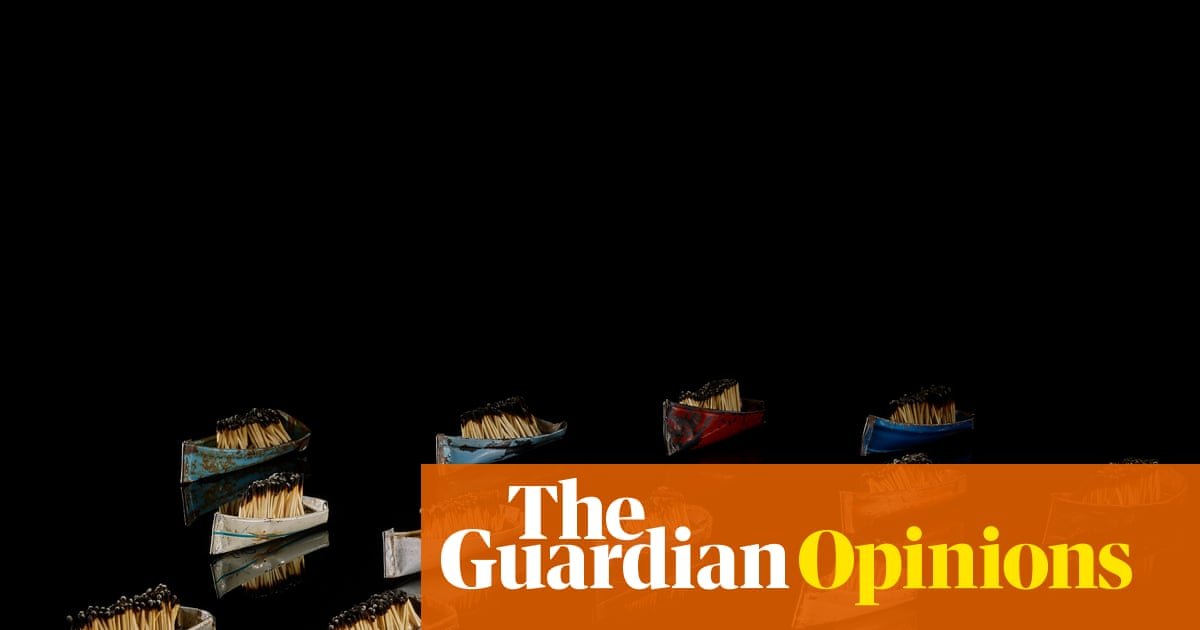
There are various ways to push against this myth-making. One is simply to take the time needed to look and listen to what migrant individuals and communities actually have to say about themselves. There have been numerous initiatives aiming to highlight art that is focused on migrant experiences – and there are some dramatic and profound instances to discuss. Issam Kourbaj, an artist who originally hails from Syria but is now working in Cambridge, has produced extraordinary work connecting his heritage with the experience of displacement today. One of his most effective installations has been exhibited in Britain and the US and is based on an ancient Syrian model boat carrying the small images of three goddesses.
The 13th-century Cosmati pavement in Westminster Abbey, London. Photograph: Jonathan Brady/PA
But there is another kind of “art” that migrants create. Anyone who has ever spent time in a refugee camp will have encountered this. People bring with them objects from home that are charged with special significance: often things snatched up at the last moment, without much reflection. Back in 2019, I was part of a small group of scholars and writers who put together a colloquium in Cambridge designed to hear and celebrate migrant voices. We were able to present some new artwork from Kourbaj and others, to listen to songwriters who had honed their skills in the Calais camps, to share food from different cultures and hear people talk about the objects they had grabbed to take with them on leaving their homes.
Take the photographer Dragana Jurišić, who described to us how, as a 16-year-old fleeing army snipers in Croatia in the 1990s, she picked up a Bible, despite having no conscious interest in religion. Looking at it years later, she found she had marked passages that had acted as “mantras” in the worst moments of terror and danger. Jurišić is still anything but a conventional believer. But she needed something from her past and her culture to talk and listen to in the middle of the chaos. She needed to know she was not travelling alone.
Recently, we held another event to mark the publication of the original conference proceedings. We were all reinforced in our conviction that these artworks and the imagination they stem from deserve sustained attention because they remind us of how our own culture, forms of poetry, architecture, song and much more. They are the way they are because people have travelled – sometimes freely, sometimes very much not.
What we called “migrant forms” in the 2019 colloquium are not some sort of pollution that compromises an original, hermetically sealed culture, but the product of a mobile – and often cruelly insecure and unjust – human world. We find new things in conversation with our own past when we are uprooted from it. We talk and listen to what we thought was familiar, and find new things to say. We absorb the sound of strangers, including oppressors and enslavers, and find a voice of our own. It is not an accident that much of the huge and sophisticated structure of Hebrew scripture – the “Old Testament” – that has formed the imagination of well over half the inhabitants of the globe found its present shape through a generation of forced displacement and unfreedom in Babylon.
Blues singer Howlin’ Wolf performing on the US TV show Shindig, watched by the Rolling Stones and Darlene Love, 1965. Photograph: Michael Ochs Archives/Getty Images
Look around: hospitality to migrant forms is not just about settled people tolerantly enjoying exotic entertainment. Many of the most characteristic forms of western medieval architecture – the shapes we see in Westminster Abbey or the Houses of Parliament – owe their development to the to-ing and fro-ing of engineers and architects between western Europe and the Middle East during the Crusades. And we find it easy to forget that most of the stylistic repertoire of modern western popular music would be unthinkable without the Black American tradition that itself adapted and reshaped African idioms in the new and terrible world of enslavement.
Migrants carry worlds with them, and whatever conditions we lay down for admission to our borders will be both inhumane and counterproductive if we do not pay attention to the sheer depth and fluidity of these worlds. We need to pay attention to the imagination of newcomers, rather than resorting to rhetoric that effectively depicts every migrant either as an individual in search of security at all costs, or as a plain enemy of all we think is humanly significant. Migrants do not have only one face or one history. They are not ciphers for some opaque and sinister worldview. They do not lack agency, especially that uniquely human kind of agency we call imagination. Paying attention to their imagination may even release our own, helping us to see ourselves in a new light.
