

This is an edition of the Books Briefing, our editors’ weekly guide to the best in books.
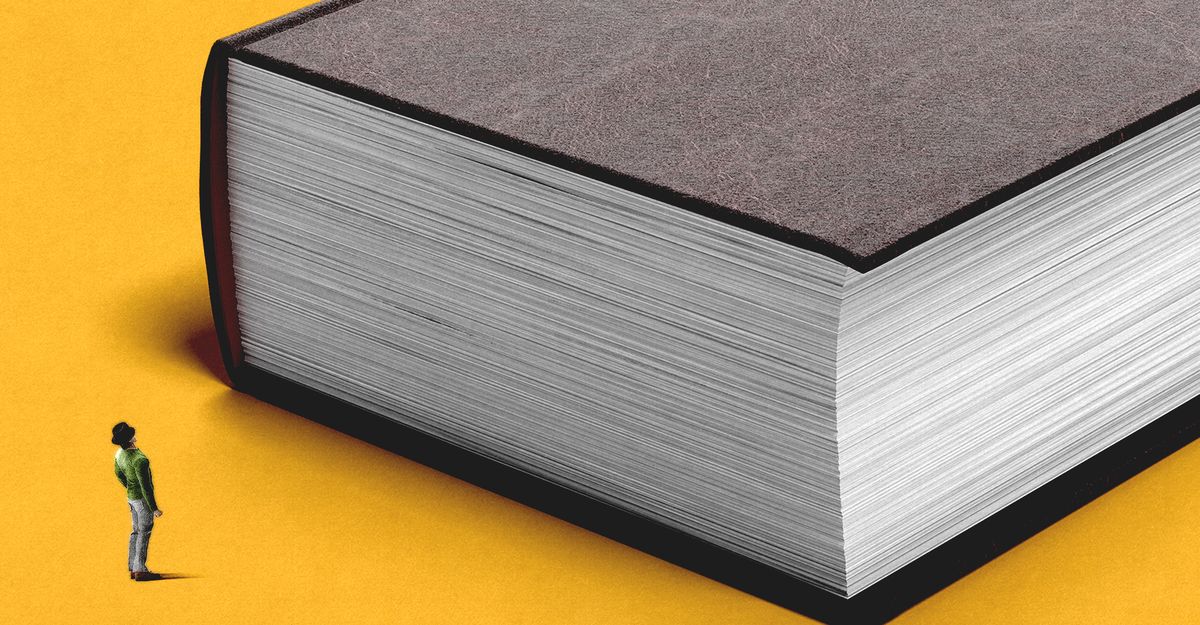
Recently, I went out for drinks with a young woman who wanted advice about establishing herself as a book critic. “Everyone has read less than you think they have,” I told her immediately. I reassured her that in some respects, making your way through the world’s great literature is a numbers game: Someone twice your age has simply spent more time on the planet—and has therefore had more time to turn pages. But no number of hours can fill every gap in the knowledge of a mortal reader, even one who’s a professional critic. Someone who seems frighteningly erudite might, at this very moment, be kicking themselves for being unable to read the French canon in its original language. Someone who has devoted their life to studying poetic traditions could be totally out of their depth in a discussion of Heated Rivalry, Rachel Reid’s hockey-themed romance novel (and its buzzy TV adaptation).
First, here are five new stories from The Atlantic’s Books section:
On the happy flip side, in this line of work, you never stop learning. The English theater critic Irving Wardle once described criticism as “conducting your education in public.” And this week in The Atlantic, Robert Rubsam wrote that every year, he gives himself some kind of reading challenge. “These are sometimes small—read more poetry; read older books—and sometimes quite large,” he explains. “Part of my annual resolution is to devote each summer to filling in a major blind spot.” While editing his article on Helen DeWitt and Ilya Gridneff’s challenging new novel, Your Name Here, I decided to crib from his resolution. I, too, will aim to bump older, culturally important, or much-recommended works to the top of my to-be-read list.
Because no one can read everything, specific and achievable objectives are crucial. Rubsam finished Marcel Proust’s Remembrance of Things Past, for example, by “cracking open one gray Vintage volume every June” over the course of three years, he writes. For my part, I plan to focus on individual titles instead of worrying about filling large holes. I’ve never read any of the great 19th-century Russian novelists, for instance, but reading all of their work in one year is far too ambitious. Starting and finishing Anna Karenina, however, is not.
One peculiar side effect of my job is that I know a lot about books I haven’t actually read. In 2026, I hope to make time for titles I’ve encountered but never got around to reading: Ice, by Anna Kavan; Lords of the Realm, by John Helyar; Rapture, by Susan Minot; The Emperor of All Maladies, by Siddhartha Mukherjee; The Kennedy Imprisonment, by Garry Wills—and, of course, all of the Great American Novels that I haven’t yet started. But I’ll try not to focus too much on older books; another perk of this career is looking forward as well as back. Nothing can replace the thrill of discovering a fantastic debut, or realizing you’re holding a classic in the making.
Illustration by Matteo Giuseppe Pani / The Atlantic
A Bizarre, Challenging Book More People Should Read
By Robert Rubsam
The true pleasure of literature can be found in demanding works such as Your Name Here, by Helen DeWitt and Ilya Gridneff.
Read the full article.
What to Read
This Is How You Lose the Time War, by Amal El-Mohtar and Max Gladstone
In this abstract, experimental, and deeply romantic science-fiction novel, enemy combatants commit the ultimate sin: They fall for each other. As spies traveling through time and multiple realities on behalf of two radically different warring factions, Red and Blue communicate through secret messages. Gradually, those missives evolve from hostile taunts to flirtation and then settle on passionate, effusive, unlikely love, which runs contrary to their missions. From there, the goal becomes not winning the war but defying indomitable forces to be together. Yet neither Red nor Blue is fully sure they can trust the other. Their relationship could be an elaborate honey trap, a possibility expressed in the most striking prose. As Blue writes to Red in one bulletin: “You’ve always been the hunger at the heart of me, Red—my teeth, my claws, my poisoned apple. Under the spreading chestnut tree, I made you and you made me.” Ironically, there’s something very old-fashioned about the central conceit, which is basically an epistolary romance—but one whose letters soar across space and time. — Carole V. Bell
Read: Five books in which romance sneaks up on you
Out Next Week
📚 Storm at the Capitol: An Oral History of January 6th, by Mary Clare Jalonick
📚 Life After Ambition, by Amil Niazi
📚 Homeschooled, by Stefan Merrill Block
Your Weekend Read
Illustration by Akshita Chandra / The Atlantic*
Albert Einstein’s Brilliant Politics
By Joshua Bennett
Einstein was among the first faculty members of the Institute for Advanced Study, which was founded in 1930 as an independent research center against the backdrop of fascism’s rise in Europe. He was a faculty member at IAS, which was initially housed at Princeton University, from 1933 to 1955, setting down roots in the town as he and the growing institution changed the trajectory of the modern world. This fall, I’m a visiting fellow at the institute, and the opportunity has inspired me to think about the wide range of subjects he explored while living here: not just his study of general relativity, quantum theory, and statistical mechanics, but also his devotion to the cause of human freedom. His critical optimism, rooted in a rigorous scientific worldview and a deeply humanistic sensibility, is imperiled today in a cultural moment marked by broad skepticism of scientific research and the promise of higher education. If we hope to revive and reclaim this persistent hope, his story—and the ethical vision it helps to illuminate—is a good place to begin.
Read the full article.
When you buy a book using a link in this newsletter, we receive a commission. Thank you for supporting The Atlantic.
Sign up for The Wonder Reader, a Saturday newsletter in which our editors recommend stories to spark your curiosity and fill you with delight.
Explore all of our newsletters.
