

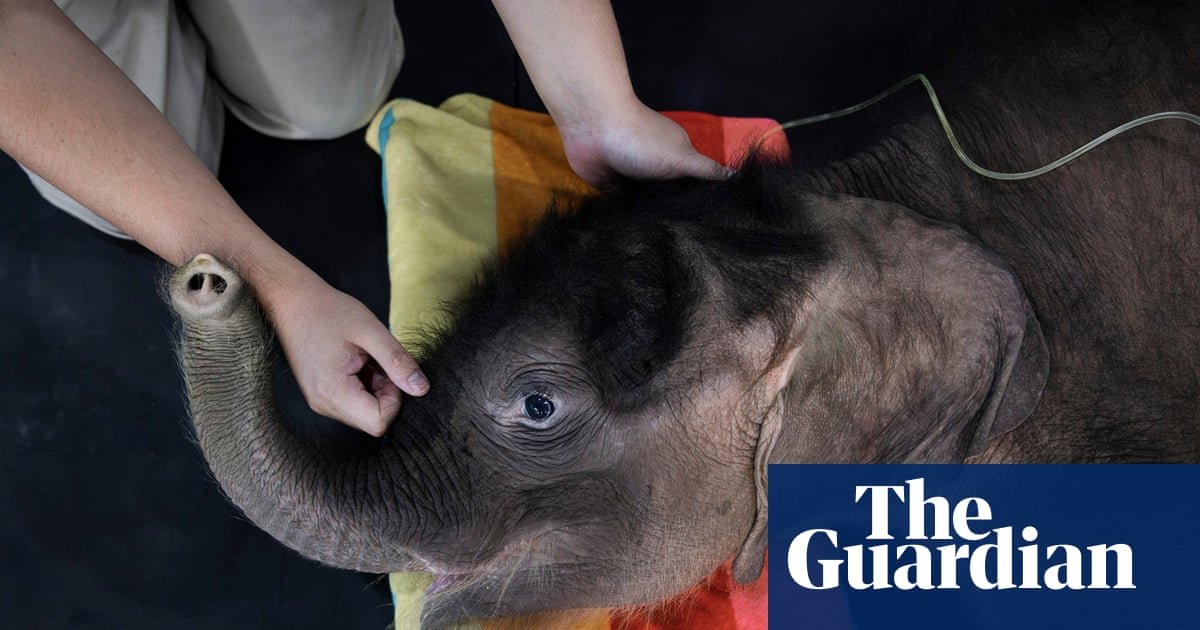
Khao Tom, a two-month-old elephant, plays with a wildlife officer, nudging his face and curling her trunk around his wrist. When she lifts her trunk in the air, signalling that she is hungry, the team at the rescue centre seems relieved – she has not been eating well. A vet prepares a pint-sized bottle of formula, which she gulps down impatiently.
Khao Tom has been in the care of Thailand’s national parks and wildlife department since September, when rangers rescued her from a farming area inside Lam Khlong Ngu national park. Born with a congenital disorder affecting her knees, she struggled to keep up with the herd. Within days of her birth, her mother had moved on without her.
Vets and keepers with Khao Tom during her recovery at the Bueng Chawak wildlife rescue centre
“We didn’t think she would make it,” says Natthanon Panpetch, senior veterinarian and director of the Bueng Chawak wildlife rescue centre. The calf had abrasions all over her body where her mother had tried to drag her through the forest to keep up with the herd and a digestive infection had left her extremely weak.
She survived thanks to round-the-clock care and a diet of rice porridge – khao tom in Thai. As the team shared updates on social media, the Thai public rallied behind the elephant calf, sending toys, formula and donations.
Khao Tom’s case is not an isolated incident. In 2025, the media reported on at least five other elephant calves in Thailand that were lost or abandoned.
A wildlife officer plays music on his phone for Khao Tom at the rescue centre
A database of reported cases across south and south-east Asia compiled by the Guardian showed a significant rise: from an average of about two a year between 2015 and 2022, to nine last year and 14 in 2025. That dataset, however, is not comprehensive and only includes media-reported incidents, so is it just reflecting increased interest in abandoned calves or is there something going on? What causes elephant herds to leave calves behind, and does this visibility reflect a broader trend?
Joshua Plotnik, a psychology professor at City University’s Hunter College in New York, has studied elephant behaviour in Thailand for nearly 20 years. His research has demonstrated, among other things, that elephants can recognise themselves in mirrors, a sign of self-awareness.
According to Plotnik, “abandonment is very rare”, even when a calf is sick or injured. This is because female elephants invest heavily in their young: gestation lasts nearly two years and calves remain dependent on their mothers for several more.
However, “elephant mothers and families can sometimes reject a calf”, especially if the mother is “under stress, or when circumstances jeopardise the safety of the rest of the herd”, he says. Calves can also end up alone if their mother is killed.
A wildlife officer bottle-feeds Khao Tom
Habitat loss and human-elephant conflict are growing sources of stress for wild elephants. Elephants are highly mobile, relying on large areas of forest to forage and find water. But across the different ecosystems of their range, those forests are shrinking and becoming increasingly fragmented. A recent study in the journal Nature suggested that 64% of Asian elephant habitat had been lost since 1700.
Elephants’ behavioural flexibility helps them adapt to changing landscapes – they can learn to move through fragmented habitats and raid crops to survive. “This adaptability, unfortunately and paradoxically, can lead to increased conflict involving humans,” says Plotnik.
As natural ranges contract, elephants are pushed closer to farms, villages and roads. These changes “can affect movement patterns, divide social groups or trigger aversive behaviour,” which, in turn, can lead to calves becoming separated, he says.
Some media reports of stray calves do not give a cause for the separation. Others blame falls, or encounters with humans and human-dominated environments. In 2024, a calf in Indonesia that was only a few months old became separated from his family after farmers drove the herd away from their crops. Earlier this year, another calf wandered into a village in Malaysia and was caught in a buffalo trap.
In India’s Assam state, an eight-week-old elephant fell into a ditch while crossing a tea estate, before being rescued by a local wildlife centre supported by the International Fund for Animal Welfare (IFAW).
While the Assam wildlife centre’s records show a slight decrease in admissions of displaced calves over the past five years – which veterinarians link to fewer severe floods in the area – IFAW describes a “growing challenge” in this region of India, where elephant and rhino calves continue to be separated from their herds each year due to floods, shrinking habitats and increased human-wildlife conflict.
Wildlife officers play with Khao Tom, who is unlikely to return to the wild
Whether these incidents are truly becoming more common across Asian elephants’ range is difficult to determine, says Plotnik. The rise in publicised cases is probably linked to increased reporting and coverage, though he believes that growing human pressures “likely also impact the rate of herd-calf separations”.
Khao Tom is unlikely to return to the wild, says Natthanon. “The longer she stays with humans, the harder it will be for the herd to accept her,” he says. As the habitats elephants depend on continue to change, cases like hers highlight the harsh realities of life in the wild.
Find more age of extinction coverage here, and follow the biodiversity reporters Phoebe Weston and Patrick Greenfield in the Guardian app for more nature coverage
