

On a chilly December morning, I descended a flight of stairs and entered the New York Transit Museum. Housed in a decommissioned subway station in downtown Brooklyn, the museum was packed with elementary-school children on a field trip. All around me, tour guides shepherded groups of them through the various exhibits. Later on, I heard one guide ask if any of the students knew how to pay for the subway. “You tap a phone,” a child volunteered.
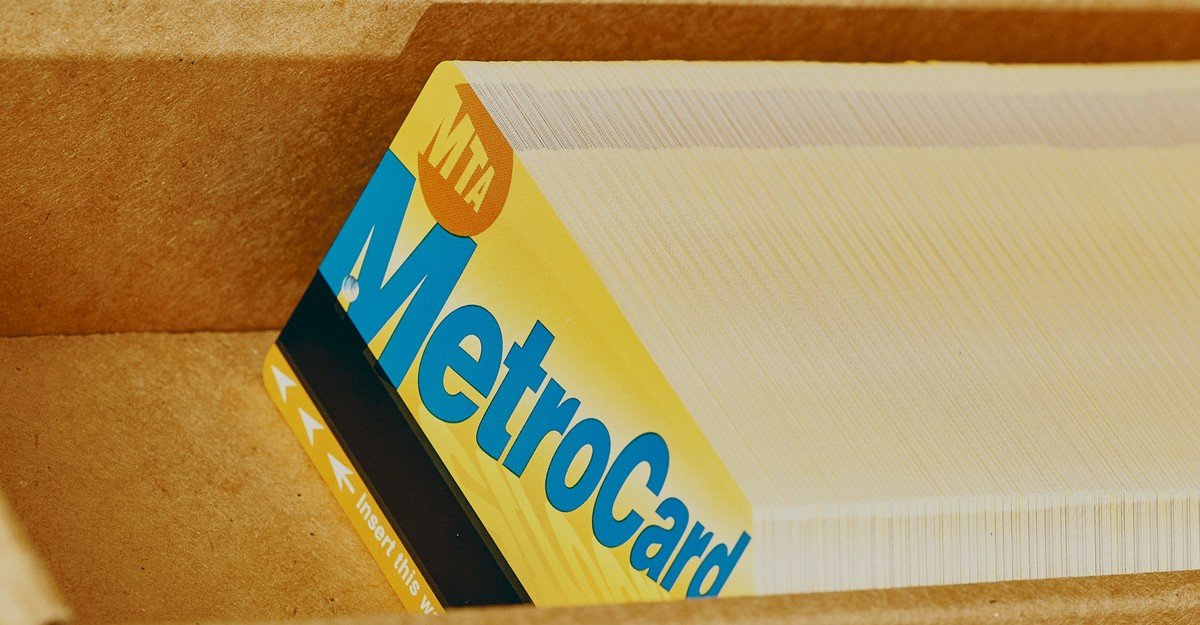
For decades, the default answer has been something else: You swipe a MetroCard. Something like a flimsy yellow credit card, the MetroCard has bound together nearly everyone in the city—real-estate moguls and tenants, Mets and Yankees fans, lifelong New Yorkers like myself and new arrivals from Ohio. Any tourist who visited New York inevitably got one. But now the MetroCard era is about to end. Today is the last day you can purchase a card.
The Metropolitan Transportation Authority, the organization that operates the city’s public-transit system, has for years been phasing out the MetroCard in favor of contactless payment—tapping your phone or a credit card, much as you would at any store. The new system, known as OMNY (“One Metro New York”), will bring together the benefits of technological progress: tens of millions of dollars in savings for both riders and the MTA each year, shorter lines, less plastic waste. Many other large metro systems have already fully transitioned to tap-and-go; in this sense, New York is behind the times.
In 2025, swiping a plastic rectangle through a card reader feels like an anachronism, but the MetroCard shouldn’t be taken for granted. Every little yellow plastic rectangle represents a genuine technological marvel.
Victor Llorente for The AtlanticVictor Llorente for The Atlantic
Victor Llorente for The Atlantic
In the MetroCard’s heyday, the MTA was minting 180 million cards per year.
At first, the MetroCard was a flop. The system was designed to be a technological leap forward: No longer would New Yorkers have to lug around physical tokens to pay for subways and buses. MetroCards would not only be lighter, but allow users to transfer between trains and buses without having to pay a second time. Despite the obvious upside, convincing people to embrace the swipe was not easy. When the MetroCard debuted, in 1994, “everybody was like, ‘I don’t want to give up my tokens. You’ll get my tokens out of my cold dead hands,’” Jodi Shapiro, the Transit Museum’s curator, told me. People lined up to buy as many tokens as possible before sales ended so they could put off converting to the MetroCard for as long as possible. Television segments reassured New Yorkers that “they could get to work by using plastic.” The MTA put out ads and flyers explaining how to use the card, and briefly considered having someone dressed as an aardvark (the “Cardvaark”) go to Times Square and educate passersby about the MetroCard.
Despite a rough start, the MetroCard swipe eventually just became routine. Knowing how to swipe a MetroCard—the crook of your elbow, the gentle flick of your wrist as you glide the magnetic stripe through the card reader—is essential New York knowledge. To create the infrastructure for this system, “all of this technology had to be upgraded,” Shapiro said. “And some of it had to be invented.” The MTA needed not just physical cards, but also a way to read them, vending machines to sell them, and a central computer system to track each one and process every transaction. Even the “swipe” mechanism, faster and easier to maintain than fare cards in other American cities at the time, was bespoke—designed specifically for New York City public transit’s sprawl and enormous ridership.
Last month, I visited the facility in Queens that mints the city’s MetroCards to see this logistical feat for myself. Known as the Fortress Revenue Collection Lab, the building does look startlingly like a fortress—with barbed wire, barred windows, brick walls, and a central tower. Before the trip, the MTA made me agree not to disclose the precise location, and when I arrived, Michael Ellinas, the MTA’s senior vice president of revenue control, led me through an entrance monitored by security guards. All of these measures safeguard the millions of MetroCards processed and stored inside the facility, many of them already loaded with money—just 1,000 monthly passes would be worth $132,000.
Victor Llorente for The Atlantic
MetroCards intended for individual retail are wrapped in plastic using “The Beast,” a machine that was modified from equipment used by Planters factories to package peanuts.
The Revenue Fortress Collection Lab doesn’t make MetroCards from scratch. The plastic yellow cards are first manufactured in North Carolina and the United Kingdom before they are shipped, some 10,000 per box, to Queens, where they are turned into usable MetroCards. Employees load decks of blank cards onto conveyor belts that assign each a serial number and encode its magnetic stripe with value: monthly passes, single-ride cards, and so on, or zero dollars if the MetroCard is intended for someone to purchase from one of the vending machines throughout the MTA system. There are roughly 100 types of MetroCards, and the encoding process is what “puts the secret sauce on the magnetic stripe,” Ellinas told me. The room is kept between 35 and 55 percent humidity: Too muggy and the cards might stick together, too dry and they might develop static.
Some of the MetroCards are then brought to another conveyor belt and wrapped in plastic for individual retail at pharmacies and gas stations. Modified from machines used by Planters factories to wrap peanuts, this contraption envelops 5,000 MetroCards every hour—or more than one every second. Sunillall Harbajan, an MTA employee overseeing the room’s operations, told me he has a nickname for the machine: “The Beast.”
At its peak, the fortress was pumping out 180 million MetroCards every year; some 3.2 billion have been prepared in total. By the time I visited the fortress, just about 10 percent of riders were still using MetroCards, and the facility was no longer making them every day. Ellinas had timed the run so that I could witness it. “All good things come to an end, but I’m happy to have been part of it,” Karen Kunak, the MTA’s chief officer of processing operations, told me from inside the fortress, surrounded by boxes of MetroCards. She started at the MTA as a college intern 36 years ago—before the MetroCard was even around: “We made it into a thing, its own living, breathing thing.” Employees operating the MetroCard machines are being retrained to work elsewhere across the MTA.
Victor Llorente for The Atlantic
Limited-edition MetroCards designed in collaboration with local legends and institutions—Biggie Smalls, David Bowie, the New York Public Library—are now collectors’ items.
If the city had never adopted the MetroCard—had not installed electronic turnstiles systemwide, developed a complex computer system, gotten people used to paying with a card at all—OMNY would have been a far more gargantuan effort. The switch from paying with one sort of card to another is far less jarring than going from coins to a piece of plastic. “If all of the technological things had not been done to make MetroCard a viable fair-payment system,” Shapiro said, “we wouldn’t have OMNY now.” Eventually, the fortress will be reconfigured into an OMNY facility, just as MetroCard vending machines in subway stations have been replaced by OMNY vending machines. (Those who don’t want to use a phone or credit card or don’t have one can instead purchase an OMNY card.)
In saying goodbye to the MetroCard, New York City is saving time, money, and waste. But the city is also losing a bit of friction, and a common denominator, that is central to its character. New Yorkers and tourists lined up to buy special MetroCards designed in collaboration with local legends and institutions—Biggie Smalls, David Bowie, the library—that are now collectors’ items. Before long, even the basic MetroCards might be coveted as well. There will never be a card to celebrate a World Series victory for my beloved New York Mets. The leap into modernity can feel like sliding into a featureless void, in which every transaction of any sort becomes hard to distinguish. Paying to ride the subway is now like paying for a coffee at Starbucks.
Or perhaps it is just me; the MetroCard is all I’ve ever really known. My friends and I used to protect our student MetroCards, which allowed us to ride for free, like amulets, our keys to the city. As I walked through the Transit Museum with Shapiro, she and an MTA spokesperson accompanying us poked fun at visitors who didn’t remember the subway token. I remained quiet, not wanting to out myself.
