

Unlock the Editor’s Digest for free
Roula Khalaf, Editor of the FT, selects her favourite stories in this weekly newsletter.
Here’s a question: what is an Xbox? If you think that’s easy to answer, then you haven’t been paying close enough attention. Over the past couple of years, Microsoft has been on a determined path to muddy these waters, most recently in a confusing ad which suggested that your Xbox wasn’t just the machine under your TV that played games, but also your TV itself, and your laptop, even your smartphone.
While PlayStation and Nintendo continue to plough their familiar furrows, Xbox is attempting to reimagine the future of gaming as a world where you can seamlessly play your games anywhere you want, across all your devices. A future where the boundaries between the console and PC gaming market have dissolved. It’s actually a rather exciting idea, once you get your head around it — but it looks as though Xbox is going to be beaten to the punch.
Enter Valve Corporation. The gaming behemoth is today best known as the owner of PC digital game storefront Steam, which controls the lion’s share of PC game sales. It also makes hardware, such as the Steam Deck handheld console. In a past life it was known for producing excellent games including the Portal, Half-Life and Team Fortress series, but it has been quiet on that front lately (though rumours interminably swirl about a long-awaited Half-Life 3).
Last month, Valve announced it would be releasing three new pieces of hardware in early 2026. First is the Steam Controller, a new gamepad designed to suit the needs of all gamers, with highly configurable control settings. Then there’s the Steam Frame, a next-gen virtual reality headset which looks sleek and impressive, but will probably remain a niche concern as VR is yet to break through into the consumer mainstream.
Valve is also known for games such as ‘Portal 2’
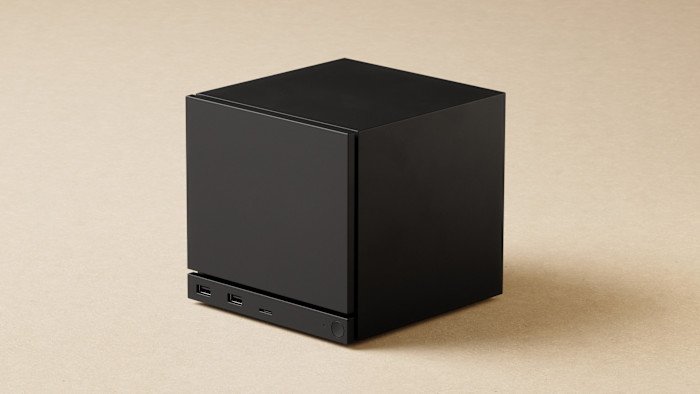
By far the most interesting is the Steam Machine, a gaming PC in the form of a six-inch cube designed to sit under your TV. At a time when the future of how people play games is a wide-open question, Valve — like Microsoft — is suggesting the answer might be found by bridging the PC and console spaces. The difference is that its messaging is less confusing, and its product is coming out imminently.
The schism between PC and console gaming first emerged in the 1990s. Where PCs were multipurpose machines that lived on your desk and allowed you to play games on a computer monitor, consoles were purpose-built boxes that sat under your TV and let you play games while sprawled on the sofa. PC gaming was considered a nerdier, more hardcore affair — games could be more complex and graphically advanced, with access to more customisation and huge game libraries, but the pursuit could also be expensive, fiddly and complex to troubleshoot. Meanwhile, console gaming was more casual and social. You just plug in the box and the game works. No fuss.
‘Counter-Strike 2’ from Valve
The Steam Machine asks: can users have the power and flexibility of PC gaming, but with the supreme ease of a console? It’s not the first time Valve has tried this. It attempted a similar concept a decade ago which floundered because the hardware was not made in-house and the PC gaming ecosystem wasn’t ready. But this new device looks far more promising. It’s a small, sleek machine resembling a grown-up Nintendo GameCube. While it’s not particularly powerful compared to high-end modern gaming PCs, with about the same capabilities as the five-year-old PlayStation 5, the Steam Machine should run modern games without a hitch, as well as streaming gameplay to your phone, tablet, or a virtual reality Steam Frame, if you splash out on one. While the device will offer the flexibility of a PC, allowing you to use a mouse and keyboard for all manner of computing tasks, it’s principally designed to offer plug-and-play ease to put PC games on your big TV.
Valve’s ‘Half-Life: Alyx’
Valve could be poised to benefit from Xbox’s current state of confusion. Microsoft’s baffling “This is an Xbox campaign” (which received a visually delightful, but no less confounding recent update directed by Michel Gondry) has come at a time when it’s less clear than ever what Xbox stands for. While Nintendo represents family-friendly fun and innovative hardware, and PlayStation offers ambitious, high-spec games with mature narratives, Xbox’s messaging is as chaotic as its console nomenclature (remember the original Xbox was followed by the 360, then the One, then the Series X and S). Despite releasing a great line-up of games in 2025, recent Xbox headlines have highlighted lay-offs, controversial price hikes and poor console sales.
Yet Microsoft’s push towards hardware agnosticism is supported by recent industry trends. Games that were previously console exclusives are now being released cross-platform, like Xbox stalwart Halo finally coming to PlayStation in 2026. Meanwhile streaming technology is rapidly improving, now allowing gamers to play high-end releases on any device that has a screen and a strong internet connection.
So there’s a space open for a company to claim the territory across devices between console and PC, but it might not be Microsoft. Valve’s Steam Machine offers a great living room option for PC gamers and a tempting opportunity for console gamers to dip their toe in the world of PC games and explore its distinct advantages. Sales success will depend partly on price — Valve has yet to announce how much the device will cost, with industry estimates suggesting somewhere in the region of $800 — and on Valve’s ability to really take the hassle out of PC gaming (though it already did a great job on that with the Steam Deck).
The Steam Machine will not become a fourth combatant in the console wars overnight — it won’t immediately appeal to casual gamers who are comfortable with their familiar brands. Rather, it might propose a new paradigm for home gaming based on the principles of openness and flexibility, which goes on to influence the wider industry. It’s been a long time since a new contender with a bold idea has dared to enter the home console space, but given Valve’s impressive pedigree, it might just pull this off.
