

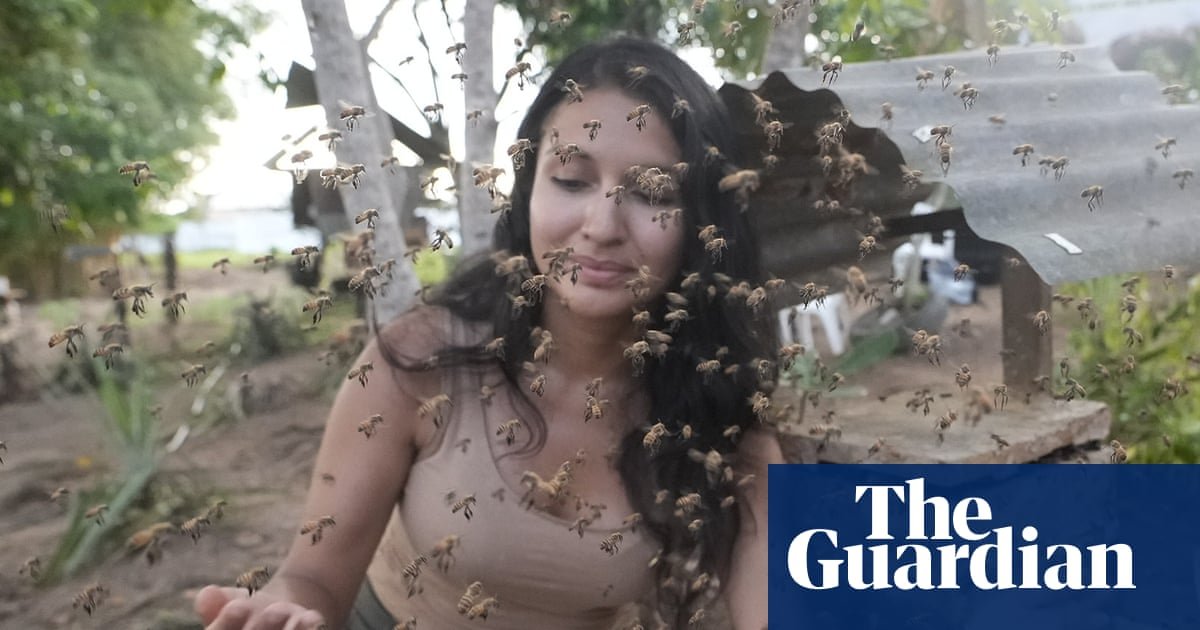
Stingless bees from the Amazon have become the first insects to be granted legal rights anywhere in the world, in a breakthrough supporters hope will be a catalyst for similar moves to protect bees elsewhere.
It means that across a broad swathe of the Peruvian Amazon, the rainforest’s long-overlooked native bees – which, unlike their cousins the European honeybees, have no sting – now have the right to exist and to flourish.
Cultivated by Indigenous peoples since pre-Columbian times, stingless bees are thought to be key rainforest pollinators, sustaining biodiversity and ecosystem health.
But they are faced with a deadly confluence of climate change, deforestation and pesticides, as well as competition from European bees, and scientists and campaigners have been racing against time to get stingless bees on international conservation red lists.
Constanza Prieto, Latin American director at the Earth Law Center, who was part of the campaign, said: “This ordinance marks a turning point in our relationship with nature: it makes stingless bees visible, recognises them as rights-bearing subjects, and affirms their essential role in preserving ecosystems.”
The world-first ordinances, passed in two Peruvian regions in the past few months, follow a campaign of research and advocacy spearheaded by Rosa Vásquez Espinoza, founder of Amazon Research Internacional, who has spent the past few years travelling into the Amazon to work with Indigenous people to document the bees.
Espinoza, a chemical biologist, first started researching the bees in 2020, after a colleague asked her to conduct an analysis of their honey, which was being used during the pandemic in Indigenous communities where treatments for Covid were in short supply. She was stunned by the findings.
“I was seeing hundreds of medicinal molecules, like molecules that are known to have some sort of biological medicinal property,” Espinoza recalled. “And the variety was also really wild – these molecules have been known to have antiinflammatory effects or antiviral, antibacterial, antioxidant, even anti-cancer.”
Espinoza, who has written a book, The Spirit of the Rainforest, about her work in the Amazon, began leading expeditions to learn more about stingless bees, working with Indigenous people to document the traditional methods of finding and cultivating the insects, and harvesting their honey.
Found in tropical regions across the world, stingless bees, a class that encompasses a number of varieties, are the oldest bee species on the planet. About half of the world’s 500 known species live in the Amazon, where they are responsible for pollinating more than 80% of the flora, including such crops as cacao, coffee and avocados.
They also hold deep cultural and spiritual meaning for the forest’s Indigenous Asháninka and Kukama-Kukamiria peoples. “Within the stingless bee lives Indigenous traditional knowledge, passed down since the time of our grandparents,” said Apu Cesar Ramos, president of EcoAshaninka of the Ashaninka Communal Reserve. “The stingless bee has existed since time immemorial and reflects our coexistence with the rainforest.”
From the outset, Espinoza began hearing reports that the bees were becoming more difficult to find. “We were talking actively with the different community members and the first things they were saying, which they still do to this day, is: ‘I cannot see my bees any more. It used to take me 30 minutes walking into the jungle to find them. And now it takes me hours.’”
Her chemical analysis had also turned up some concerning findings. Traces of pesticides were appearing in the stingless bees’ honey – despite their being kept in areas far from industrial agriculture.
A lack of awareness about stingless bees made obtaining funding for research difficult, Espinoza said. So at the same time as beginning fieldwork, she and her colleagues began advocating for recognition of the insects, both in Peru and at the International Union for the Conservation of Nature (IUCN).
The stingless bees hold deep cultural and spiritual meaning for the forest’s Indigenous Asháninka and Kumama-Kukamiria peoples. Photograph: Luis Garcia/Handout
For years, the only kinds of bees to have official recognition in Peru have been European honeybees, brought to the continent by colonisers in the 1500s.
“It almost created a vicious cycle. I cannot give you the funding because you’re not on the list, but you cannot even get on the list because you don’t have the data. You don’t have the funding to get it.” In 2023, they formally began a project to map the extent and ecology of the bees, “because by that time we had already spoken with the IUCN team and some government people in Peru and understood that that data was critical.”
The mapping revealed links between deforestation and the decline of stingless bees – research that helped contribute to the passing of a law in 2024 recognising stingless bees as the native bees of Peru. The law was a critical step, as Peruvian law requires the protection of native species.
Dr César Delgado, a researcher at the Institute of Investigation of the Peruvian Amazon, described stingless bees as “primary pollinators” in the Amazon, contributing not just to plant reproduction, but also to biodiversity, forest conservation and global food security.
But their research revealed something else too.
An experiment in 1950s Brazil to create a strain that would produce more honey in tropical conditions led to the creation of the Africanised honeybee – a variety that was also more aggressive, earning them the fearsome moniker “African killer bees”. Now, Espinoza and her colleagues found, these Africanised bees have begun outcompeting the comparatively gentle stingless bees in their own habitats.
On an expedition in the Amazonian highlands of Junin, southern Peru, they met Elizabeth, an Asháninka elder, who told them of what Espinoza said was “the strongest example of [bee] species competition that I have ever seen”.
Living a semi-nomadic lifestyle in a remote part of the Avireri Vraem Biosphere reserve, Elizabeth farmed and kept bees at a spot in the forest some distance from her home. But she described how her stingless bees had been displaced by Africanised bees, which attacked her violently whenever she visited.
“I felt so scared, to be honest,” said Espinoza. “Because I have heard of that before, but not to that extent. She had horror in her eyes and she kept looking at me straight and asking: ‘how do I get rid of them? I hate them. I want them gone’.”
It is the municipality where Elizabeth lives, Satipo, that became the first to pass an ordinance granting legal rights to stingless bees in October. Across the Avireri Vraem reserve the bees will now have rights to exist and thrive, to maintain healthy populations, to a healthy habitat free from pollution, ecologically stable climatic conditions and, crucially, to be legally represented in cases of threat or harm. A second municipality, Nauta, in the Loreto region, approved a matching ordinance on Monday 22 December.
The ordinances are precedents with no equivalent worldwide. According to Prieto they will establish a mandate requiring policies for the bees’ survival, “including habitat reforestation and restoration, strict regulation of pesticides and herbicides, mitigation of and adaptation to the impacts of climate change, the advancement of scientific research, and the adoption of the precautionary principle as a guiding framework for all decisions that may affect their survival.”
Already, a global petition by Avaaz calling on Peru to make the law nationwide has reached more than 386,000 signatures, and there has also been strong interest from groups in Bolivia, the Netherlands and the US who want follow the municipalities’ examples as a basis to advocate for the rights of their own wild bees.
Ramos said: “The stingless bee provides us with food and medicine, and it must be made known so that more people will protect it. For this reason, this law that protects bees and their rights represents a major step forward for us, because it gives value to the lived experience of our Indigenous peoples and the rainforest.”
