

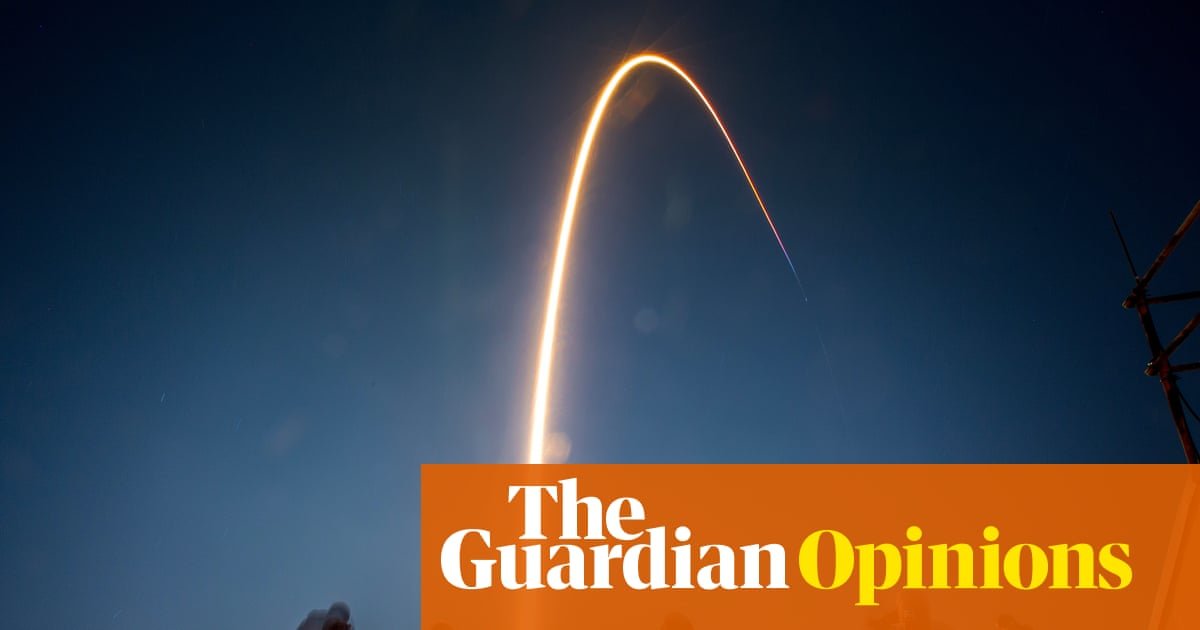
During the cold war’s space race, the Apollo moon missions were driven by the need to prove American superiority. Having made that political and technological point with the 1969 moon landing, the contest between Moscow and Washington petered out. A new dash across the skies kicks off in 2026, reigniting geopolitical competition under the guise of “peaceful exploration”. The moon’s south pole is emerging as the most valuable real estate in the solar system, offering “peaks of eternal light” for solar arrays and ice deposits in craters shielded from the sun.
The US and a China-led bloc are eyeing the lunar surface and its potential to control a post-terrestrial economy. Space had been humanity’s last commons, supposedly shielded by the 1967 UN outer space treaty that bans state exploitation of the heavens. It is vague, however, on private claims – a loophole that is now fuelling a tycoon-led scramble for the stars. The aim is obvious: to act first, shape norms and dare others to object. Two lunar missions launching next year– Nasa’s Artemis II and China’s Chang’e 7 – are competing for strategic supremacy.
To hasten the commercialisation of space, Donald Trump is shrinking state support for Nasa, which will have its smallest budget since 1961. Washington wants space exploration to be led by the private sector, a wish anchored in the Artemis accords. Signed by more than 40 nations, the accords are a vision of extending earthly ownership structures into space – and one embraced by tech moguls such as Elon Musk and Jeff Bezos. Little wonder, then, that Mr Musk aims to float his space exploration firm SpaceX in 2026 for $1.5tn.
By contrast, the International Lunar Research Station – China’s joint effort with Russia and global-south partners – embodies a state-led approach that seeks to escape an American-led system. China and Russia say that they are complying with UN rules because their lunar bases will be under an international “collaborative” consortium not any one state’s control.
Superpower rivalry
The result is a rivalry with two camps both publicly invoking “peaceful exploration” while engaging in strategic competition for lunar resources. Already there are claims that water could produce rocket fuel and sustain life. Others speculate whether moon rock might be useful for construction. These are essentially rhetorical claims – like the oft-repeated assertion that space’s helium-3 is a potential fusion fuel. These are arguments, however thin, for governments to justify lunar spending with the promise of future potential.
Nuclear fission on the moon, by contrast, is a concrete engineering race, with the US and China-Russia already funding reactor designs necessary to support human lunar colonies. Nasa intends to do so within five years; China and Russia say theirs will be running by 2035. The technology is not new: small fission reactors in space were part of cold war duelling. But the moon looks like a proving ground. Reliable nuclear power during the 14-day lunar night would be needed for permanent human bases. Once solved, the same power technology can be taken to Mars. Mr Trump has already said US astronauts will plant the stars and stripes on Mars.
The 1992 UN principles relevant to the use of nuclear power sources in outer space provide a framework for safety and risk reduction, but not a regulator. The nation that works out how to achieve reliable off-world energy systems could determine the balance of industrial and digital power for the next century.
The drive to leave Earth is often characterised as humans’ need for discovery and exploration. But there may be something more pressing: humanity is using up natural resources 1.7 times faster than our planet’s biocapacity can regenerate them. There are essentially three ways out: become more efficient by squeezing more GDP per unit of energy; green the production, distribution and consumption of the economy to bring capitalism in line with ecological limits; or move energy-intensive processes off-world.
Much of Silicon Valley favours the last techno-optimist option rather than the first two Earth-based approaches. Google wants datacentres in orbit powered by solar energy. Energy and computer arms races have merged in a startling admission that Earth-based datacentres are approaching ecological and political limits. The answer: Google is to put them in the skies. As artificial-intelligence demand and electrification accelerate faster than terrestrial grids can decarbonise, the incentive for off-Earth, continuous solar energy will grow stronger. What begins as pragmatic innovation could end as a new phase of extraction: a search for energy and compute capacity once Earth’s limits have been reached.
Red Mars
Life may be imitating art. Kim Stanley Robinson’s classic sci-fi Mars trilogy opens in 2026 with humanity’s first colonial voyage to the planet. In its first book, Red Mars shows Earth’s nations and corporations over decades compete to control the new frontier. Robinson’s “Transnats” foreshadow today’s private contractors and state conglomerates. Echoes of the novel’s debates – nuclear versus solar, terraforming versus preservation – can be found in the real space race today. And just as the colonisation of Mars was justified by Earth’s ecological decline, today’s lunar exploration is rationalised by “resource utilisation” – using the moon’s resources to reduce dependence on the home planet. The logic subtly inverts the problem: planetary overshoot becomes a licence to expand it.
Red Mars ultimately warns that humanity would export its old politics to new worlds with disastrous results. Before occupying another planet, the novel’s message is that we must first learn to live sustainably on our own. We can escape Earth but, the novel asks, can we escape ourselves? Yet today, space law is being fashioned to allow appropriation under the guise of peaceful, commercial activity. The US’s 2015 Space Act permits the mining of asteroids as if they were open seams of ore. Nasa’s moon rock returns helped the US Congress justify space property rights – opening the door for humanity’s last commons to slide into corporate hands.
In the last instalment of Robinson’s trilogy, Blue Mars, by the year 2225 settlers are living in harmony with the world they have made. Humans terraform Mars and begin, at last, to inhabit it responsibly. One can only hope we understand that far sooner.
