

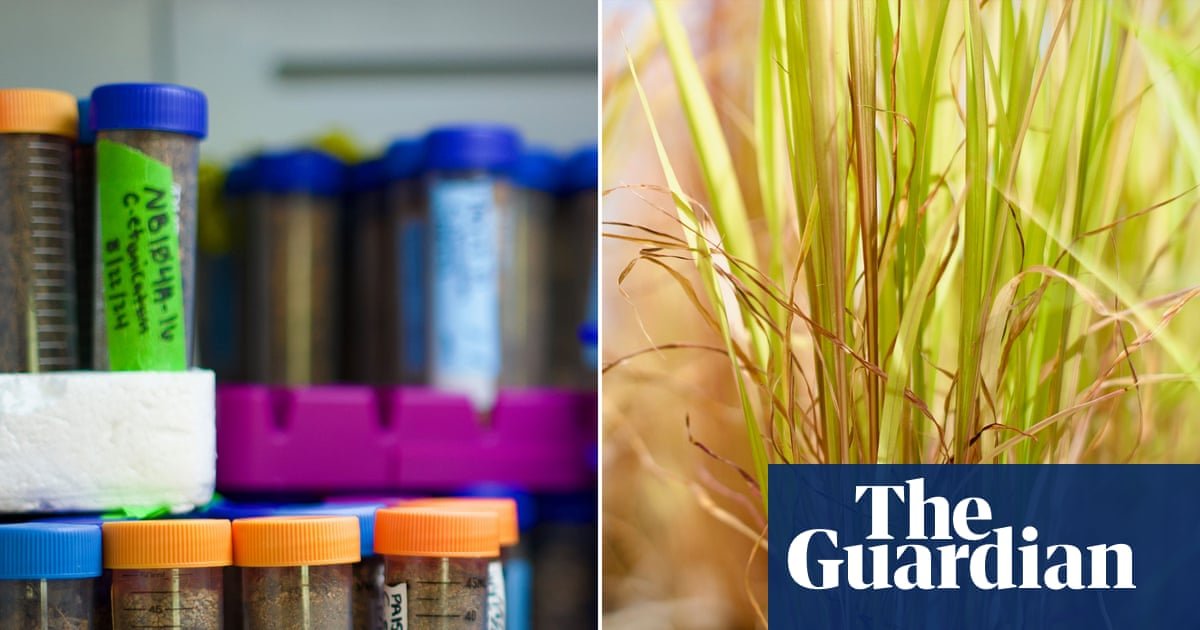
Inside a large greenhouse at the University of Kansas, Professor Liz Koziol and Dr Terra Lubin tend rows of sudan grass in individual plastic pots. The roots of each straggly plant harbor a specific strain of invisible soil fungus. The shelves of a nearby cold room are stacked high with thousands of plastic bags and vials containing fungal spores harvested from these plants, then carefully preserved by the researchers.
The samples in this seemingly unremarkable room are part of the International Collection of Vesicular Arbuscular Mycorrhizal Fungi (INVAM), the world’s largest living library of soil fungi. Four decades in the making, it could cease to exist within a year due to federal budget cuts.
For leading mycologist Toby Kiers, this would be catastrophic. “INVAM represents a library of hundreds of millions of years of evolution,” said Kiers, executive director of the Society for Protection of Underground Networks (Spun). “Ending INVAM for scientists is like closing the Louvre for artists.”
The arbuscular mycorrhizal (AM) fungi conserved by INVAM are symbiotic organisms that support the growth of 70% of land plant species across all ecosystems. In exchange for sugars and fats, they provide plants with vital nutrients – phosphorus, nitrogen, trace metals – and buffer them against drought, disease and other stressors. They also represent a substantial underground sink for carbon dioxide.
INVAM maintains living spores of more than 900 distinct fungal strains collected from six continents. It’s an irreplaceable hub for mycological research worldwide – but these fungi also have practical power: restoring degraded ecosystems, rebuilding damaged soils and slashing artificial fertilizer use. They are essential tools for growing food and undoing the environmental harm caused by agriculture.
Established in 1985, INVAM has relied on successive federal grants for its entire existence. Its latest US National Science Foundation (NSF) funding ended in May. As curator and professor Jim Bever and team prepare a new funding proposal, the outlook is ominous: the Trump administration’s proposed budget for fiscal year 2026 would slash NSF funding by 57% and make it even more difficult to win the remaining funds.
Without another grant, Bever estimates the collection can limp along for perhaps another year. Beyond that, INVAM could be forced to close. “I have a hard time thinking about that possibility,” Bever said, “but we can’t deny it’s true.” For now, INVAM is surviving on temporary research grants and volunteer labor. Unlike the collection’s previous home at West Virginia University, which provided institutional support for personnel, the University of Kansas covers infrastructure and overhead costs but not staffing.
Liz Koziol and Terra Lubin stand amid sudan grass plants used to culture AM fungal spores in INVAM’s greenhouse at the University of Kansas in Lawrence. Photograph: Ben Martynoga
And the staff are critical. Unlike seeds stored in vaults or cells frozen indefinitely, without sustained, meticulous work, the spores of AM fungi die. At INVAM, associate curator Lubin works at a microscope to isolate and identify AM spores from intact soils. Seen through the microscope, these spores are visually stunning: glistening orbs, packed with nutrients needed to support young fungi.
Lubin then paints isolated spores on to the roots of a sudan grass seedling. These host plants will grow in a sterile greenhouse for 12 weeks while fungi colonize their roots and soil. Then the plants will be water-starved, prompting the fungus to produce millions of spores, which workers harvest and store in the adjoining cold room. For every one of INVAM’s 900-plus strains, this process must be repeated annually.
“The isolation and maintenance of AM fungi requires an arcane skillset,” said Bever. “There really isn’t another lab in the US that has been doing this.”
Most commercial biofertilizers are ‘really just terrible’
INVAM prepares small batches of AM fungal spores to distribute or sell to other researchers and land managers. But Bever is clear this isn’t a commercial operation, and INVAM has neither the capacity nor the ambition to scale up production. That matters because the commercial AM fungus market is rife with problems.
In a 2024 study, Bever and colleagues tested 23 products marketed as fungal biofertilizers – AM spores alleged to boost plant growth naturally. Eighty-seven per cent failed to colonize plant roots. Many contained only dead spores or no spores at all. Some products contained known plant pathogens. A large-scale 2022 study by European researchers revealed similar failings. Bever and Koziol’s 2024 mata-analysis of global research reached the same disturbing conclusion: the majority of commercial AM fertilizers are worthless.
“Unfortunately, the quality of most products available to farmers or restoration practitioners is really just terrible,” said Bever.
Yet land managers are buying them. The global market for fungal biofertilizers is worth $1.29bn. Most of that money is being wasted on products that simply do not work. Bever sees two key problems: the industry lacks regulation, and most producers lack the specialized expertise needed to steward and distribute these delicate organisms effectively. Meanwhile, the public research infrastructure that could provide real solutions struggles to survive.
But quality biofertilizers can be priceless
The failure of most commercial biofertilizers stands in stark contrast to research demonstrating what these organisms can actually achieve.
At a field research plot near INVAM’s base in Lawrence, Kansas, the impact of invisible fungi is obvious. Nine years ago, this was a tired old hay field, dominated by invasive grass. Today it is a riot of color and diversity. Twelve-foot prairie docks tower over head-tall grasses; grasshoppers leap and butterflies flit between late blooming flowers, even in October. This small patch has become a reincarnation of the tall-grass prairie that once dominated the central US states. It was this ecosystem that built the deep, fertile soils that made this area such a prime target for conversion to farmland – a shift that has diminished the prairie to a mere 1-4% of its original extent.
AM fungi drove the transformation. In 2016, INVAM curator Koziol seeded plots with dozens of native prairie plants, plus AM spores from surviving old-growth prairie fragments. Control plots received the seeds but not the fungi. As a result, dozens of plants in the control plots failed to establish and all plants grew slowly. Nine years on, the difference between control and AM-treated plots is still clear.
Modern agriculture decimates AM fungi – which is why reintroducing them can deliver such dramatic results. Fungicides used to control plant diseases seep into soils, killing AM fungi. Excessive synthetic fertilizer application causes plants to break symbiotic ties, starving fungi. Ploughing destroys their underground networks. As a result, AM fungi often vanish entirely from cultivated land, “We can barely even find the DNA [of AM fungi] in some of the soils that have been in intensive agricultural production,” said leading fungal ecologist Matthias Rillig of Freie Universität Berlin.
This matters because AM fungi disperse slowly – they produce no above-ground fruiting bodies to scatter spores on the wind. As a result, reintroduction is often essential for restoration.
Building on their successful prairie restoration experiments, Bever and Koziol see potential for AM fungi in establishing prairie strips – patches of deep-rooted, species-rich perennial plants within existing farm fields that boost pollinators and limit fertilizer runoff, which contaminates groundwater and creates dead zones in bodies of water.
“Prairie strips are awesome,” said Bever, but he believes there’s grander potential in the Conservation Reserve Program. This federal scheme has already enlisted more than 20m acres, supporting landowners to transition marginal farmland into native grassland and woodland to improve soil health, retain water and store carbon. “The return on that investment would be much greater if there was a national policy to reinoculate with native mycorrhizal fungi,” he said.
Beyond habitat restoration, and despite the current failure of most commercial fungal biofertilizers, AM fungi can be useful in mainstream agriculture. In 2016, Koziol founded MycoBloom to produce high-quality preparations of old-growth prairie fungus spores. In addition to restoration practitioners, customers report promising results in vineyards, orange orchards, and high-value organic crops such as peppers and tomatoes.
The effects of AM fungi are likely to be strongest in perennial crops, including new grains like Kernza, whose roots remain in the ground long enough for stable symbiosis to establish. But evidence shows AM fungi can also boost growth of annual staples such as maize.
“The benefits of mycorrhizal fungi are real,” said Bever. Yet scientists are only beginning to understand how these organisms work. Numerous research questions about AM fungi can only be answered with living libraries such as INVAM, Bever added. Why do AM fungal cells contain thousands of nuclei, for instance, when ours need just one? And how can apparently distinct species merge their cells to create hybrids? “Research on mycorrhizal fungi is totally dependent on having these fungi in culture,” Bever said.
“The current administration has shifted funding away from basic science,” he added, “and while there is always a hope that private donors could fill that void, I don’t think there is a real substitute for federal investment.”
Kiers, now a professor at Vrije Universiteit Amsterdam, described how visiting INVAM in the 1990s to identify spores collected from Panama’s hyper-diverse rainforests shaped her entire career: “After seeing the collection, I was hooked. It changed the way I saw the underground.
“To have any hope in leveraging fungi for future climate change strategies, restoration efforts and regenerative agriculture, we need to safeguard this collection,” Kiers said.
Merlin Sheldrake, mycologist and author of Entangled Life: How Fungi Make Our Worlds, Change Our Minds and Shape Our Futures, agreed emphatically.
“These organisms are vital ecosystem engineers that hold the key to so many problems we face,” he said. “To lose this library would be an unimaginable tragedy.”
