

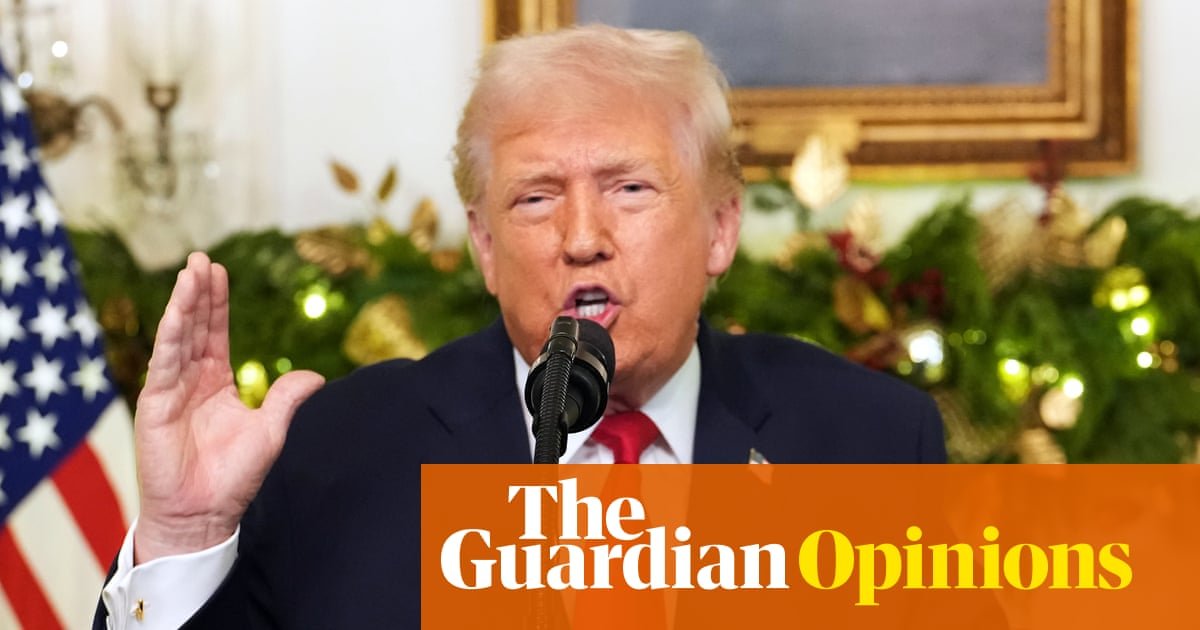
When Donald Trump spoke about drug prices on 19 December, he struck a familiar note. Americans, he said, were paying far too much for medicines – and it was everyone else’s fault.
There would be no talk of reining in private insurers or pharmaceutical profits. Instead, Trump blamed foreign governments for getting a better deal. Countries like France, Germany and Japan, he argued, were piggybacking on the United States by keeping their drug prices low.
Later that day, at a rally in North Carolina, he performed an imaginary showdown with Emmanuel Macron. Trump claimed he had told the French president that France would have to double or triple its drug prices – and that France would ultimately give in. Thanks to this tough approach, Trump promised to cut US drug prices “by 700%”, a figure so nonsensical it barely merits scrutiny.
Trump is right about one thing: the US system is a public health failure. Drug prices are eye-wateringly high. Millions of Americans struggle to afford essential medicines such as insulin. Private insurers add costs without improving access. The result is a country that spends more on healthcare than anyone else, yet has lower life expectancy than many poorer nations.
But Trump’s explanation is wrong. Americans are not paying high prices so that European, Canadian, South Korean and Japanese citizens can enjoy cheap medicines. They are paying high prices because pharmaceutical companies charge what they can get away with.
Other countries’ patients and their governments do pay less than Americans, but they hardly get medicines for free. Prices for new drugs are high and rising everywhere. The real winners are the shareholders of multinational pharmaceutical companies who have enjoyed extraordinary profits, dividends and share buybacks over the past two decades – more than $1,500bn between 2000 and 2018. A majority of them are US-owned. In 2024, US corporations made 49% of the top 20 big pharma revenue.
This matters because Trump’s outburst points to something bigger than campaign rhetoric. The United States is now turning against a global pharmaceutical system it helped to create.
That system took shape in the 1990s, when rich countries pushed tough intellectual property rules through global trade agreements, especially the infamous 1994 Trips agreement. Patent rules were strengthened and harmonized worldwide, with devastating effects on many patients in countries dependent on generic manufacturing. The new patent rules overwhelmingly benefited large pharmaceutical firms based in the US, Europe and Japan.
In return, through parallel trade agreements, poorer countries were offered access to rich markets for their manufactured goods and were drawn into global supply chains. The system delivered huge profits for pharmaceutical investors – but also restricted access to medicines and pushed prices ever higher.
Today, that model is under strain. Pharmaceutical companies are spending a smaller share of their revenues on research, for innovations that are often judged less innovative by experts, while paying more out to investors. In 2024, the US pharma giant Pfizer spent just 18% of its revenue on internal research and development – while 27% went to shareholders through dividends and debt repayment. Innovation has slowed. Breakthroughs that transform public health are rarer, while ultra-expensive treatments for small groups of patients are becoming the norm.
At the same time, countries outside the old system are catching up. China, for example, has built a large state-backed pharmaceutical industry and now produces vaccines and medicines without relying on western patents. Between 2021 and 2022, Chinese corporations alone were able to produce 3.4bn Covid-19 vaccine doses, 28% of all doses produced at the time. Even countries such as Cuba were quick to develop their own vaccines through a state-controlled biotech ecosystem.
From Washington’s point of view, the problem is that profits may have peaked. When US industries face that kind of pressure, they tend to look for someone else to pay. Trump’s answer is to target allies rather than companies.
Instead of challenging pharmaceutical power at home, he wants to force European and Asian allies to pay more for US drugs, while pushing down prices for US citizens. It is a familiar strategy: use economic pressure on partners who depend on US military protection and have limited room to resist.
This could leave governments in Europe and Japan in an awkward position. Their domestic pharmaceutical firms have long argued for higher domestic prices, closer to US levels. Private insurers would probably not object. But voters would – as public healthcare systems would quickly be unable to handle even more elevated price levels.
Trump presents his plan as standing up for American patients. In reality, it protects the same corporate interests that made medicines unaffordable in the first place – while exporting the damage to others.
