

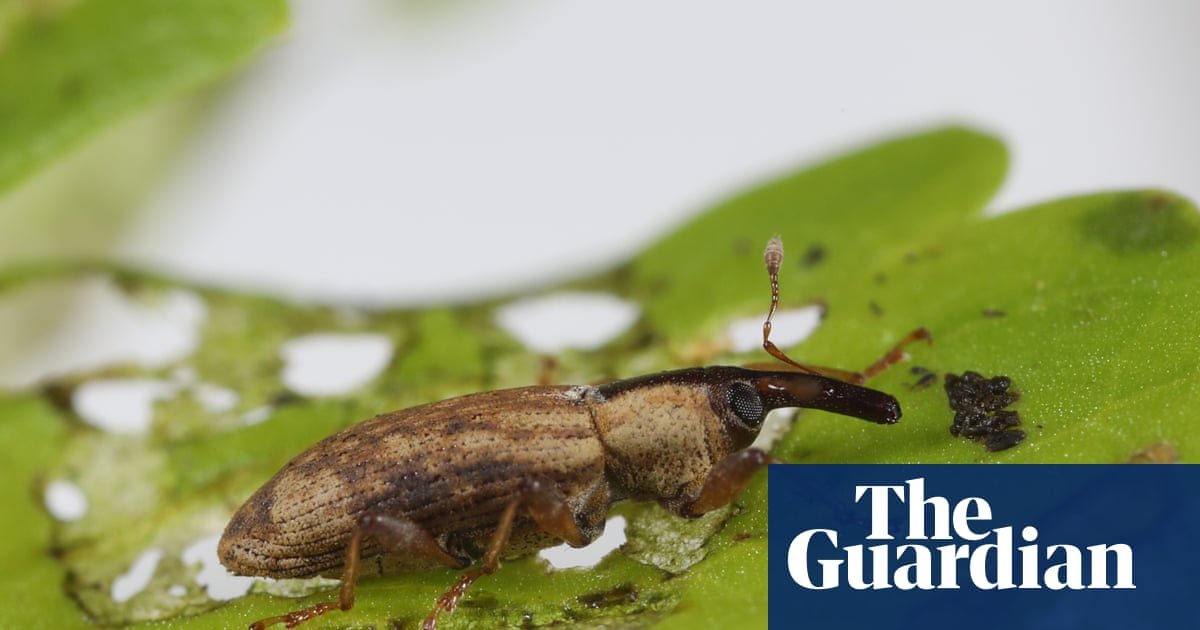
Crayfish, weevils and fungi are being released into the environment in order to tackle invasive species across Britain.
Scientists working for the government have been breeding species in labs to set them loose into the wild to take on Japanese knotweed, signal crayfish and Himalayan balsam, and other species that choke out native plants and wildlife.
They are doing this, in part, to meet tough targets set by the Department for Environment, Food and Rural Affairs in its recently announced environmental improvement plan. Ministers have directed the Animal and Plant Health Agency (Apha) to reduce the establishment of invasive species by 50% by 2030.
Olaf Booy, deputy chief non-native species officer at Apha, said: “The science around biological control is always developing. It really works for those species that were introduced quite a long time ago, that we haven’t been able to prevent getting here or detect early and rapidly respond.”
Scientists have been working out which species would be able to tackle the invasive pests by killing them and reducing their ability to spread, without harming other organisms. Booy said the perk of biological control agents was they reduced the need for human labour.
Japanese knotweed in Taff’s Well, near Cardiff. Photograph: Dimitris Legakis/Athena Pictures
This includes targeting floating pennywort, which spreads and chokes the life from rivers, by releasing the South American weevil Listronotus elongatus. Where weevils have overwintered for several years, floating pennywort biomass appears reduced across a number of release sites.
Defra has also employed specialist scientists at the Centre for Agriculture and Bioscience International (Cabi) to conduct biological control (biocontrol) research into the use of naturally occurring, living organisms to tackle Japanese knotweed. Cabi has targeted this species using the release of the psyllid Aphalara itadori, which feeds on the plant.
Similarly, Cabi has been trialling the release of the rust fungus Puccinia komarovii var. glanduliferae to tackle Himalayan balsam. Defra said the results of the release were encouraging and would continue at compatible sites.
“Once the biocontrol agent is working properly, then it should actually start to spread naturally across the range, where the non-native species is, and it will start to bring that population of the non-native species down,” Booy said. “Hopefully, once it starts to establish in the wild, then it sort of starts taking over itself, and the human effort bit starts to reduce significantly.”
As well as releasing biological control agents into the wild, government scientists have been breeding threatened species to protect their populations from invasion. Britain’s native white-clawed crayfish has disappeared from most of the country since the invasive American signal crayfish was introduced in the 1970s. These non-native creatures outcompete the native crayfish and carry a deadly plague, making eradication or containment virtually impossible.
Himalayan balsam invades the banks of the river Avon. Photograph: Mark Boulton/Alamy
Invasive species experts have created protected “ark sites”: safe habitats where white-clawed crayfish can survive free from threats. A new hatchery has been set up in Yorkshire to release them into the wild in secure locations, and in Devon the Wildwood Trust is expanding its hatchery, building a bespoke ark site pond, and rescuing crayfish from rivers under threat. More than 1,500 breeding-age crayfish so far have been translocated to eight safe sites in Gloucestershire.
The creatures Booy is most concerned about establishing in the wild include raccoons and raccoon dogs, which are kept as pets but are very good at escaping into the wild.
The medium-sized predators could be harmful to the amphibians and small birds they feed on, he said. At the moment, keepers of raccoons and raccoon dogs do not have to register with the government, though breeding and selling them is banned.
Social media trends depicting raccoons as cuddly and desirable pets could be a concern, he said: “You do see things like raccoons and raccoon dogs popping up on social media and stuff. Particularly raccoons, they’re kind of cute and cuddly, and you could imagine that a TikTok trend might encourage people to think about getting a species like that. Obviously years ago we had the interest in terrapins from the Teenage Mutant Ninja Turtles.”
He added: “If you have a raccoon, you really need to know how to keep it securely to avoid it escaping. You don’t really want any predators of that sort of size establishing and spreading in the country, because it will have knock-on impacts for biodiversity. But they are also potentially vectors of disease as well.”
The biosecurity minister and Labour peer Sue Hayman said: “With a changing climate we are constantly assessing for new risks and threats, including from invasive plants and animals, as well as managing the impacts of species already in this country. Invasive non-native species cost Britain’s economy nearly £2bn a year, and our environmental improvement plan sets out plans to reduce their establishment to protect native wildlife and farmers’ livelihoods.”
