

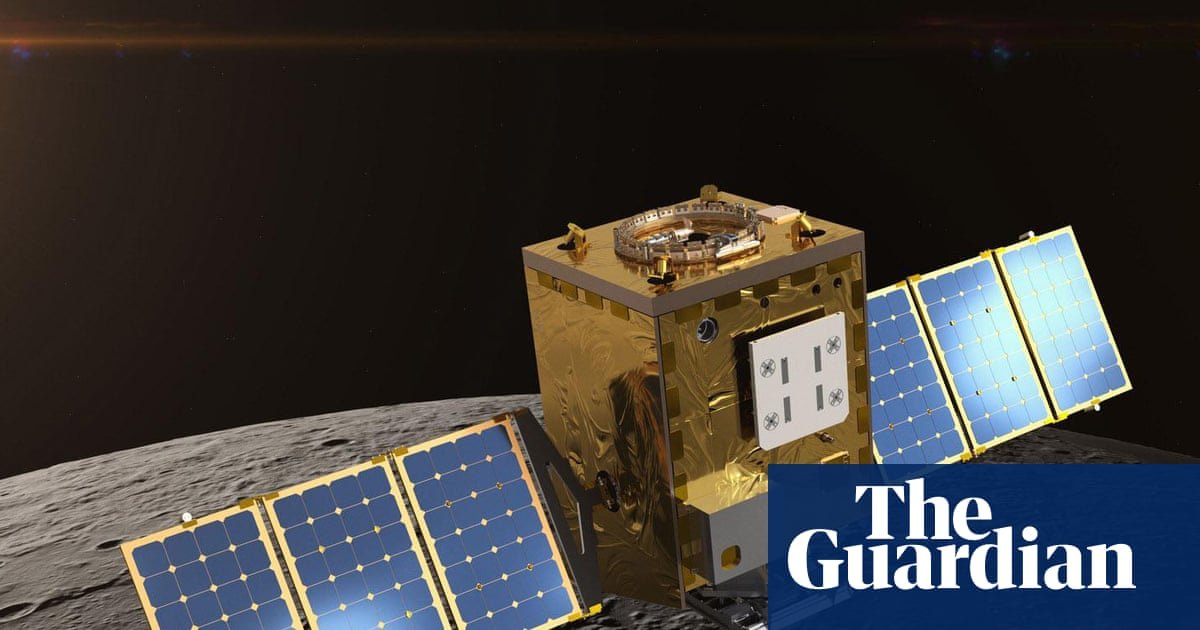
Patches of the moon are destined to become spacecraft graveyards where dead lunar satellites and other defunct hardware can be crashed into the ground, far away from sites of cultural and scientific importance, researchers say.
The number of satellites circling the moon is set to soar in the next two decades as space agencies and private companies build moon bases and dabble with mining operations and constructing scientific instruments on the barren terrain.
The surge in activity will be supported by constellations of lunar satellites for positioning, navigation and communications. But when the satellites run out of fuel, operators have few options other than steering them into the ground, where they will be smashed to pieces.
“These satellites will have to be crash-landed on the moon, so it will potentially become a rubbish site,” said Dr Fionagh Thomson, a senior research fellow at the University of Durham, who convened an expert panel on the issue at the Space-Comm meeting in Glasgow in December.
Beyond scattering satellite parts across the surface, researchers fear that if scores of dead satellites rain down across the moon, they risk causing damage to buildings, scientific instruments, historic sites such as the first astronaut footprints, and pristine sites of scientific interest.
With impact speeds of 1.2 miles per second, the collisions will produce intense vibrations, which could disrupt the sensitive instruments scientists want to build on the moon. The scars carved into the surface are expected to stretch for tens of metres and produce vast clouds of abrasive dust that could obscure telescopes and damage equipment.
“It’s not an immediate concern, given the surface area of the moon, but the more lunar satellites there are, the greater the chance that some may crash into scientifically or culturally sensitive locations,” said Prof Ian Crawford of Birkbeck, University of London. “We do need a plan going forward.”
Satellite operators routinely use Earth’s atmosphere to dispose of dead satellites drifting around the planet. Each year, thousands of defunct satellites are incinerated on re-entry. But because the moon has no atmosphere, lunar satellite operators need other solutions.
And they need them soon. More than 400 moon missions are planned in the next two decades. They include the Nasa-led Lunar Gateway, a space station that will orbit the moon, and the Artemis base camp on the surface. A second moon base is planned by China and Russia.
Next year, the European Space Agency will launch the Lunar Pathfinder satellite, a testbed for its Moonlight constellation of lunar satellites that should be operational by 2030. Work is under way on how to dispose of Lunar Pathfinder at the end of its eight-year lifetime.
Lunar satellite operators have three main options. With a propulsion unit and sufficient fuel, a satellite can fly off and orbit the sun. But this is costly. Alternatively, it could move to a more remote lunar orbit, but the moon’s lumpy gravitational field makes this difficult. Finally, satellites can be crashed into the ground, but this needs careful planning.
Sarah Boyall, the head of the Office of Regulation at the UK Space Agency, said the UN’s Action Team on Lunar Activities Consultation (Atlac) and the Inter-Agency Space Debris Coordination Committee (IADC), which the UK currently chairs, are working to establish best practices for disposing of lunar satellites.
Spacecraft graveyards are a leading contender, with operators required to crash old satellites at designated spots, or into giant craters that would contain the dust kicked up on impact. Both the UK Space Agency and signatories to the US Artemis accords, a set of principles for future space exploration, are pursuing the approach.
“Establishing graveyard zones on the moon is the most practical solution,” said Ben Hooper, senior project manager for Lunar Pathfinder at SSTL, the Surrey-based satellite manufacturer. “Designating specific regions as ‘impact zones’ would limit the spread of human artefacts across the lunar surface, preserving other areas for scientific exploration and future operations.”
Charles Cranstoun, the head of the ESA’s Moonlight programme office, said when the time came, the satellites would be crashed into the surface in a controlled manner “in specified zones”, to avoid “sites of scientific interest and historical importance and ongoing missions”.
John Zarnecki, emeritus professor of space science at the Open University, said crash-landing satellites in graveyard zones could be put to good use because the impacts generate seismic waves at known spots, to shed light on the moon’s structure. “If you have an object of known mass, known geometry and known speed, and you know pretty much where it impacted, that’s a fantastic experiment in seismometry,” he said.
