

It’s 2.30pm on a Wednesday afternoon and the Himmah Hub, a community centre in Nottingham, is abuzz with activity. Crates of leftover supermarket food are being carried inside, trestle tables assembled, and volunteers are arriving to prepare meals that will be served in a few hours’ time to anyone who needs one – a queue has already begun to form outside.
This is the Salaam Shalom kitchen, known as SaSh, a joint Muslim-Jewish project set up in 2015, and based on one of the core tenets of both faith groups: bringing people together through food. It also draws on a north Indian tradition of community meals, with food prepared collectively and duties shared across the village, Sajid Mohammed, director of the Muslim-led social justice initiative Himmah, explains.
Mohammed had previously worked with the then rabbi of Nottingham Liberal synagogue, Tanya Sakhnovich, on a number of community projects when, in 2014, the pair got chatting about their shared concern about the number of English Defence League (EDL) marches that were taking place. “She goes: ‘Look, I’m just dead worried, Saj. Week in, week out there’s these bloody marches, and I don’t know what it means for the Jewish community.’ And I said: ‘Don’t worry, they’ll never get anywhere,’” Mohammed says with a wry smile. But he agreed there was a growing fear of bigotry in both Nottingham’s Muslim and Jewish communities, and that “something deeply unsettling” was happening.
Although at leadership level Muslims and Jews had been working together on interfaith projects for years, when it came to “the congregations, the community groups, families, parents, children, our communities were not connected,” the charity leader explains. It just so happened that Himmah had already been considering setting up a hot meal provision in Hyson Green, home to Nottingham’s largest ethnic minority population – and also home to a historic Jewish cemetery. It seemed like the perfect project with which to bring both faith communities together, with Mohammed recruiting in volunteers from Himmah, and Sakhnovich from the synagogue, to provide a service that “demonstrates our shared values of dignity, justice and service to our communities,” he says.
Sajid Mohammed, director of Himmah. Photograph: Fabio De Paola/The Guardian
People thought it was bonkers to try to bring together two faith groups that have been so often pitted against each other: when the pair approached a local vicar to apply for a grant from the Church of England’s Church Urban Fund he called it “a disaster idea,” Mohammed says. Which only fired them up more – Sakhnovich went directly to the bishop of Nottingham to get the grant signed off, and the SaSh kitchen opened its doors for the first time in June 2015 and has been running ever since, even during the coronavirus pandemic, when it moved outdoors.
Initially there were about 50 guests a week, says SaSh’s co-chair, Ferzana Shan. And though anyone is welcome to receive a meal, no questions asked, at first the guests were mostly white homeless men. Over the years, the demographic has diversified, with people of all ages, genders and backgrounds coming along. While the charity is pleased to reach so many people – tonight, they anticipate feeding approximately 130 – it is also “really heartbreaking” that so many people need it, Shan says.
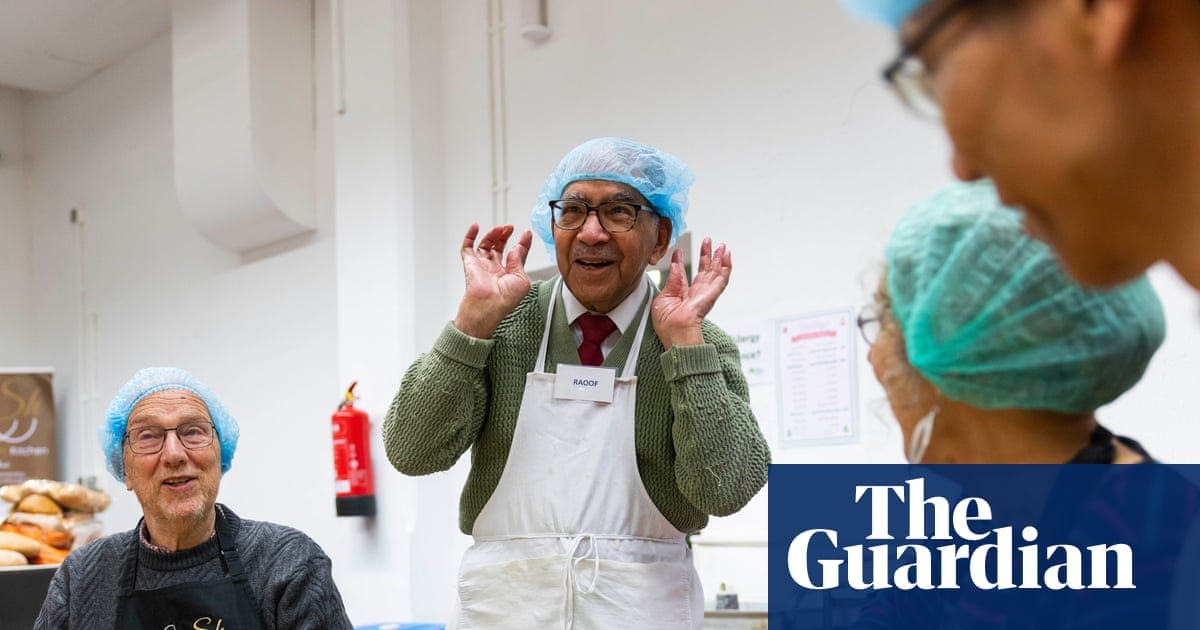
While I’ve been talking to the project’s trustees, volunteers have pulled chairs around a trestle table and started chopping vegetables. The food served is always vegetarian, which takes away decisions about whether to make the food kosher or halal. “We’re the chop and chat table,” the volunteers tell me cheerfully when I approach them, and I’m invited to start dicing peppers.
Volunteers chop vegetables and help prepare the food. Photograph: Fabio De Paola/The Guardian
I meet 91-year-old retired consultant Dr Raoof, who has been given the job of finely slicing garlic, since he is, according to the others, “the best chopper”. I also meet Justyna, 38, a GP practice manager who spends her one day off each week volunteering with SaSh. Though many of the volunteers are from Nottingham’s Muslim and Jewish communities, there are also members of the local Catholic cathedral who heard about the project and wanted to get involved and people of no faith who simply want to help.
Justyna, who moved to the UK from Poland in 2006, is passionate about showing the guests who are refugees and asylum seekers that they are welcome. “Frequently they think ‘everyone hates us’ because of what they hear on the news, so it’s nice [for them] to come and feel included knowing that there are people here to support you and like you and want you to do well in this country,” she says.
Jews and Muslims working together on this kind of project “in the present climate, is a bloody miracle,” thinks fellow volunteer Daniel, 75, who heard about SaSh via his synagogue. Against the backdrop of the war in Gaza and increasing division in the UK, running the project has been “stressful at times,” says Andrea Chipman, one of SaSh’s Jewish trustees. “We’re really dedicated to the project and the community, and I think that’s helped us work through a difficult situation,” she says.
“We share the pain of antisemitism and Islamophobia together,” Shan adds – pointing out that both communities have been used as “the scapegoat for any societal issues. So that keeps us together.”
Ferzana Shan, SaSh’s co-chair, (left) and Andrea Chipman, one of SaSh’s trustees. Photograph: Fabio De Paola/The Guardian
SaSh is being supported by advocacy group Hope Not Hate’s charity arm, Hope Unlimited, one of the recipients of this year’s Guardian charity appeal. The charity believes that community-led initiatives can provide hopeful alternatives to extremist hate. Mohammed says the war in Gaza, along with Brexit and the UK’s cost of living crisis, have created “fertile land” for people with deep political agendas to push ideas. “I don’t think British people are intrinsically racist,” he says, arguing instead for creating spaces where dialogue can happen and people can share their hopes and dreams so they realise “we’ve got so much more in common than what divides us”. Building community bonds, he adds, “is the herd immunity that will protect us from the virus of fascism”.
For that reason, SaSh aims to tackle not just food poverty, but social isolation. As 5.30pm approaches, the chop and chat table is cleared, and more tables assembled. They’re covered with colourful tablecloths to make the space look inviting. Sometimes, musicians will come and play as the food is served, the trustees tell me, and during Muslim and Jewish festivals volunteers come along to talk to the guests about their significance. Everything is geared towards making the space somewhere for people to come together and connect – not just receive basic essentials. Many of the guests pick up bunches of flowers alongside their food – it will brighten his home up, says one guest, Danciel. “I met a lot of people here – it’s a good community,” he adds.
SaSh kitchen guest Danciel. Photograph: Fabio De Paola/The Guardian
Janet, 66, has been coming to the SaSh kitchen since its inception. She tells me it gives her a break, and “some normality”, away from her home, where she is a full-time carer for two of her family members, one of whom has autism and schizophrenia, and the other a spinal injury. “It gives me that time for me,” she says, giving her the energy to return to her caring responsibilities.
Of all the projects that Himmah runs, Mohammed hopes if he is remembered for anything it will be SaSh. “It’s a project of immense hope,” he says. “And we live in some dark, dark times. Times that many of us, people of colour, the Jewish and Muslim communities, had thought we would never see again in this country.” As both Islamophobia and antisemitism continue to rise, it has been helpful that “even through the trauma of everything going on, that we have people who are from similar and different backgrounds to share the experience with,” Chipman adds. The strong relationships and the conversations between the Jewish and Muslim communities “never stop” even “when everything’s feeling a bit hopeless,” she says. It’s “a very local hands-on way where you can make a difference”.
SaSh’s message is “don’t give up,” Mohammed says. “We know we’re living in tough times, and it’s easy to get demoralised,” and to think the division shown on social media is representative of the world we live in.
But “it isn’t: the world is your family, your street, your neighbourhood, your city.” We will get through this moment in history, he says. “As long as we hold the rope of unity together.”
