

This article is an on-site version of our Moral Money newsletter. Premium subscribers can sign up here to get the newsletter delivered twice a week. Standard subscribers can upgrade to Premium here, or explore all FT newsletters.
Visit our Moral Money hub for all the latest ESG news, opinion and analysis from around the FT
Welcome back.
Volodymyr Zelenskyy may have failed to persuade EU leaders to hand over frozen Russian assets to Ukraine — but his government will nonetheless receive a financial lifeline of €90bn, under a deal hammered out in the small hours of this morning in Brussels.
A big chunk of that money will need to go towards shoring up Ukraine’s teetering energy system, which is now coming under another intensifying wave of attacks from Russia as winter draws in. And investment in grid-level battery storage — which has been surging globally this year to complement renewable power generation — will play a particularly central role in Ukraine, as I explore below.
We’ll be off for Christmas and the new year, returning to your inbox on Wednesday, January 7. We wish you all a great end-of-year break — ahead of what is likely to be another very eventful 12 months.
Battery developers find opportunity in Ukraine energy crisis
Start-up life in Ukraine has its downsides, Andrii Bondar concedes.
Nearly four years into Russia’s all-out invasion, the war has had a devastating effect on the national economy, with relentless aerial attacks pummelling infrastructure and claiming thousands of civilian lives. Ukrainian GDP this year is forecast to be about a fifth lower than in 2021.
It’s perhaps not surprising, Bondar reflects, that many of his fellow entrepreneurs have moved to the US or calmer parts of Europe, rather than struggle to raise venture funding in a country at war.
But Bondar’s own sector of the Ukrainian economy is undergoing something of a boom. His start-up, R.Flo, is developing a battery technology that uses chemical reactions of iron salts to store and release energy.
Investment in grid-level power storage has been surging in Ukraine over the past year, from previously negligible levels, in a crucial part of national efforts to build a grid more resilient against attack.
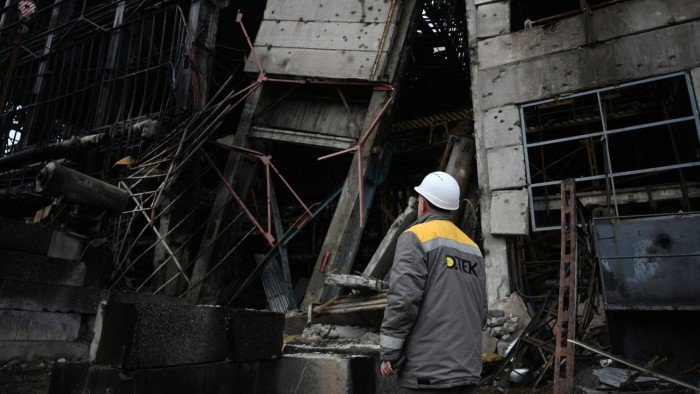
Russian aerial strikes or occupation have now knocked out the majority of Ukraine’s coal, gas and nuclear generation, which provided the vast bulk of the country’s power before the conflict. In contrast, solar power capacity — far less vulnerable to missiles than bulky thermal power plants — has continued to grow.
This has resulted in frequent large electricity surpluses on sunny days — followed by huge deficits that plunge swaths of the country into darkness. It makes for a chaotic crisis situation — but also, as Bondar points out, “a great market for arbitrage”, as wholesale electricity prices sink to near-zero before surging to extortionate levels at night.
Companies are now moving at an accelerating pace to tackle this opportunity, a trend that could yield them hefty returns while shoring up the country’s battered electricity system.
The investment surge was triggered in August last year when the national grid operator Ukrenergo launched a system of auctions for grid-level power storage. Since then, about half a gigawatt of battery storage investment has been announced. That’s equivalent to roughly 2 per cent of Ukraine’s currently operational grid generation capacity — already a high ratio by international standards. By comparison, Germany has about 2.3GW of grid-level battery storage installed, on a grid with generation capacity of over 250GW.
And some of these Ukrainian battery installations are being developed at unusual speed. Witness a 200-megawatt battery project that was brought online in September by Ukraine’s DTEK, in partnership with US-based Fluence, a joint venture of Siemens and AES. That project was completed in six months, compared with a typical timeframe of two years for installations of similar scale, according to the developers.
The government is targeting still faster growth in storage, accompanying a wider goal of doubling the country’s renewable energy consumption from 2023 levels by 2030. To pursue that goal, it will lean heavily on support from foreign development finance bodies, which have been giving a crucial push to the battery drive.
The European Bank for Reconstruction and Development last month announced a loan for a battery storage project by Ukrainian company Power One. The World Bank has provided financing to support a 197MW storage project by state-owned power company Ukrhydroenergo. R.Flo, meanwhile, is among the beneficiaries of InnovateUkraine, a £33mn ($45mn) programme funded by the UK government to support low-carbon innovation in the country.
It’s also received investment from Kness Group, a renewable energy company that’s now among the country’s biggest investors in grid-level storage. Kness Group — where the R.Flo team started developing its technology before spinning out into a separate company — is betting that the start-up’s iron-based approach could offer a more cost-effective way of storing energy for longer periods than the lithium-ion batteries that currently dominate this field.
Ukraine’s grid-level storage needs will keep increasing, Kness chief executive Sergii Shakalov told me, as the country continues to shift towards renewable power sources that might be intermittent but are more secure against attack. “Russia keeps striking our gas systems,” Shakalov said. “But Russia can’t stop the wind and can’t stop the sun.”
Smart reads
Sudden succession What lay behind the sudden exit of BP boss Murray Auchincloss — and who is Meg O’Neill, the former ExxonMobil executive chosen to succeed him?
High hopes “We have people begging me to do this,” Donald Trump said as he signed an order loosening restrictions on marijuana. But shares in cannabis companies plunged, amid a sell-off by investors who had expected Trump to go further.
Recommended newsletters for you
The Climate Graphic: Explained — Understanding the most important climate data of the week. Sign up here
The AI Shift — John Burn-Murdoch and Sarah O’Connor dive into how AI is transforming the world of work. Sign up here
