

This is an edition of The Atlantic Daily, a newsletter that guides you through the biggest stories of the day, helps you discover new ideas, and recommends the best in culture. Sign up for it here.
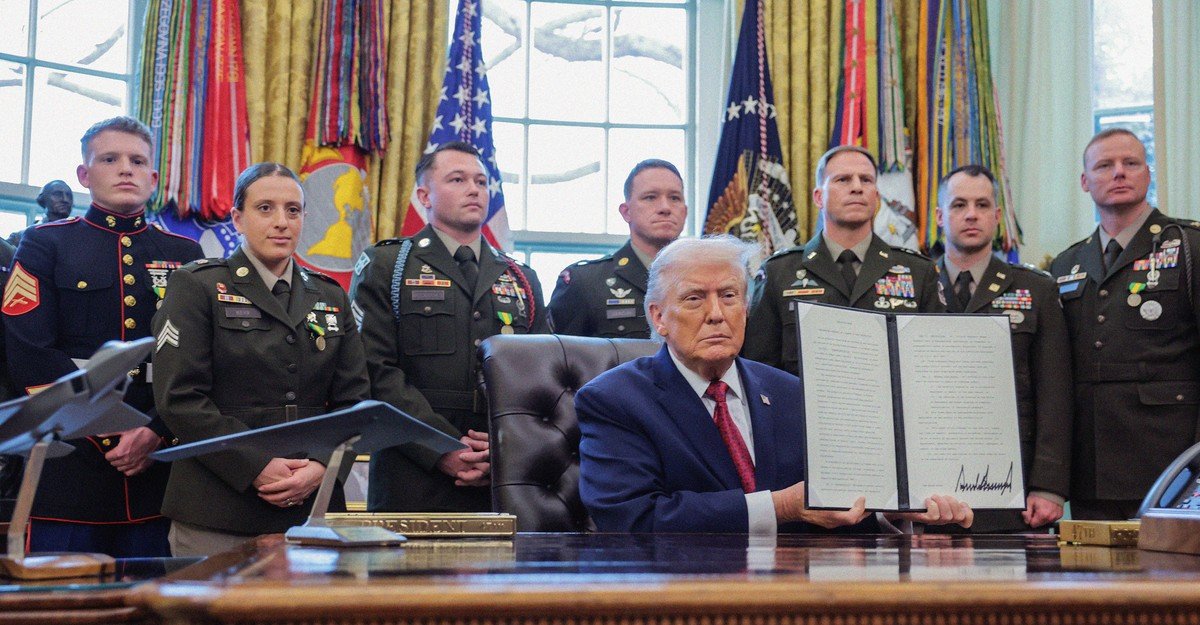
For months, President Donald Trump’s crusade against the drug trade has carried the threat of violence: “I think we’re just going to kill people that are bringing drugs into our country,” he said in October. Yesterday, hours before his administration announced that the United States had conducted three more strikes on alleged drug boats, he designated fentanyl as a weapon of mass destruction—a move that could help him further justify the deadly conflict.
Under U.S. law, the definition of a WMD is broad enough to encompass incendiary bombs, rockets, grenades, biological agents, toxins, and other weapons that “can have a large-scale impact on people, property, or infrastructure.” Lawmakers have pushed to classify fentanyl as a WMD in the past; the drug belongs to the category of synthetic opioids, which accounted for roughly 48,000 deaths in the U.S. last year (approximately 60 percent of all overdose deaths). The idea was discussed and eventually abandoned during Trump’s first term and under Joe Biden—but ongoing military activity in the Caribbean and political tensions with Venezuela may have given Trump a reason to reverse course.
On his first day of his second term in office, Trump signed an executive order designating certain drug cartels as terrorist organizations. And since early September, the U.S. has launched 25 known attacks against boats that officials have claimed were carrying illicit drugs; at least 95 people have been killed, and at least one strike may have been a war crime. “Killing cartel members who poison our fellow citizens is the highest and best use of our military,” Vice President J. D. Vance wrote after the strikes began. “Every boat kills 25,000 on average—some people say more,” Trump said in September. “These boats, they’re stacked up with bags of white powder that’s mostly fentanyl and other drugs, too.” Never mind that some of the slain may not have worked for cartels, or that no evidence of fentanyl has been found on these boats: Cocaine and marijuana, not fentanyl, represent the majority of drugs intercepted on the high seas.
Yesterday’s reclassification of fentanyl may not grant the president special power to authorize new military activity, or to unilaterally declare war. But it is a rhetorical escalation that reaffirms this administration’s posture in the armed conflict that’s already under way. Similar to how WMDs were used as a pretext for the Iraq War, Trump is “using that same language, that same authority to be able to do what he wants,” Christopher Sabatini, a senior research fellow at the think tank Chatham House, told me. It’s a “public relations” tactic, according to Regina LaBelle, a professor of addiction policy at Georgetown University. The reclassification may be playing on the public’s understanding of WMDs as a global, existential threat: the kind of thing a country could go to war over.
In apparent contravention of Trump’s campaign promise to extract the country from foreign conflicts, the U.S. has mounted a large-scale military buildup off the coast of Venezuela. An estimated 10,000 troops and 6,000 sailors are now deployed on Navy warships, including an aircraft carrier. Last week, the U.S. seized a Venezuelan oil tanker. Trump said on Friday that he will be “starting” land strikes on drug operations in Latin American countries, Venezuela among them, although he hasn’t said when. And he has explicitly threatened Venezuela’s autocratic leader, President Nicolás Maduro: When asked last week whether he’d push for regime change, Trump said that Maduro’s “days are numbered.”
The new designation for fentanyl was “part of trying to put forward some sort of justification for taking military action,” Paul Poast, a University of Chicago political-science professor, told me. But if that justification was aimed in part at Venezuela, as some experts have suggested, it’s not a very good one. The illicit fentanyl now flooding the U.S. doesn’t come here through Venezuela; most of it is manufactured in Mexico. The fact that Venezuela wasn’t explicitly invoked in yesterday’s announcement could also indicate that the executive order is a “signal that’s being sent to governments and transnational criminals in Latin America to watch out—you could be next,” Sabatini said.
Perhaps a bigger problem with the classification of fentanyl as a WMD is that unlike, say, sarin gas, it is not actually being used as a weapon. Although a chemical can be a WMD, “the vast majority of time when Americans die because of a fentanyl overdose, it was not an intentional outcome,” Jonathan Caulkins, a policy professor at Carnegie Mellon, explained. Fentanyl has been used as a weapon at least once: During the Moscow-theater hostage crisis in 2002, Russian Spetsnaz commandos deployed fentanyl in gas form, killing the Chechan terrorists and many of the hostages too. But just because the drug can be deadly on a large scale doesn’t necessarily mean it is a WMD. “We don’t use that term for cigarettes, bullets, cars,” Caulkins said—each of which also causes tens of thousands of deaths every year.
Although the WMD designation may not have immediate legal implications for Trump’s military powers, it could potentially change how domestic drug cases are prosecuted. The use of a WMD against people or property in the U.S. carries a maximum sentence of life in prison; if someone dies, prosecutors can argue for the death penalty. According to research co-authored by LaBelle, that could impose “a life sentence on any person who uses drugs laced with illicitly manufactured fentanyl, or anyone who gives drugs laced with illicitly manufactured fentanyl to their friend.” As of now, the Trump administration has offered no guidance on how this might play out.
Although the reclassification of fentanyl reinforces Trump’s position against drug trafficking, it may not do much on its own to solve the opioid crisis. Overdose deaths have been declining in the U.S. since before Trump took office, long before the boat strikes began. Many theories have been proposed as to why—but the escalation of armed conflict isn’t one of them.
Related:
Here are three new stories from The Atlantic:
Today’s News
- The U.S. unemployment rate rose to 4.6 percent last month, its highest since September 2021, even as the economy added 64,000 jobs.
- Susie Wiles, President Donald Trump’s chief of staff, gave more than 10 interviews to Vanity Fair, during which she said Trump “has an alcoholic’s personality” and that some of his actions could appear retaliatory. After two articles about the interviews were published today, Wiles called them a “disingenuously framed hit piece.”
- California prosecutors will file two counts of first-degree murder against Nick Reiner in the stabbing deaths of his parents, Rob Reiner and Michele Singer Reiner, an official said. Reiner, who was arrested Sunday and is being held without bail, was not medically cleared to appear in court, according to his attorney.
Evening Read
Bill Tompkins / Getty
The Savage Empathy of the Mosh Pit
By James Parker
Hot autumn night has fallen over Worcester, Massachusetts, over the huge, baked asphalt lot behind the Palladium, the ancestral seat of the Northeast’s heavy-metal kingdom. This is the New England Metal and Hardcore Festival, 25 bands on three stages, 10 unbroken hours of heavy music, and all day, I’ve been watching the pit—the mosh pit, the area close to the stage where inflamed dancers whirl and collide. I’ve been watching it, and skulking around it journalistically, because I am possessed by an idea: What if the pit, this ritualized maelstrom at the heart of the hardcore-metal crowd, could teach us something about how to live together in 2025—about how to be?
Read the full article.
More From The Atlantic
Culture Break
Illustration by Paul Spella / The Atlantic. Source: Todd Owyoung / NBC / Getty.
Explore. Confessional outbursts after a failed relationship have a long history—and some people do them better than others, Anna Holmes writes.
Read. Dara T. Mathis writes about what people don’t understand about Black nationalism.
Play our daily crossword.
Explore all of our newsletters here.
Rafaela Jinich contributed to this newsletter.
When you buy a book using a link in this newsletter, we receive a commission. Thank you for supporting The Atlantic.
