

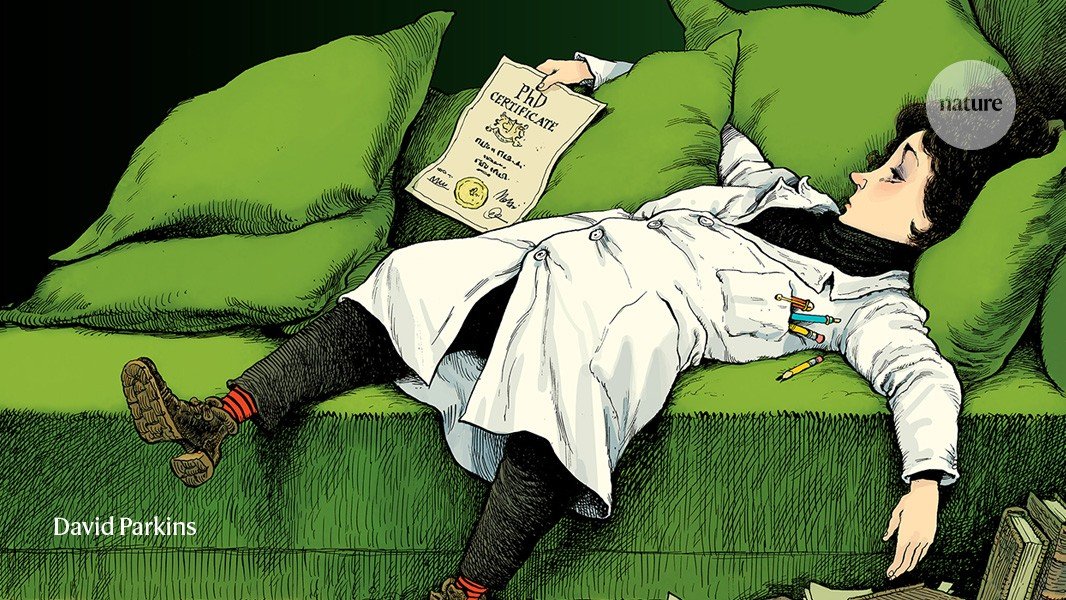
Illustration: David Parkins
The problem
Dear Nature,
In December 2024, I finished my PhD in biomedical chemistry in Italy, and I now find myself in that all-too-familiar early-career crisis, struggling to work out what to do next.
Research is important to me as a way to contribute meaningfully to a better, healthier world. But I have other life goals, such as becoming financially stable and starting a family, that seem incompatible with the reality of academic life. The cost of living is rising everywhere, and early-career research jobs come with low pay and short contracts.
Trying to transition out of academia brings its own frustrations. After years of dedication, I’m treated by those hiring in industry as if I have no real work experience. It feels like starting from zero again.
Is this early-career crisis an inevitable part of life after a PhD? How do I navigate a career when my goals and values conflict? Does my passion for research have to be all-consuming? Do I have to choose between research and a reasonable work–life balance? — A melancholy chemist
The advice
You’re not alone. These are big questions, echoed by newly minted PhD graduates around the world. This is a notoriously challenging time in the career of any young scientist, and it doesn’t mean you’re failing if you’re struggling. Nature’s careers team sought advice from three researchers on how to resolve your problem.
Peter Hanenberg, vice-rector for research and innovation at the Catholic University of Portugal in Lisbon, says: “The first step is to recognize that this crisis is something which comes with what it is to be a researcher. An academic career is, to a certain point, a matter of passion, which means it might not be just a job. But the balance should be healthy.”
When she completed her neuroscience PhD at Pompeu Fabra University in Barcelona, Spain, last year, Maria del Mar Cajiao Manrique knew that she didn’t want to continue in academia, but she didn’t have a clear idea of the alternatives.
“From the time we start university,” she says, “we are shown there’s only one path: bachelor, master, PhD, postdoc, and then more postdocs until you become a principal investigator. It becomes internalized. If someone doesn’t feel like they fit that one path, that’s when they start having this existential crisis: What is it that I’m good at? Have I wasted the past four years on this PhD?”
Cajiao Manrique took a three-month contract as a visiting researcher at the Icahn School of Medicine in New York City, then found a position as a medical writer in August this year. She says that going to talks at other research institutions and connecting with PhD holders who have been in similar situations has helped her to broaden her perspective and discover fresh possibilities.
An ‘agony aunt’ for working scientists
Lynn McAlpine, whose higher-education research at the University of Oxford, UK, focuses on PhD and post-PhD career trajectories, points out that research career paths are not as straightforward as they once were. “Now we see a shift to what we’re calling self-authored careers,” she says, “where people have to take more responsibility for figuring out what they want, what kinds of jobs there are, and find ways to integrate their life–career goals.”
McAlpine has investigated how researchers navigate their careers and personal lives after finishing their doctorates. She observed that personal life aims, such as the desire to live close to a partner, have children and achieve financial security, tend to have greater influence in shaping career paths in the long term than do professional aims — such as reaching for a prestigious job title or a dream research project.
“There are myriad factors coming into play in the life journey of early-career researchers,” says McAlpine. Your priorities and your opportunities will be affected by variables such as location, age, international mobility and personal values.
Sometimes, she says, people seek academic careers, but realize that what they really love is the academic environment. “So maybe they find a job in academia — not as a professor, but working in a museum or university archives, or as a communications officer in a research centre.”
One PhD holder, interviewed as part of McAlpine’s research, wanted to relocate with her partner, who was also an academic, but she knew that it would be difficult for both of them to get posts in the same place. “When she got a postdoc in another country, they both moved there, and he took a professional position working in the university museums as a curator. There, he could apply his academic knowledge — until they moved again.”
Perseverance
McAlpine points to perseverance as a crucial skill from a PhD programme that can be applied at the job-seeking stage. Getting a job is itself a job, she says. In her observations, whether they were looking for an industry job or an academic grant, “the people who were most successful just kept applying. They weren’t put off by not getting an answer or getting a no.” In other words, “it’s a race against your own frustration”, says Cajiao Manrique. After her PhD, she spent months applying for jobs. “I was sitting at my desk nine to five. I sent over 1,000 job applications.” She estimates that she received a response for only about one in every 50 that she sent.
Then, Cajiao Manrique went on LinkedIn and started finding communities of PhD graduates who were dealing with the same issues. Through these connections, she learned that her CV was probably being discarded by AI tools. After more research and more conversations, she rewrote her CV to make it ‘industry-ready’, focusing on results rather than technicalities. For example, she changed “performed in vivo experiments to assess A using technique B” to “planned, managed and performed more than X studies, leading a team of Y people, which resulted in the publication of article Z”.
