

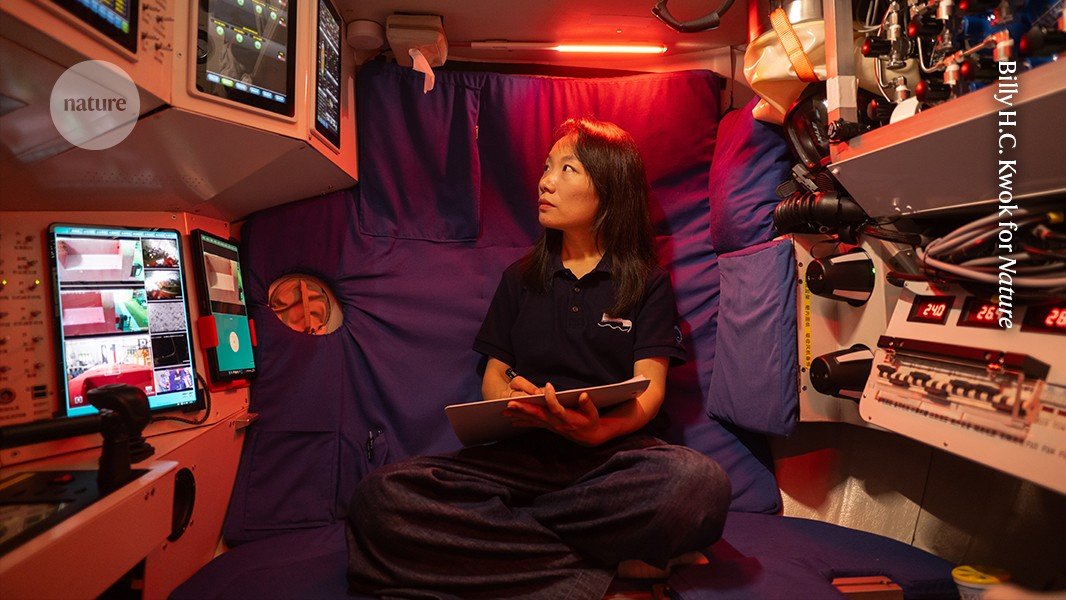
Geoscientist Mengran Du and her team reported the deepest ecosystem known to host animals this year.Credit: Billy H.C. Kwok for Nature
A year of chaos. That is how many researchers in the United States, at least, will remember 2025. Cuts to federal funding and the federal workforce, political threats to US universities, an immigration crackdown and the country’s withdrawal from global organizations have stymied research in many fields and reshaped, probably for decades to come, the landscape of the world’s leading sponsor of science. Throughout the world, financial pressures, political interference and rising nationalist sentiment have put increased strain on a scientific enterprise that thrives on independence, openness and diversity, as Nature’s special series on the future of universities has reported over the past few months.
Yet there remains much to celebrate — which is made plain in the stories of the scientists and innovators profiled in this year’s Nature’s 10, a selection of ten people who shaped the research landscape in 2025.
Nature’s 10: Ten people who shaped science in 2025
Some stood up for scientific values, such as Susan Monarez, who was fired after a brief tenure as head of the US Centers for Disease Control and Prevention, during which time she was asked to pre-approve vaccine recommendations without considering the relevant data.
Others kept the flame of multilateralism and evidence-based policymaking burning. In a year of rising tensions and unresolved conflicts, the agreement of the world’s first pandemic treaty in April was a bright spot. Some details still need to be hammered out, but representatives of the 190-odd nations that are members of the World Health Organization — with the exception of the United States, which withdrew from the treaty negotiations in January — managed to forge an agreement on how humanity should prevent and prepare for future pandemics. Negotiations leader Precious Matsoso, a former director-general of South Africa’s health department, describes the gruelling process, and how persistence, humour and a constructive approach paid off.
Grant cuts, arrests, lay-offs: Trump made 2025 a tumultuous year for science
And several feed humanity’s insatiable thirst for knowledge. In 2025, geoscientist and diver Mengran Du at the Chinese Academy of Sciences’ Institute of Deep-sea Science and Engineering in Sanya and her colleagues reported the deepest ecosystem known to host animals, in an underwater trench northeast of Japan1. This chemosynthetic ecosystem derives its energy from methane and other compounds that seep up from the ocean floor — in contrast to most life, which depends on sunlight and the process of photosynthesis. There is still much about our planet that we don’t understand, but a thriving global enterprise of science can uncover its mysteries.
Reflecting that, seven of this year’s profiles are of individuals outside the United States. Among them is entrepreneur Liang Wenfeng in Hangzhou, China, whose company created the country’s home-grown artificial-intelligence model DeepSeek-R1. The breakneck speed of developments in AI — with all its benefits and risks — was another key story of this year. DeepSeek stunned the world with a model that had capabilities on a par with the best tools designed by more established technology firms, yet made for a fraction of the cost and with unusual openness. In September, the model became the first major AI tool to be scrutinized by peer review, with the results published in this journal2.
Transformative science can transform lives. Entomologist Luciano Moreira established a company in Curitiba, Brazil, that infects Aedes aegypti mosquitoes with a bacterium called Wolbachia, curbing the insects’ ability to transmit human pathogens. Moreira helped to persuade the government to use the approach to combat the mosquito-borne disease dengue, which killed some 6,300 people in Brazilian cities last year.
The future of universities
And, in Israel, systems biologist Yifat Merbl at the Weizmann Institute of Science in Rehovot and her team reported that a piece of cellular machinery — the proteasome, which chops up proteins into smaller peptide fragments — has a role in immunity3. They found that many of these peptides have antimicrobial properties and that cells use them as a first line of defence against bacteria.
Besides being at the cutting edge of their fields, Moreira and Merbl share something else: they both studied in the United States before returning home. Their stories are a reminder of the unique part the country has played in recent decades in supporting science around the world, as it has nurtured its own research — a win–win for the nation and the world. That network now seems at risk as an immigration crackdown makes it more difficult, more expensive and less attractive for researchers globally to study and work not just in the United States, but in other countries, such as the United Kingdom, Australia and Canada, too.
The individuals who feature in Nature’s 10, and their breakthroughs, showcase the ongoing strength of science globally: its ability to transcend national borders and nurture collaboration, and its power to save and improve lives, satisfy curiosity and spark innovation. They also serve as a reminder of what is lost when governments cease to follow the evidence, stop funding excellent science and fail to nurture the international collaborative spirit that creates the breakthroughs that make the world a better place for all.
