

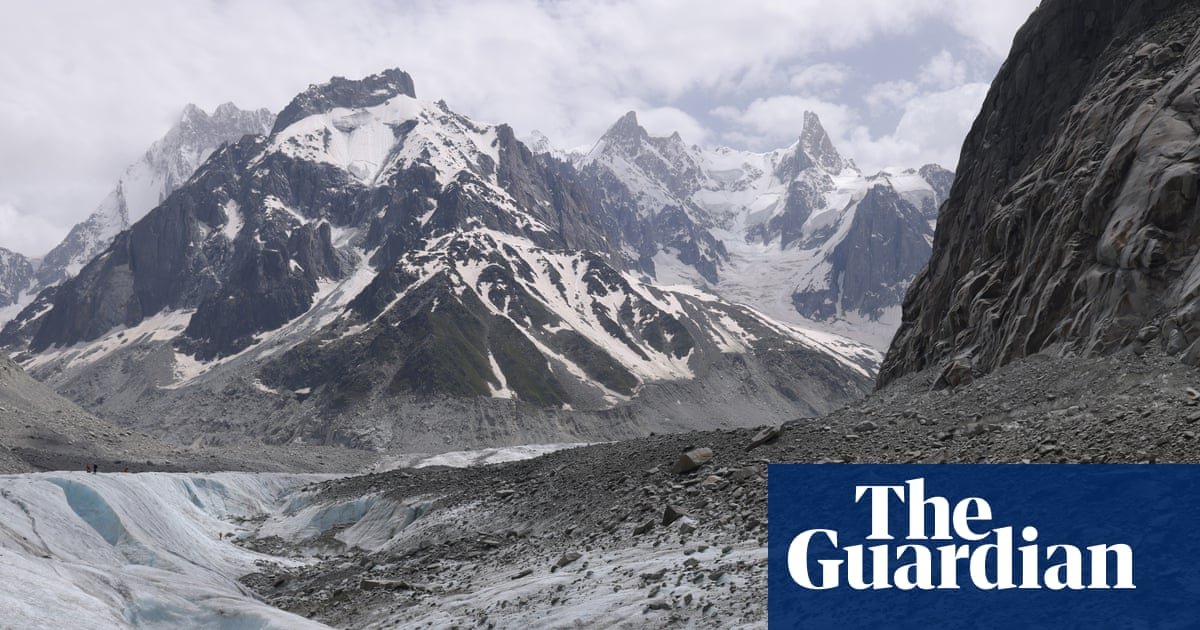
Glaciers in the European Alps are likely to reach their peak rate of extinction in only eight years, according to a study, with more than 100 due to melt away permanently by 2033. Glaciers in the western US and Canada are forecast to reach their peak year of loss less than a decade later, with more than 800 disappearing each year by then.
The melting of glaciers driven by human-caused global heating is one of the clearest signs of the climate crisis. Communities around the world have already held funeral ceremonies for lost glaciers, and a Global Glacier Casualty List records the names and histories of those that have vanished.
About 200,000 glaciers remain worldwide, with about 750 disappearing each year. However, the research indicates this pace will accelerate rapidly as emissions from burning fossil fuels continue to be released into the atmosphere.
Current climate action plans from governments are forecast to push global temperatures to about 2.7C above preindustrial levels, supercharging extreme weather. Under this scenario, glacier losses would peak at about 3,000 a year in 2040 and plateau at that rate until 2060. By the end of the century, 80% of today’s glaciers will have gone.
glacier extinction graphic
By contrast, rapid cuts to carbon emissions to keep global temperature rise to 1.5C would cap annual losses at about 2,000 a year in 2040, after which the rate would decline.
Glacier collapses, burying evacuated Swiss village in mud and rocks – video
Previous studies have focused on the volume of ice lost, given its contribution to rising sea levels that threaten coastal towns and cities. Individual glaciers, however, are also important as water sources and tourist attractions for many communities, and often have spiritual significance for local people. This prompted the researchers to analyse the number of glaciers disappearing.
Matthias Huss, a senior scientist at ETH Zurich in Switzerland and a member of the study team, said: “As glaciologists, we do not only model the disappearance of glaciers globally, but we are very directly concerned with this loss of glaciers in our daily work.”
As the director of the Swiss glacier monitoring network, Huss recently declared four extinct, the latest in an estimated 1,000 lost in the country over the past three decades.
Huss also spoke at a funeral ceremony for the Pizol glacier in 2019. “More than 250 people climbed up to this glacier to say goodbye. It was very impressive.”
Such funerals have also taken place in Iceland, Nepal and elsewhere. “People climb up to these vanishing glaciers to say goodbye for themselves, but also to send out a strong signal to the public to tell them it matters to us.”
The Kā Roimata o Hine Hukatere in New Zealand is experiencing substantial ice loss. Photograph: Jon Bower New Zealand/Alamy
Many glaciers hold spiritual significance, for example Māori culture regard them as ancestors. The Māori political leader Nā Lisa Tumahai visited the melting Kā Roimata o Hine Hukatere in 2022 and told the Global Glacier Casualty List: “This mighty glacier, a presence once so physically commanding, is shrinking into oblivion. [It] has been subdued, humiliated by the actions of humans.
“To see this retreating giant is to understand impermanence, to understand the real and terrible results of industrialisation, of climate change.”
The new study, published in Nature Climate Change, analysed more than 200,000 glaciers from a database of outlines derived from satellite images. The researchers used three global glacier models to assess their fate under different heating scenarios.
Regions with the smallest and fastest-melting glaciers were found to be the most vulnerable. The study estimates the 3,200 glaciers in central Europe would shrink by 87% by 2100 – even if global temperature rise is limited to 1.5C, rising to 97% under 2.7C of heating.
The towering Dawes glacier carves into the Endicott Arm fjord in Alaska, where glaciers are melting at a record pace. Photograph: VW Pics/Universal Images Group/Getty Images
In the western US and Canada, including Alaska, about 70% of today’s 45,000 glaciers are projected to vanish under 1.5C of heating, and more than 90% under 2.7C. The Caucasus and southern Andes are also expected to face devastating losses.
Larger glaciers take longer to melt, with those in Greenland reaching their peak extinction rate in about 2063 – losing 40% by 2100 under 1.5C of heating and 59% under 2.7C. However, the melting is forecast to continue beyond 2100.
The researchers said the peak loss dates represent more than a numerical milestone. “They mark turning points with profound implications for ecosystems, water resources and cultural heritage,” they wrote. “[It is] a human story of vanishing landscapes, fading traditions and disrupted daily routines.”
Glacier melt in Antarctica threatens sea levels. Photograph: Anadolu/Getty Images
These transitions also underscored the urgent need to help communities adapt to changing conditions, they said, with 2 billion people downstream reliant on mountain water for regular supplies and food security. Adaptation measures could include new types of farming, alternative businesses to replace tourism and even artificial glaciers, which have been trialled in Kyrgyzstan.
Dr Arun Bhakta Shrestha, a senior adviser at the International Centre for Integrated Mountain Development and not part of the study, said: “[The study] underscores how today’s climate decisions will profoundly influence the future of these vital natural features.”
Shrestha said the work offered a valuable perspective on the rapid changes occurring in glacier landscapes and the people that depend on them, while noting some limitations, including uncertainty in counting small and debris-covered glaciers and the lack of up-to-date data.
