

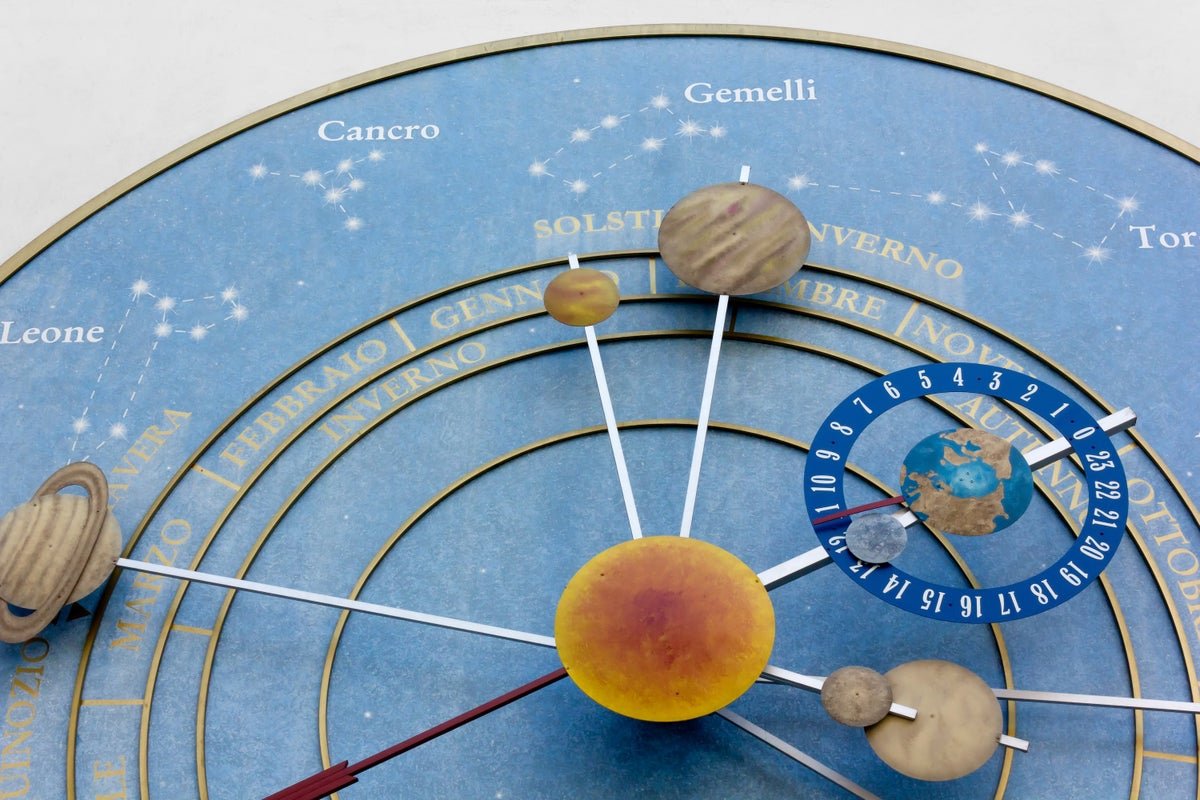
You know how it goes: You’re trying to get some shut-eye in your bunk after a long shift of scraping samples of prebiotic material from red rocks in Utopia Planitia, and before you know it, your alarm bell rings. And then you see it woke you up a full 477 microseconds early!
Life on Mars is tough. Figuring out the exact time isn’t much easier.
Even on the larger end of the timescale, Martian chronometry is not exactly simple; the planet takes about 687 Earth days to go around the sun, making calendrical coordination with Earth pretty hairy. It also spins on its axis—completing one Mars day—in 24 hours, 39 minutes and 35 seconds (to distinguish this period from an Earth day, we call it a “sol,” referencing the Latin word for the sun). Keeping track of your schedule on Mars would be different than doing so on Earth. But still, at its core, it would just be a matter of conversion.
On supporting science journalism
If you’re enjoying this article, consider supporting our award-winning journalism by subscribing. By purchasing a subscription you are helping to ensure the future of impactful stories about the discoveries and ideas shaping our world today.
Building an accurate Martian clock, on the other hand, can be very tricky, depending on how accurate you want it to be. When you start to slice time into smaller and smaller bits, the problem concerns not only engineering but also fundamental physics. That’s because the flow of time on milli- and microsecond scales is affected by relativity, gravity and orbital mechanics, which can vary radically from world to world.
The good news is that a pair of physicists did all the associated mathematical heavy lifting for Mars and published their results on December 1 in the Astronomical Journal. With their help, we can fine-tune our Martian timepieces.
It was Albert Einstein who really first got this ball rolling. Among many other things that emerged from his special theory of relativity, he postulated that time does not necessarily flow the same for two independent objects. The most commonly used example of this is how a clock runs more slowly when it is moving relative to an observer. The effect is pretty small until that motion nears the speed of light, whereupon it can get very large.
But there’s another twist to relativity: besides relative motion, gravity affects time’s flow as well! The stronger the gravity, the slower a clock will tick relative to some observer far away, where the gravitational effects are weaker. Both of these phenomena can affect us on Earth: GPS satellites, for example, orbit far above Earth, where gravity is weaker, so their clocks run faster than those on the surface. But the satellites’ rapid orbital motion also slows their clocks. Combined, these effects cause their clocks to tick about 38 microseconds faster than ones on the ground. This profoundly affects their accuracy in mapping, throwing them off by about 10 kilometers per day. Think about how angry you’d be if your smartphone’s map app was off by a kilometer or so after only a half hour of use. Happily, GPS takes all this into account, so the positional accuracy it calculates is pretty high. But this situation just shows how important relativity can be.
What does this have to do with the Red Planet? Well, for one thing, while Mars is a rocky world like our own, it’s much smaller, about a tenth the mass of Earth. Its surface gravity is some three times less than what we feel at home. So on Mars, I’d only weigh about 65 pounds (29 kilograms)! I bet my knees and back would feel a lot better about that.
But this also means a clock on Mars feels less gravity than one on Earth, so it will run faster. And unfortunately, plugging this into Einstein’s equations to calculate that advancement is no easy task.
First, you have to define what the average surface of Mars is. After all, if you’re on a mountain, you’re farther up from the average elevation than you’d be if you were in a valley, where you’d feel a different amount of gravitational force.
But you can’t just average between the highest peaks and lowest valleys to arrive at some clear median. Oh, no. Just as a world can have varying surface elevation, it can also have a varying subsurface composition, with some regions being denser (and thus having greater local gravity) than others. Still, factoring this in alongside things like a global rotation rate and the influence of any massive orbiting moons, it’s possible (though difficult) to determine the average surface for any given world.
We did this properly for Earth in the late 20th century—and thanks to our extensive robotic orbital reconnaissance, we’ve done it more recently for Mars, too. Once calculated, Mars’s average surface can be used to gauge gravity’s influence on clocks anywhere on the planet.
But that’s not all. Mars orbits the sun farther out than Earth does, and this has two effects: The solar gravity the Red Planet feels is reduced, so its clocks will run faster than Earth’s. Plus, it orbits the sun more slowly relative to Earth, so its clocks will run faster still.
Even worse, the orbit of Mars is elliptical (think of a slight oval rather than a perfect circle), which means that sometimes the planet is closer to the sun than average (so it orbits more quickly, and the clocks slow) and that sometimes it’s farther out (so it orbits more slowly, and the clocks run faster).
The equations covering all this are fierce, to say the least. After some serious numerical plugging and computational chugging, however, scientists found that, on average, a clock on Mars will run about 477.6 microseconds faster per day than a clock on Earth. But that’s really on average! The change in orbital distance and motion applies a variation of about plus or minus 113 microseconds over the course of a Martian year, which means clocks there can run ahead of Earth’s anywhere between 364 to 590 microseconds per day.
That’s not much, in everyday terms. A typical human blink has a duration of about 165 milliseconds, which is more than 300 times longer than the Martian clock offset! So this won’t affect your daily sol, but scientists routinely need to measure times much faster than this. Like GPS on Earth, there would be effects taken for granted by any future planetary explorers; for example, synchronizing earthly and Martian Internet connections would require this relativistic correction. And if we ever need to build a robust GPS for Mars, a variation on these calculations will have to be applied as well, lest any users on the ground get lost in the red dust.
At some point—maybe not soon but someday—humans may live on Mars and will need to sync their clocks to those on Earth. By then, that shouldn’t be too hard—relatively speaking.
