

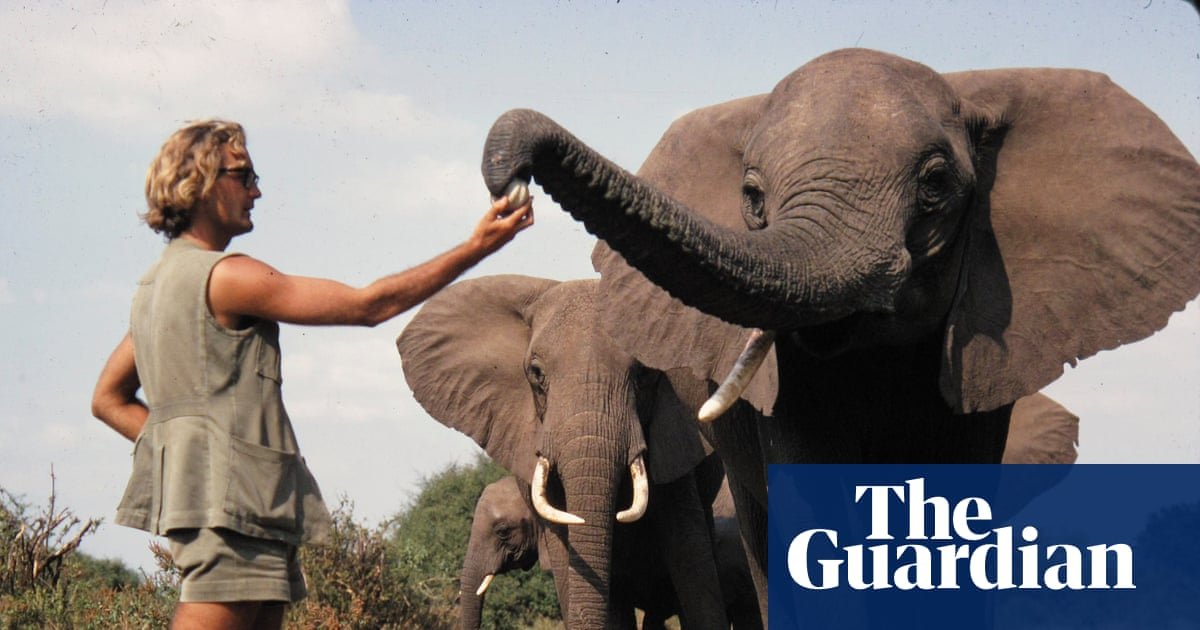
The British scientist Iain Douglas-Hamilton, who has died aged 83, became the world’s leading authority on the behaviour of African elephants and played a vital part in ensuring their conservation.
His efforts to save the African elephant began in 1965 when, as an Oxford zoology graduate who had also just received his pilot’s licence, he flew his Piper Pacer bush plane from Nairobi down to Tanzania’s pocket-sized Lake Manyara national park. The challenge he had accepted at the age of 23 was how to solve the problem of 450 elephants confined in a space too small to support them.
For five years, having built a camp in an area renowned for its tree-climbing lions, he lived among Manyara’s elephants, first teaching himself to recognise them as individuals in order to make the first systematic study of their behaviour in the wild.
He was utterly fearless, a quality that stood him in good stead, as his work was not without risks. Often he was forced to climb trees to avoid being killed by angry elephants, such as the formidable matriarch he called Boadicea, and on three occasions his Land Rover was skewered by their tusks. But eventually they came to accept him, while remaining truly wild.
It was also during his sojourn in Manyara that Oria Rocco came to visit him from her family’s farm on the shores of Lake Naivasha in Kenya. Oria not only fell in love with Manyara and its elephants – she stayed and married the dashing young scientist in 1971 and they had two daughters, Saba and Dudu. The story of their early years together, Among the Elephants (1975), which became a bestseller, was illustrated by Oria’s superb photographs – including a picture of her introducing Saba as a babe in arms to a wild cow elephant and its calf.
Having become the first scientist to study the elephants’ social interactions, Iain came to believe that understanding their seasonal migratory movements was the key to their conservation. But the growing menace of ivory poaching soon caused him to devote the rest of his life to staunching the flow of tusks that was bleeding Africa dry.
Douglas-Hamilton, founder of Save the Elephants, at the Kenya Wildlife Training School in 2011, as confiscated ivory is burnt. Photograph: Sayyid Azim/AP
Although elephant poaching had been endemic in Africa, the price of ivory had remained stable until 1969, but then suddenly took off as tusks became a commodity, to be stored and traded like gold. This proved disastrous for Africa’s great elephant herds, and Kenya became the first country to feel the full effect of the ivory price hike as the shifta – Somali poachers armed with semi-automatic weapons – swept down into Tsavo national park, the country’s biggest elephant stronghold.
I first met Iain in the late 1970s and it was at his insistence that I went to Tsavo in 1988 to report for the Sunday Times on what became known as the ivory wars. By then, the poaching scourge had already spread far beyond Kenya, reaching into every corner of the elephants’ range and reducing their numbers from 1.3m to 600,000 in a decade.“Make no mistake,” he declared. “What we are witnessing is the greatest animal tragedy of this century.”
To prove his point he had begun carrying out pan-African aerial surveys that revealed the extent of the crisis for the first time. In 1980 he was made honorary chief warden in Uganda, where he introduced air and ground patrols against Sudanese poachers who sometimes shot at his plane, and in 1988 he was awarded the Order of the Golden Ark by Prince Bernhard of the Netherlands for alerting the world to the sheer scale of the elephant killing. He was appointed CBE in 2015.
It emerged that 90% of all ivory stocks had been obtained illegally, and in July 1989, the Kenyan president Daniel arap Moi publicly torched a 12-tonne pyre of tusks worth $6m. So powerful was the case put forward by Iain and his fellow conservationists that Cites (the Convention on International Trade in Endangered Species) was compelled to ban the international trade in ivory in 1990. The full story is told in Battle for the Elephants (1992), written by Iain and Oria.
Douglas-Hamilton fits a GPS collar on to an elephant in Meru national park, 1998. Photograph: Jean-Marc Bouju/AP
Although the ban did not put a complete end to poaching, it bought Africa’s dwindling elephant herds a precious reprieve, a time in which their numbers might increase again, and to this end in 1993 Iain moved to Samburu national park in northern Kenya and founded Save the Elephants, a conservation charity working to secure a future for the species by enabling them to coexist alongside local communities. There he pioneered techniques of tracking collared elephants by satellite, an invaluable tool to increase their protection and avoid possible conflicts with people.
Born in Donhead St Andrew, Wiltshire, Iain was the son of Lord David Douglas-Hamilton, who had commanded a Spitfire squadron during the second world war and was killed in a crash in 1944, and Prunella Stack, the head of the Women’s League for Health and Beauty, a fitness organisation founded by her mother in the 1930s. He was educated at Gordonstoun school in Scotland and Oriel College, Oxford, where he gained a BSc in biology and a DPhil in zoology before realising his childhood dream of moving to Kenya.
In 2008 Iain almost came to grief at Samburu when he was charged by a cow elephant that then tried to impale him as he lay on the ground. Somehow he emerged unscathed, with little damage except for a broken pair of spectacles. In the event it was not elephants that ended his life but a swarm of bees, which attacked him while he was walking back to his home at Naivasha. He was flown to Cape Town for treatment but never recovered.
He is survived by Oria, Saba and Dudu, and six grandchildren, Bundi, Selkie, Mayan, Luna, Cosimo and Luca.
Iain Douglas-Hamilton, zoologist and conservationist, born 16 August 1942; died 8 December 2025
