

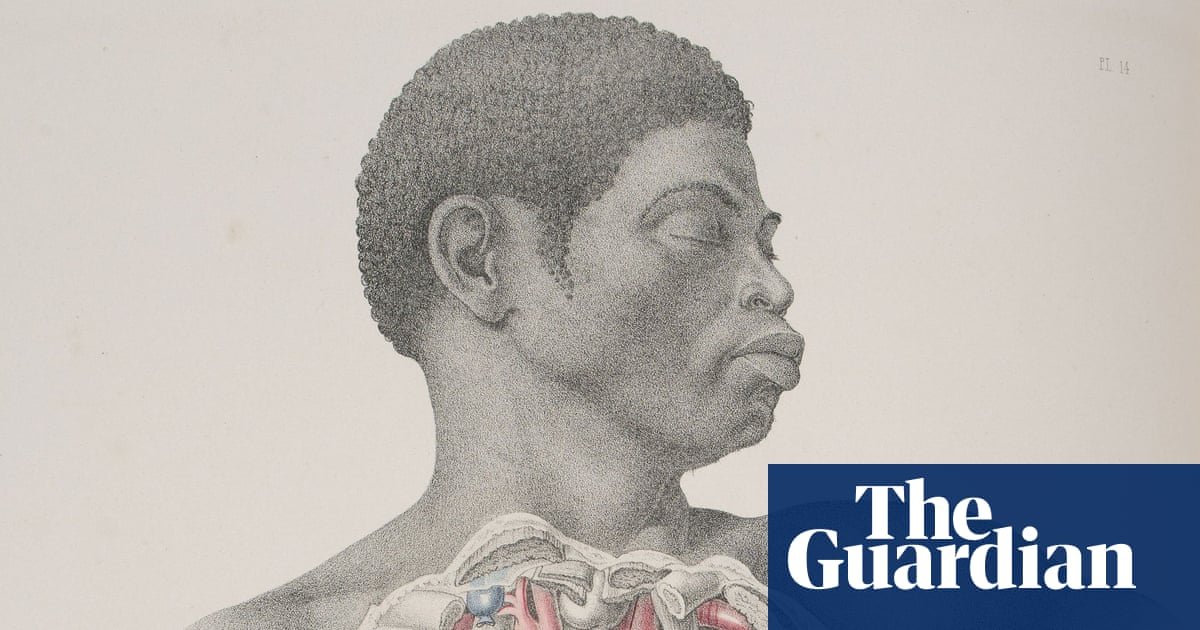
It is an image of an unnamed black man with his eyes closed and his innards exposed. Drawn with care and precision, the image may be the only anatomical drawing of a black body made during the Victorian age.
Now it is part of a new exhibition that focuses on the work of Joseph Maclise, a surgeon and artist whose work – including his 1851 atlas Surgical Anatomy – made the human anatomy accessible to the general public, and who was the brother of the celebrated artist Daniel Maclise.
Jack Gann, the curator at Thackray Museum of Medicine in Leeds, which is hosting the Beneath the Sheets: Anatomy, Art and Power exhibition, says Joseph Maclise’s work also broke new ground by centring black bodies and focusing on queer desire.
The portrait of the black man featured in Surgical Anatomy, which sold widely. But when the book was published in the US that image was the only one omitted, with racial prejudice and segregationist attitudes in the lead-up to the American civil war blamed for the decision.
Maclise used living models from the streets of London and Paris to create his drawings, combining their figures – often idealised visions of the human body – with dissections of corpses taken from the morgues of the French capital.
Maclise used living models from the streets of London and Paris, combined with dissections of corpses, to create his drawings. Illustration: Mark Newton Photography
His drawings were intricate and delicate, often homing in on small details that other artists might have avoided. “He drew little scars or blemishes,” says Gann. “One of them has an ear piercing, they aren’t like Greek gods.”
The artist also consistently drew the genitalia of his subjects, even when the drawing concerned another part of the body. “He drew these beautiful portraits and lavished attention on the body far beyond the bits that the anatomist needed to show,” says Gann.
The American medical historian Michael Sappol describes Maclise’s work as “a catalogue of irrelevant penises” and that recurring feature has led to speculation about Maclise’s sexuality.
Although there is no evidence to confirm it, Gann says some believe Maclise was gay and that the drawings doubled as erotica. “He never left any real records of his personal life – he never wrote letters or diaries and he never married,” Gann adds. “The story is most clearly told by just looking at the pictures and coming face to face with that sensuality.”
Maclise’s drawings were intricate and delicate, often homing in on small details that other artists might have avoided. Illustration: Mark Newton Photography
Sappol argues in his book Queer Anatomies that Maclise’s images are part of a “lost archive of queer expression”, alongside the work of artists including the French anatomist and painter Jacques Fabien Gautier d’Agoty and the English surgeon William Cheselden.
Ultimately, Maclise’s work was eclipsed by the popularity ofGray’s Anatomy, which was much more accessible and cheaper. But his work has continued to fascinate: one of his illustrations was used to promote the National Theatre’s production of Frankenstein in 2011.
Female bodies also feature in the exhibition, including the case of Mary Paterson, whose body was sold for medical study after she was a victim of Burke and Hare, the most notorious serial killers in Scottish history. She is described by the Thackray as “a posthumous object of anatomical fascination, medical men marvelled at her preserved beauty, raising troubling questions about class, violence and the male gaze”.
Drawing of Mary Paterson, taken from William Roughead’s Trials of Burke and Hare, 1948. Illustration: Thackray Museum of Medicine
Charles Estienne’s 1545 book, De Dissectione Partium Corporis Humani Libri Tres, with images that were essentially collages, or “body parts stitched together like Frankenstein’s creation from sketches of many dissections”, also features.
As does Andreas Vesalius, whose 1543 De Humani Corporis Fabrica publication was the first major work to show human anatomy drawn directly from dissected bodies.
Beneath the Sheets: Anatomy, Art and Power at the Thackray Museum of Medicine in Leeds opens on 7 February 2026 and runs until 27 June.
