

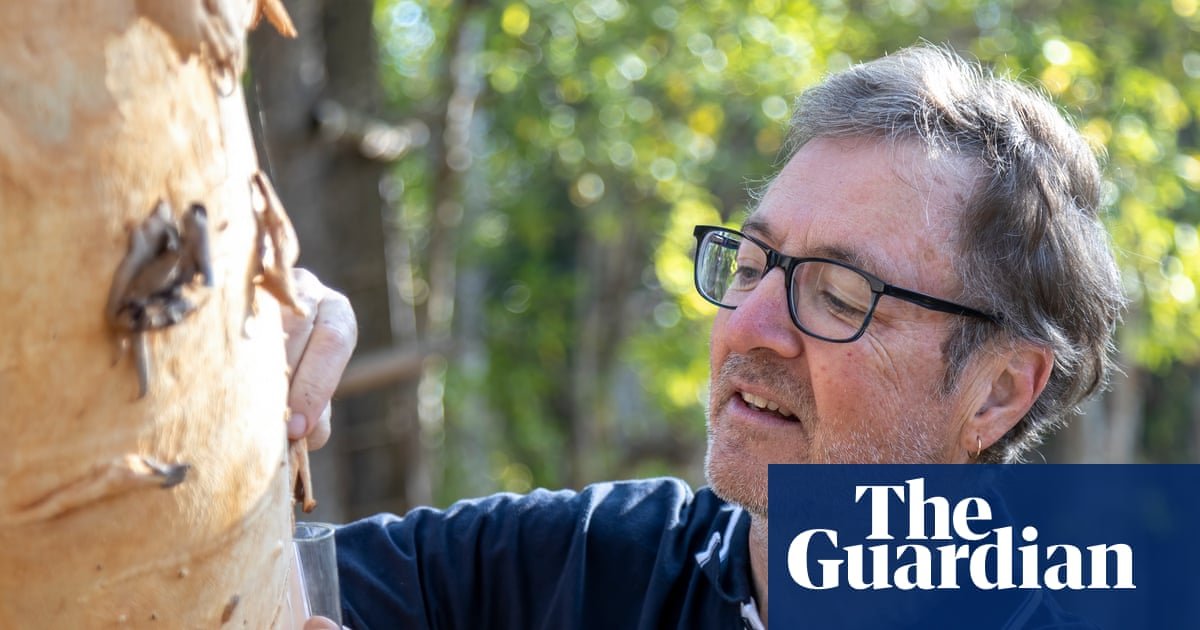
For most people around the world, 16 August 1977 was memorable because it was the day Elvis Presley died.
“We turned the radio on when we got back in the car and that was the headline. Elvis was dead,” remembers Dr Mark Harvey.
But that day was pivotal for the then 18-year-old Harvey for a different reason.
It was the first time he had collected a pseudoscorpion – a tiny and ancient relative of the spider he had found under a rock in western Victoria and popped into a jar of ethanol for preservation.
This year Harvey has become one of the few people on the planet to have described more than 1,000 new species, many of them arachnids like spiders, pseudoscorpions and scorpions, and other invertebrates such as millipedes and velvet worms.
When Harvey spoke to the Guardian earlier this week, the tally of new species he had described in scientific journals stood at 1,015.
Sign up: AU Breaking News email
But by Friday there were two more – Enigmachernes dissidens and Enigmachernes parnabyi – pseudoscorpions found attached to the fur of two different bats and published in the Australian Journal of Zoology.
Trapdoor spider Proshermacha telaporta discovered by Mark Harvey. Photograph: WA Museum
His 1,000th species was reached in October when he described, with colleagues, 24 new wishbone spiders in the journal Invertebrate Systematics.
Harvey spent much of his career as the curator of arachnids and myriapods (things such as centipedes and millipedes) at the Western Australian Museum in Perth, but his fieldwork has taken him around the world.
He remembers his very first new species – the pseudoscorpion Geogarypus rhantus, which he described from a specimen in the Queensland Museum in 1981.
“I was very excited about describing a whole new species. I thought I was king of the world,” he laughs. His memory for dates and detail is as precise as his work.
“I couldn’t tell you what I had for dinner yesterday but I can tell you about a specimen I found on top of a hill in 1986. But it took me a long time – maybe the 1990s – before I worked out I had a gift for taxonomy.”
Taxonomy is the scientific field of discovering, defining, cataloguing and naming species.
The discipline is labour-intensive but is considered vital for conservation.
“If you don’t know what it is or where it occurs, you can’t conserve it,” says Harvey.
‘An enormous achievement’
“I’ve always been really interested in animals and bugs. I would go down to a local creek in Melbourne when I was a kid – it’s not there any more, it’s a car park I think – and bring things back home. That would horrify my mother.”
Colleagues have honoured Harvey over the years, naming 45 species after him.
Dr Mike Rix, the curator of arachnology at the Queensland Museum, has worked with Harvey for three decades and is just one of many scientists to have emerged from his tutelage.
“Describing more than 1,000 species is an enormous achievement,” says Rix.
Mark Harvey showing child from Wilinggin Country discoveries made during a West Kimberley field trip. Photograph: Helen Cross/Bush Blitz
“Mark is one of very few taxonomists in Australian history to have reached that milestone. He is undoubtedly one of the greatest taxonomists of his generation and one of the world’s foremost arachnologists.
“There’s a scientific legacy from the sheer number of species he has described, but his legacy as a mentor and science leader in the field of taxonomy is almost unquantifiable.”
Ask Harvey what makes him good at describing species, and he puts it more modestly.
“I’m a good drawer and I have a good eye for details. I can remember all the shapes,” he says.
He usually sticks to straightforward Latin names drawn from a Latin dictionary but, like many taxonomists, will sometimes name a species after another scientist or a place or a characteristic.
Take, for example, the short-tailed whip scorpion Draculoides bramstokeri, so named because “it was first found in a cave and in my fertile imagination had pincers a bit like Dracula’s fangs”.
His fascination with pseudoscorpions – about which he is the world authority – comes down to their complexity, their ancient lineage (fossils of them are hundreds of millions of years old) and the fact “they can run faster backwards than forwards, and me being an avid basketballer, I think that’s a useful skill.”
Mark Harvey searching for a rare pseudoscorpion and trapdoor spiders in the Kimberley, 2022. Photograph: WA Museum
‘The legacy we’re leaving’
Harvey officially retired earlier this year and he says he is saddened at seeing the animals he loves disappear during his career, blaming habitat loss, climate change and bushfires.
“They are suffering and populations are dropping off here, there and everywhere. I am troubled by the legacy we are leaving for our children and grandchildren.”
Harvey still has a backlog of work and usually has about 10 manuscripts on the go, including one he has been working on for years that runs to 400 pages which he hopes will describe about 60 new species.
150 million years old and critically endangered: assassin spider stalks its prey – video
“I feel like I have another 10 years in me,” he says. “Maybe I can describe a few hundred more?
“I would have to live for another 50 years to describe all the ones I have collected. I’ve collected maybe a couple of thousand new species that are still undescribed.”
Back to the pseudoscorpion Harvey picked up in 1977.
The specimen, he says, is still in a jar in the WA Museum.
“It hasn’t been described yet,” he said. “But it’s probably a new species.”
