

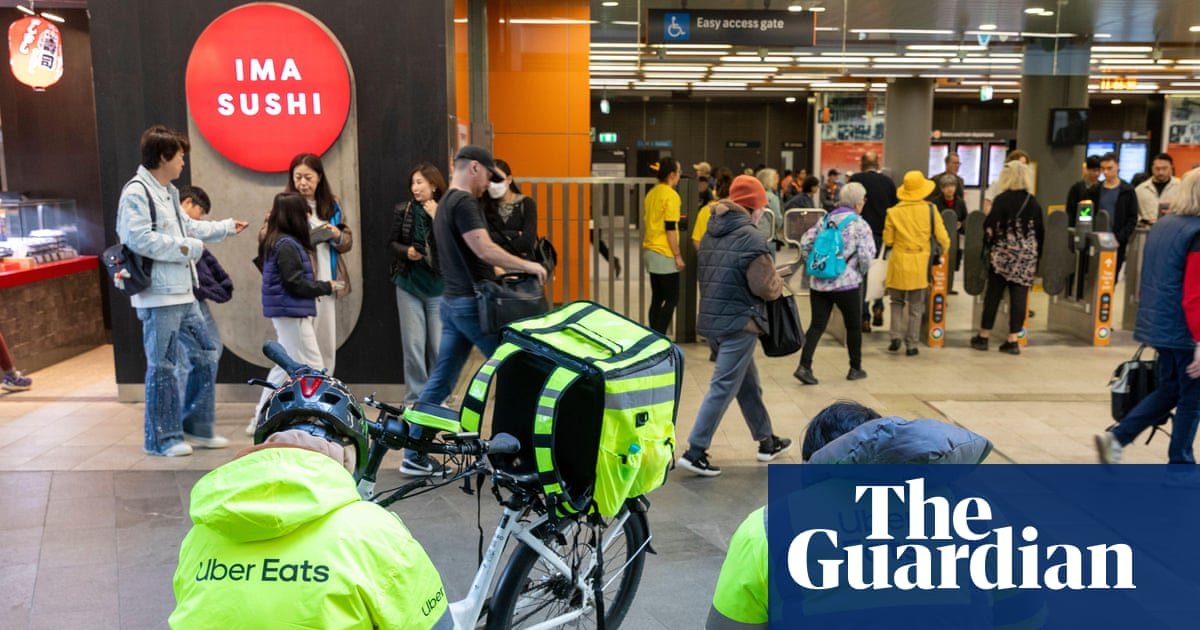
Food delivery companies in Australia have teamed up with the Transport Workers’ Union to set new minimum standards for delivery drivers, including a minimum hourly wage and accident insurance for injuries sustained on the job.
In a deal described as a “world first”, the country’s two largest food delivery services, DoorDash and Uber Eats, have submitted a joint application with the Transport Workers’ Union to the Fair Work Commission.
The deal still requires approval from the industrial umpire, but here’s what we know so far.
What is changing for delivery drivers and their pay?
The application to the FWC comes after a wide range of workplace reforms was introduced by the Albanese government, which included empowering the industrial umpire to set minimum standards for gig workers.
DoorDash, Uber Eats and the TWU have agreed on new protections for delivery drivers after years of talks. The deal is likely to have involved concessions from either side of the negotiating table, including the union agreeing to call the workers “employee-like”.
Among the protections that would be legally enforceable under the new standards is a minimum “safety net” rate of pay of at least $31.30 an hour which would come into effect from 1 July 2026 and increase slightly from 1 January 2027.
The safety net would apply to all modes of transport used by delivery drivers, with the rate varying slightly depending on the type of vehicle used.
The protections also include new dispute resolution processes, new engagement and feedback mechanisms, representation rights and accident insurance for injured workers.
Eric Ireland, a driver in Melbourne who has worked for several platforms, believes the new standards will result in an increase in pay because it means he and his colleagues will get paid even if they have to wait for a restaurant to finish preparing the food.
“The peace of mind that you are actually getting paid while you’re on the job … can only be a good thing,” he says.
Ireland says while some working conditions have improved since he started delivering food six years ago, pay has not kept up with the cost of living.
“I sort of worked out on average I get about $22 an hour before I pay for petrol,” he says. “Sometimes you can earn a lot more than that if you do what they call a ‘quest’, which is doing 10 jobs in a weekend or something.”
However, as the workplace relations expert Prof Alex Veen points out, the safety net is different to a “minimum wage” in the way you may typically think of one.
The deal does not include penalty rates for things such as working late at night and, Veen says, the minimum hourly rate does not apply to time spent waiting between delivery jobs.
“What it materially means for gig workers is that when they’re working in periods of low demand they are unlikely to make that as their hourly pay,” Veen, a lecturer at the University of Sydney’s business school, says.
But he says there are many positives to the deal, including clarifying who is responsible for insuring both vehicles and the workers themselves.
How will the accident insurance work?
The application to the FWC states that workers are responsible for maintaining third-party insurances on the vehicles they use for deliveries, so if they get in an accident and damage another vehicle the delivery platform will not be liable for the cost.
On the other hand, Uber Eats and DoorDash will have to organise and pay for personal accident insurance that “provides a reasonable minimum level of cover” for their delivery workers. As Veen points out, that is “obviously open to interpretation”.
The TWU says 23 gig workers have been killed in Australia since 2017 and the figure could be higher because some are never reported as workplace deaths.
Will customers pay more for food delivery?
While Uber Eats and DoorDash are yet to confirm how they plan to fund an increase in operating costs, Veen says the platforms are most likely to pass them on to consumers.
“They may try to pass some of the costs on to restaurants and they could take a smaller [profit] margin themselves, although that’s not in their interests to do so,” he says.
Dr Michael Rawling, an associate professor who teaches workplace law at the University of Technology Sydney, says there may be a small increase in the price of a takeaway ordered through a third-party delivery app.
“In Australia we like to see workers treated fairly and if the consumer knows that then I think they’ll cop a small increase,” he says.
Is it really a world first?
Rawling agrees the deal is “world leading” and “very significant”.
He says while the deal hasn’t been ratified by the FWC, the “major players” who will be affected by the new standard have agreed on its content, which the industrial umpire will factor into its decision.
“[Typically] what the parties have actually consented to is a preferred direction for the FWC to go into for that particular matter,” he says.
What comes next?
The FWC needs to approve the deal before it can come into effect.
Prof Andrew Stewart, a workplace relations expert at the Queensland University of Technology, says it is “not a done deal”, especially as the FWC will have to consult with other stakeholders – including other delivery platforms.
“Potentially a huge fly in the ointment is that the FWC is going to have to come to a view as to whether the workers are eligible for a minimum standards order,” he says. “Because there’s a perfectly credible argument that the workers are already employees [and not employee-like].”
Stewart says if the FWC ruled that food delivery drivers were employees and not “employee-like” this would be a landmark ruling that would likely result in a challenge from the delivery platforms that could go all the way to the high court.
He is not ruling out this outcome, even though he says it is more likely the FWC will accept the application as it stands.
“I do not want to understate the significance of this deal,” he says. “It is a really important agreement that makes it much more likely we will get a minimum standards order much more quickly than we would if the TWU and the platforms were fighting over the details.”
What does this mean for the gig economy more broadly?
Overall, Stewart says the agreement on the application brings Australia a lot closer to having a safety net for at least one part of the gig economy.
It could also influence future FWC decisions relating to minimum standards. At the moment, the commission is considering similar gig workers in other sectors including package delivery. And the TWU has previously flagged it will submit an application to cover ride-share drivers.
