

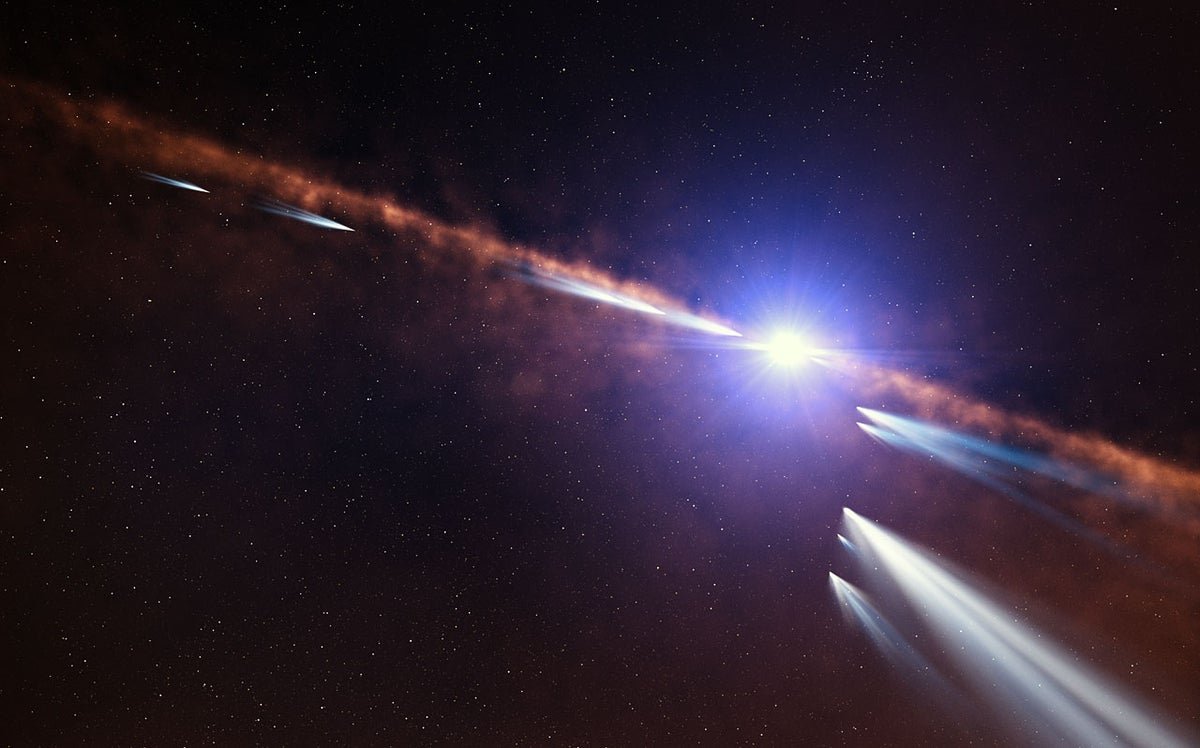
I do so love an ostentatious comet.
As I wrote in a recent “The Universe” column, when these dusty ice balls are billions of kilometers from the sun, they’re frozen solid. But as they near our star on their orbit, they warm up. The ice thaws and turns directly to gas, which expands around a comet’s solid nucleus as a fuzzy head and, sometimes, as a long, spectacular tail.
Some of these comets can get bright enough for us to see without optical aid, but the vast majority of them never become very conspicuous. When they’re out in the deep solar system, beyond the orbit of Neptune, we need gigantic telescopes to see them at all, so feebly do they reflect sunlight.
On supporting science journalism
If you’re enjoying this article, consider supporting our award-winning journalism by subscribing. By purchasing a subscription you are helping to ensure the future of impactful stories about the discoveries and ideas shaping our world today.
Given that we now know that planets are the norm around other stars, too, it’s not a big leap to think those stars might host comets as well. The sun sits in the center of a vast collection of small cometary bodies, which may number as many as a trillion. If that’s the case for other stars, might we be able to detect them?
This may seem hopeless at first blush; the next nearest star is 10,000 times farther away than Neptune, so even in this best-case scenario, any comets beyond our solar system would be impossibly faint. Searching for them might seem like a fool’s errand.
And yet, incredibly, we know of dozens of stars that sport exocometary companions! And just as astonishing, the first such alien comets were detected nearly 40 years ago.
Beta Pictoris is a young star located a little more than 60 light-years from the sun. In the early 1980s, infrared observations revealed a warm glow around the star that proved to be from an accompanying large debris disk left over from planet formation; indeed, two worlds have since been confirmed to orbit the star. But by 1987 astronomers had noted something peculiar in certain observations of Beta Pictoris. When they studied the incoming light from the system as rainbowlike spectra, dispersing it into its individual wavelengths, they saw surprisingly sporadic and rapid fluctuations. Of the several potential causes for this mysterious activity, exocomets gradually emerged as the favored explanation: falling in from the debris disk, some of these objects would pass in front of the star as seen from Earth, absorbing some of the starlight and creating the spectral fluctuations.
Over the years, further observations showed that these exocomets really do exist and were responsible for quite a few features seen in Beta Pictoris. In fact, so many were found, several hundred at least, that it was possible to categorize them into two different groups, similar to the various categories of comets orbiting our own sun. Amazingly, the exocomets, which formed around an alien star trillions of kilometers away from us, looked downright familiar.
Spectroscopy of other stars has led to most discoveries of exocomet systems. In research led by University of Colorado Boulder undergraduate Adalyn Gibson and published this year in the Astrophysical Journal Letters, however, astronomers announced they’d found a cometary cloud around the star RZ Piscium without taking spectra.
Some 600 light-years away, this star is slightly smaller and cooler than the sun and is quite young, about 50 million years old (that’s a baby in stellar terms; the sun is 4.56 billion years old). Much like Beta Pictoris, it displays an excess of infrared radiation from a surrounding warm debris disk. Rather than studying it spectroscopically, the team used years of data about the star’s fluctuating brightness from NASA’s Transiting Exoplanet Survey Satellite. If a star has planets, and we happen to see that planet’s orbit edge-on, it will periodically move in front of the star—in what we call a transit—and dim the light like a mini eclipse. This is by far the most successful planet-hunting technique used today.
What the astronomers found, though, weren’t planets. Instead they saw two dozen huge dips in RZ Piscium’s light, some showing a dimming as great as 20 percent—which is more than you’d expect for a planet. The best explanation, they argue, is that these enormous dips were caused by the expanding gas clouds around a population of orbiting exocomets that occasionally blocked the star’s light.
Applying some statistics to the data, the team found the solid nuclei of the exocomets ranged from 1 to 7 km in diameter, in a size distribution similar to that of solar system comets in the Kuiper Belt, a region of icy bodies that extends some ways out past Neptune.
Again, we look at stars trillions of kilometers away from us across the gulf of space and see ourselves reflected in the data. I find that wonderfully comforting. It’s a nice thought.
There is, however, another, more direct way to detect and study exocomets: sometimes they swing by our neighborhood!
As I write this, in fact, an exocomet is passing through our solar system. Comet 3I/ATLAS is the third such alien visitor we’ve unambiguously observed. The first, 1I/‘Oumuamua, was discovered in 2017, and the second, 2I/Borisov, was spotted in 2019. All three clearly came from interstellar space because they have moved too rapidly for the sun to hold on to them. Each one’s stay was and will be brief: a swoop by our star and then back to the black.
While ‘Oumuamua and 3I/ATLAS each displayed some odd behavior, by and large, all three known interstellar objects have acted much as our homegrown comets do, indicating they’re small objects made of ice and rock, perhaps flung out of their home systems by a gravitational kick from a too-close passage by a planet there. Statistically speaking, there’s probably more than one such alien comet in our solar system at any given time; they’re mostly just too small and faint to detect.
It’s a certainty that some of our own sun’s comets have been kicked into interstellar space over the eons as well, though it’s not clear how many have percolated away from the solar system to roam the Milky Way. It’s nice to think that maybe, just maybe, some alien astronomers on a distant world may someday observe a fine display from a comet we sent them—an exocomet from their point of view—and see similarities that remind them of their own system.
That’s a nice thought, too.
