

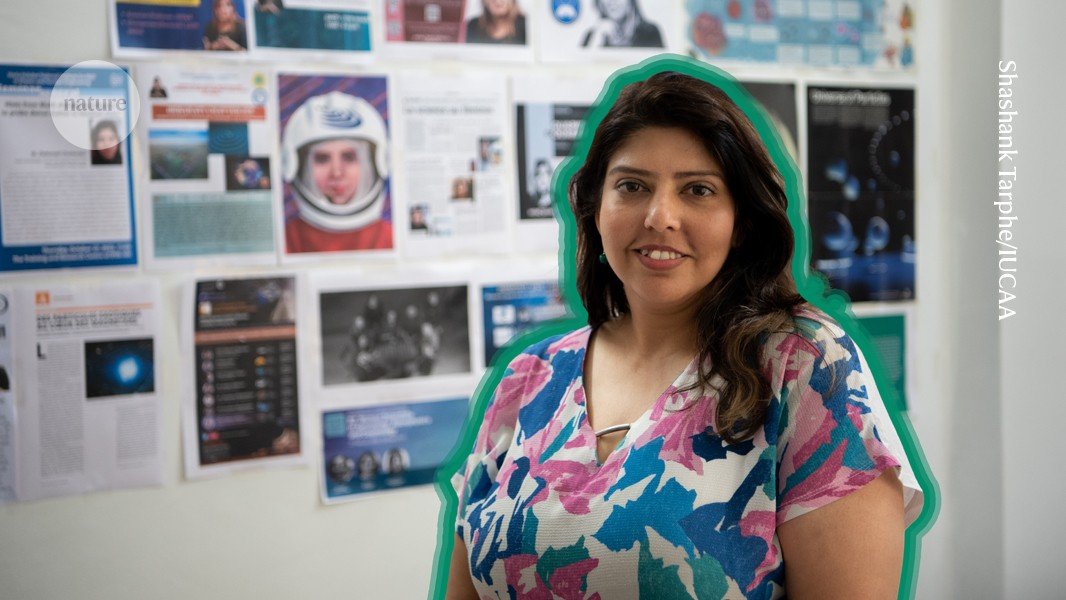
Theoretical astrophysicist Debarati Chatterjee has always seen gender for what it is — a social construct. Despite witnessing domestic violence as a child, experiencing sexual harassment as an undergraduate and a PhD student, and being one of the small proportion (around 20%) of astronomers in the world who are women, she hasn’t let her gender define her career.
Leaving her home country of India to start a postdoctoral position in Germany in 2010, she saw that prejudices based on race, class and gender also existed in the international scientific community. Chatterjee works in the emerging and male-dominated field of gravitational-wave science. She studies neutron stars — ultra-dense cores that are left over when massive stars collapse — by looking at gravitational waves, or ripples in the fabric of space-time. It’s an approach that brings together several disciplines, including nuclear, particle and condensed-matter physics.
On her return to India in 2020, she joined the Inter-University Centre for Astronomy and Astrophysics (IUCAA) in Pune. In June, the 45-year-old was promoted to full professor, becoming the first woman to be awarded this role in the institution’s 37-year history. Her research group generates complex theoretical models to crack the mystery of the interior composition of neutron stars.
She also wants more women to pursue science subjects, especially astrophysics, and has held various roles to promote gender equity. She was a core member of the IUCAA’s committee to combat sexual harassment and was part of the Astronomical Society of India’s Working Group for Gender Equity, for which she helped to run campaigns highlighting pioneering work by female Indian scientists. An avid science communicator, this year, Chatterjee launched the Indian branch of the Pint of Science festival — an annual festival that invites scientist to pubs and cafés to share their latest research — this year across three cities. Chatterjee has also popularized the science behind the planned Laser Interferometer Gravitational-Wave Observatory-India (LIGO-India), which is to be built in a rural area called Hingoli. By delivering talks at schools, universities and astronomy clubs across India, she helps to inspire girls and young women to become scientists.
Chatterjee spoke to Nature about how she overcame sexual harassment to become an astrophysicist, and why she promotes gender and racial diversity in her field.
What is the great passion that has driven you as a scientist?
Curiosity and adventure have always driven me. Since childhood, I have been obsessed with finding solutions, and I don’t rest until I get to the root of the issue. The fact that science can be about addressing extremely complex problems, which can take a lifetime to solve, excites me. Even for someone like Einstein, conundrums in fields such as quantum physics and general relativity were too difficult to solve in his lifetime. During my undergraduate studies at St Xavier’s College in Kolkata, my summer project at the Indian Institute of Astrophysics (IIA) was about understanding how the Sun rotates, a question that remains unanswered. That was when I fell in love with how the academic world works.
When I went to the IIA, I realized I didn’t need to pursue a 9-to-5 routine. I saw that some researchers woke up at 10 a.m. and worked past midnight — then they would go off to play badminton until the early hours. I was very attracted to this way of life. Also, visiting observatories such as the Vainu Bappu Observatory in Tamil Nadu, which is in the middle of a forest, felt like an adventure that I was ready to have for the rest of my life.
Debarati Chatterjee (front row, second from right) with students at a Pint of Science outreach event.Credit: Kshitij Parshetti/Pint of Science India
When did you realize you wanted to tackle racism and sexism in science?
There have been countless times during my professional life when I have confronted unfriendly racist or sexist attitudes. I remember one incident when I was a postdoc overseas. A visitor to the laboratory made an incorrect statement during a seminar, and I pointed it out. While I was having this conversation, several members of my institute walked out of the room in protest at my questioning the visitor. Such disrespectful microaggressions were a daily occurrence.
As a foreigner, if I didn’t speak the local language, I would be left out during important conversations, which sometimes happened when researchers were socializing. Many of my peers would give up and retreat into isolation. Instead, I learnt to speak five languages with enough fluency that I could give interviews in them. Adapting to new fields of research and work environments is crucial for all early-career researchers, and it is often necessary for people to receive full credit for their contributions and achievements. These days, there are welcome centres that help international students to tackle such issues.
At other times, while taking part in official inquiries into why there are so few women in nuclear and particle physics, I have had an institute director barge in demanding to know, “Why is this taking so long?”. These experiences have motivated me to stand up for myself, and to work towards diversity, equity and inclusion to set an example for others who might not speak up because of a lack of support. I have heard from leading female theoretical physicists about how hard their journey has been and why speaking up is necessary.
How have you dealt with racism or discrimination in your personal and professional life?
During my PhD, I faced many instances of sexual harassment from a senior scientist. I had no choice but to continue my studies, because my living expenses depended on my fellowship. This person often told me that I was not good enough and that my work was inconsequential. The overwhelming pressure of the situation threw me into clinical depression, and I had to consult a therapist. I also took my grievance to the head of the department, who advised me to focus on completing my degree, because I was close to submitting my thesis. Two decades ago, there were hardly any female theoretical physicists at my university, and there was no office to which one could complain. I even trained in martial arts for self-defence at the time.
Towards the end of my PhD, I won a German Academic Exchange Service (DAAD) fellowship, which gave me and my work international exposure, and helped me to develop a wide collaboration network. That is how I became an independent researcher who did not have to rely on any senior scientist for advancement.
