

November 22, 2025
4 min read
5 Charts Show Climate Progress as Paris Agreement Turns 10
The 2015 Paris Agreement forged a path for the world to stave off the worst climate change scenarios. Here’s where we stand 10 years later
Ten years ago the world came together to forge a path out of the climate emergency in the form of a global treaty dubbed the Paris Agreement.
Under the accord, nations committed to keeping global temperatures to “well below” a two-degree-Celsius increase over preindustrial levels and to striving to limit that increase to 1.5 degrees C. These goals were ambitious and required greenhouse gas emissions to begin declining by 2025.
Yet emissions continue to rise. Annual negotiations around seeing the Paris Agreement through have continued over the past two weeks at this year’s United Nations Climate Change Conference, or COP30, in Brazil, where participants are acknowledging two simultaneous truths: we have made meaningful strides in protecting our planet, but huge leaps are still needed to avoid the worst outcomes. Those leaps are daunting, given that President Donald Trump is once again pulling the U.S. out of the accord and that countries such as China and Saudi Arabia are also still trying to keep fossil fuels in the energy mix. China, however, is rapidly overtaking the U.S. as a renewable energy powerhouse, and solar and wind have seen exponential gains globally in recent years.
On supporting science journalism
If you’re enjoying this article, consider supporting our award-winning journalism by subscribing. By purchasing a subscription you are helping to ensure the future of impactful stories about the discoveries and ideas shaping our world today.
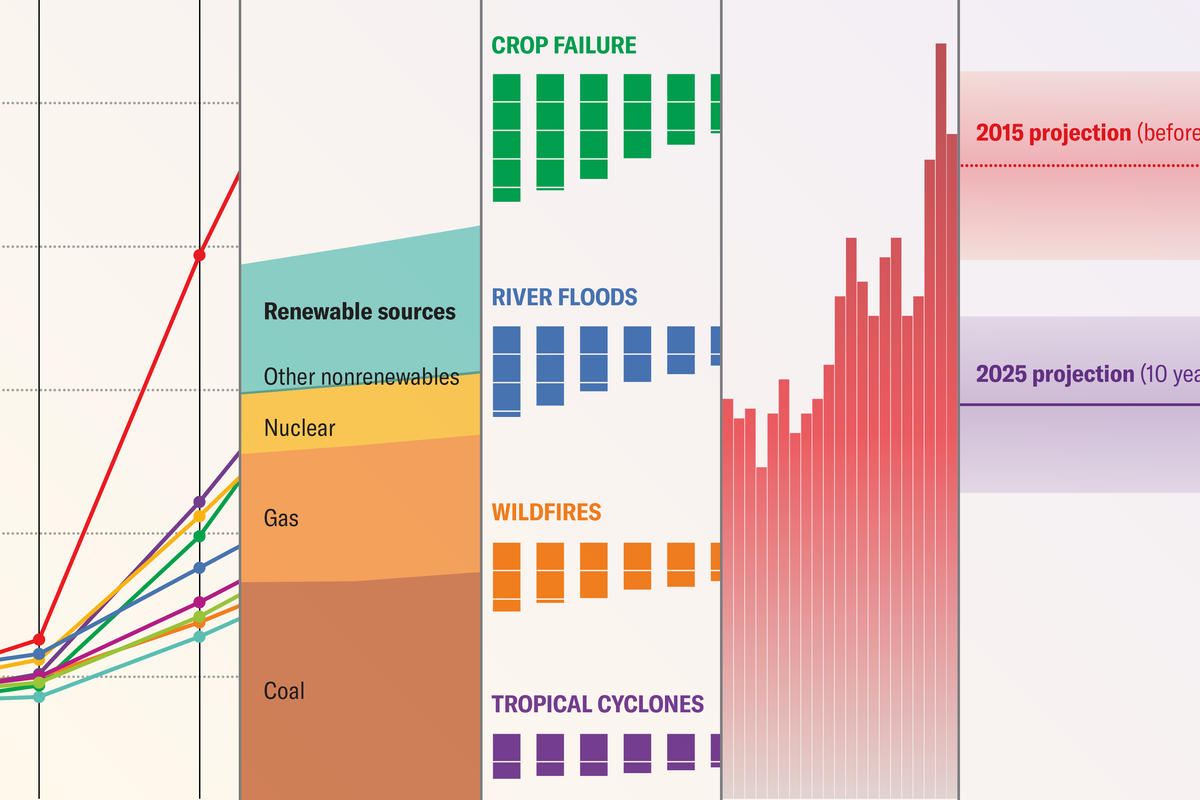
These five charts show why the Paris Agreement is vital—and how the world is doing 10 years into the endeavor.
The Paris Agreement is built around temperature increases compared with an unspecified preindustrial baseline, generally taken as the latter half of the 19th century. Every year since 1970—more than half a century—temperatures have been above this average and soaring upward.
In 2015 the average global temperature was 1.1 degrees C hotter than it was during the preindustrial period. Today it is around 1.3 degrees C. (In 2024—the hottest year on record—the planet was more than 1.5 degrees C, but the Paris agreement looks at the average over many years. The World Meteorological Organization projects that 2025 will be around 1.4 degrees C above the preindustrial average and either the second or third hottest year on record.)
The increase is grim but not the end of the story—especially if humans can stop climate pollution quickly enough to reverse the warming trend. “Every ton matters; every tenth of a degree we avoid matters; every year matters,” says Costa Samaras, an energy policy expert at Carnegie Mellon University.
In fact, before the Paris Agreement, the world was set to see between 3.7 and 4.8 degrees C of warming by 2100. But if nations follow through on their Paris commitments to reduce emissions, that level of warming will drop to around 2.9 degrees C, with a likely range of 2.3 to 3.4 degrees C, according to one recent estimate.
It’s still a steep challenge to follow through even on the Paris road map, however—and its goals permit some spewing of carbon pollution into the atmosphere.
“Until global emissions are at net zero,” Samaras says, “the climate outcomes of tomorrow are going to be worse than today.”
Amanda Montañez; Source: “Ten Years of the Paris Agreement: The Present and Future of Extreme Heat,” Climate Central and World Weather Attribution (data)
Those climate outcomes could be dire, though not as dire as those that would occur on our pre-Paris track. New research shows that with around four degrees C of warming, U.S. residents would see some 118 more extremely hot days than would occur under a preindustrial climate by the end of the century. (Other nations would fare even worse.)
If we achieve the current commitments to reduce emissions, the number of days with the worst heat in 2100 will drop to 88 in the U.S. If we can limit global warming to 1.3 degrees C, the U.S. will see just 58 such days per year on average.
Of course, even if we follow through on current commitments, there will be climate consequences regardless. With 2.6 degrees C of warming, today’s five-year-olds will experience an extra 22 percent more heat waves than today’s 15-year-olds, work by climate scientist Wim Thiery of Vrije University of Brussels shows. Similarly, today’s children will experience more than twice as many heat waves than their 35-year-old parents will—and more than six times as many as their 65-year-old grandparents.
Other climate-fueled disasters, including droughts, wildfires and tropical cyclones, are also increasing in frequency.
One of the key bright spots since the Paris Agreement was signed is the surge of renewable energy. A particular win has been that solar power facilities are coming online much faster than anyone expected in 2015. Better yet, energy from these facilities is being stored for nighttime use thanks to battery technology that was nonexistent when the Paris Agreement was signed. “Batteries is really the miracle story here,” Samaras says.
Now we need a similar miracle story for sectors such as transportation, agriculture, industry and land use. “I hope that we can revisit this in 10 years and be able to say that the Paris Agreement started a rapid reduction in greenhouse gas emissions,” Samaras says. “But we need to work for the next 10 years in order to make that happen.”
It’s Time to Stand Up for Science
If you enjoyed this article, I’d like to ask for your support. Scientific American has served as an advocate for science and industry for 180 years, and right now may be the most critical moment in that two-century history.
I’ve been a Scientific American subscriber since I was 12 years old, and it helped shape the way I look at the world. SciAm always educates and delights me, and inspires a sense of awe for our vast, beautiful universe. I hope it does that for you, too.
If you subscribe to Scientific American, you help ensure that our coverage is centered on meaningful research and discovery; that we have the resources to report on the decisions that threaten labs across the U.S.; and that we support both budding and working scientists at a time when the value of science itself too often goes unrecognized.
In return, you get essential news, captivating podcasts, brilliant infographics, can’t-miss newsletters, must-watch videos, challenging games, and the science world’s best writing and reporting. You can even gift someone a subscription.
There has never been a more important time for us to stand up and show why science matters. I hope you’ll support us in that mission.
