

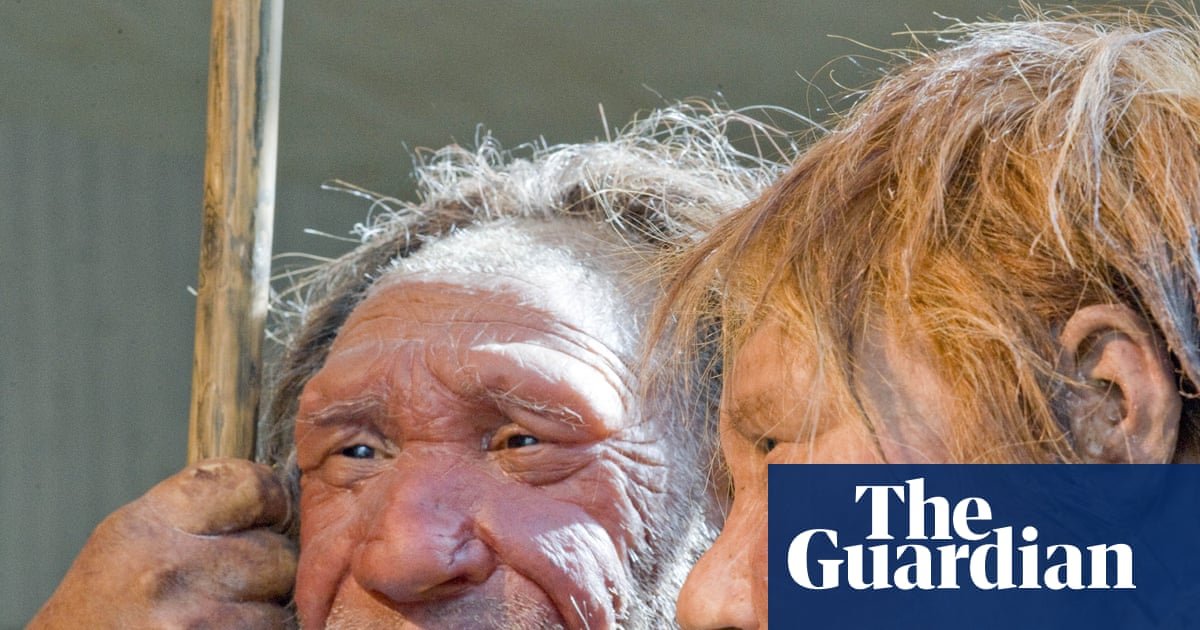
From Galápagos albatrosses to polar bears, chimpanzees to orangutans, certain species appear to kiss. Now researchers suggest Neanderthals did it too – and might even have locked lips with modern humans.
It is not the first time scientists have suggested Neanderthals and early modern humans were intimately acquainted. Among previous studies, researchers have found humans and their thick-browed cousins shared the same mouth microbe for hundreds of thousands of years after the two species split, suggesting they swapped saliva.
Dr Matilda Brindle, an evolutionary biologist and the first author of the new study from the University of Oxford, said while various theories had been proposed, the new work supported a simple explanation.
“Probably they were kissing,” she said, adding that the idea chimed with research that has found humans of non-African ancestry have bits of Neanderthal DNA in their genome, revealing interbreeding was at play.
“It certainly puts a more romantic spin on human-Neanderthal relations,” Brindle said.
Writing in the journal Evolution and Human Behavior, Brindle and colleagues report how, to investigate the evolutionary origins of kissing, they first had to come up with a definition that was not limited to how humans smooch.
“There have been some previous attempts to define a kiss, but it’s very much been human-centric, which means that basically other animals don’t kiss. Now we know that they probably do, it might just not look exactly what human kissing looks like,” said Brindle.
However, she said some behaviours that looked like kissing were something rather different – such as the chewing and transfer of food, or “kiss-fighting”, seen in fish known as French grunts.
As a result the team came up with a definition of kissing based on friendly interactions involving directed mouth-to-mouth contact with a member of the same species, with some movement of the mouth but no transfer of food.
Brindle said they focused on reports of kissing in primates from Africa and Asia, including bonobos, chimpanzees and orangutans, and used YouTube videos to confirm the reports.
The researchers then combined this data with information on the evolutionary relationships between living and extinct species of such primates.
Primates including bonobo apes are known to kiss one another; the behaviour may have its origins deep in humans’ evolutionary past. Photograph: Finbarr O’Reilly/Reuters
The team say the results suggest kissing evolved somewhere between 21.5m and 16.9m years ago in the ancestors of the large apes.
The position of Neanderthals on this family tree means it is likely they, too, indulged in a kiss, the researchers say. But the behaviour might not have been confined to their own species.
“The fact that humans kiss, the fact that we now have shown that Neanderthals very likely kissed, indicates that the two [species] are also likely to have kissed,” Brindle added.
While the evolutionary explanation is debated, Brindle said kissing could be used in sexual contexts to potentially increase reproductive success or help choose between mates, while it might help reinforce bonding when used in a platonic way.
Dr Jake Brooker, an expert in the behaviour of great apes at the University of Durham, who was not involved in the work, said that as kissing behaviour was seen in a wide range of apes it made sense its origins lie deep in our evolutionary past, and an analysis of different forms of kissing among a wider variety of species might push its origins back even earlier still.
“Things that we think of as signatures of human life, like kissing, are not unique to us if we look closely at other animals,” he said.
Penny Spikins, a professor of the archaeology of human origins at the University of York, said kissing had a cultural element as it was not common to all societies.
“Nonetheless, as humans we thrive or fail on the strength of our emotional bonds, and ways of promoting trust and intimacy will have been important for millions of years,” she said. “It might be an image that seems a bit incongruous to our misplaced ideas of a rather ruthless and aggressive past, but really it should be no surprise that Neanderthals- and even Neanderthals and our own species together – kissed.”
