

The Trump administration’s slick videos of an immigration raid at a Chicago apartment building showed federal agents rappelling from a helicopter, banging down doors and marching out tan-skinned men whose hands were zip-tied behind their backs.
It was a made-for-TV spectacle, captured by a cable news crew that had been invited to accompany the agents. Footage of the September raid went viral on social media, and national and local news outlets reported on what happened. But one thing has been missing from nearly all of the coverage: the voices of the immigrants who were taken away in the middle of the night and whose names were never released.
I am a reporter in ProPublica’s Chicago office, and I write about immigration. I have experience tracking down relatives of Venezuelans caught up in Trump’s immigration dragnet. This year, I worked with colleagues to report on another group of Venezuelans that the Trump administration had claimed were gang members and expelled to a prison in El Salvador.
So when my editors assembled a team to report on the raid, I knew how I wanted to contribute: finding the immigrants and telling their stories. Eventually, I spoke with a dozen Venezuelan men and women who were detained in one of the most dramatic federal raids to take place inside a U.S. city in recent history.
Norelly Eugenia Mejías Cáceres, 37, told me she collapsed and passed out in a hallway as heavily armed agents took away her husband and her barefoot 6-year-old son.
Johandry José Andrade Jiménez, 23, said his three little girls — all in diapers — wailed when agents threw him against the floor.
Naudelys Yeyes, 20, said she pleaded with agents to stop hitting a Venezuelan man she knew. “There are children here,” she told the agents repeatedly, worried about her 4-year-old son who was watching.
Trump officials have said they had intelligence that the Venezuelan gang Tren de Aragua had taken over the building, and that there were guns, explosives and drugs inside. After the raid, they said they had detained two gang members.
But the administration refused to identify the immigrants they detained or provide evidence about any of its claims. My colleagues Jodi S. Cohen, T. Christian Miller, Sebastian Rotella, Mariam Elba and I set out to determine what actually happened.
Mustafa Hussain for ProPublica
Jim Vondruska for ProPublica
Federal agents raided this apartment building in Chicago’s South Shore neighborhood.
Despite the high-profile nature of the raid, federal prosecutors have not filed criminal charges against any of the immigrants detained that night. A spokesperson for the U.S. Department of Homeland Security did not respond to our questions but sent us a statement about how the raid was “performed in full compliance of the law.” You can read the full statement here.
I encourage you to read our investigation. But I would like to tell you a little more about the Venezuelan men and women we spoke to, how we found them, what they went through and how different their profiles are from those alleged by the government.
To try to find them, I spent hours watching Spanish-language videos about the raid on TikTok and Facebook, and reading hundreds of comments under the posts. A few of the comments appeared to be written by relatives and friends of the detained immigrants. I reached out to them and some agreed to talk.
From those interviews, I learned that the government had sent some of the Venezuelan men, women and children to jails in Kentucky, Indiana and Texas. Others had already been deported. Some mothers had been released with their children — including babies born in the U.S. All were angry and confused about what had happened. Their lives had been torn apart. Families were separated. Asylum-seekers were returned to a country with an authoritarian government and a collapsed economy that they had once fled.
Co-published with
As we learned the immigrants’ names, we tried to find out if they were still in federal custody. We wrote letters to them in jail and asked for interviews. Then they started to call us.
Jonahyker Francisco López Manzano, 23, said he entered the U.S. in early 2024. He crossed the border illegally and surrendered to immigration authorities seeking refuge. He was processed and released to pursue an asylum claim. In Chicago, he worked mostly construction jobs he found by waiting in a Home Depot parking lot.
The night of the raid, he awoke to the sound of a helicopter over the five-story apartment building and agents yelling, “Open the door!” López said he sat on the edge of his bed, wishing that his own door would become invisible. But the door came down and agents burst in. He said they dragged him to his knees and zip-tied his hands behind his back. They marched him outside as the cameras rolled. His head was down and his long, disheveled hair hung over his face.
The agents didn’t ask him any questions or explain why they were there, López said. “They didn’t say anything,” he said from the Kentucky jail where he was detained. “I haven’t done anything wrong.”
José David Saavedra Pérez, 22, hid under his bed the night of the raid. In the videos released by DHS, Saavedra is shirtless, his apartment number scrawled in black marker across his chest. Two masked agents are holding his arms and marching him outside.
We learned from his attorney that Saavedra left his apartment before dawn each morning and rode buses and trains to a suburban Home Depot parking lot to look for construction work. His dedication so impressed a contractor who regularly hired him that, when the contractor realized that Saavedra had been detained in the raid, he helped find him a pro bono attorney.
Most of the detained immigrants we spoke to didn’t have lawyers, though. They couldn’t afford to hire one. That was the case for Jean Carlos Antonio Colmenares Pérez, a 39-year-old construction worker who was a former paratrooper in the Venezuelan army.
At an immigration court hearing in mid-October, Colmenares told the judge he’d been sick with a fever and begged to be sent back to Venezuela. “I want to go back to my country now,” he said. “I don’t want any more hearings.”
The judge couldn’t order his deportation that day, as his case was being transferred to another immigration court. As the weeks ticked by, he and other men called from jail and told me they were in despair. Like Colmenares, some were getting sick. Others said they felt like they were mentally unravelling.
More than a dozen children were taken out of the apartment building that night. Colmenares told me he worried about his 6-year-old nephew, who clung to his legs when agents knocked down the door. The little boy was a first grader at the elementary school across the street from the building.
I learned that the boy’s father, Colmenares’ cousin, was detained at another jail in Kentucky. Meanwhile, the boy and his mother, Norelly Eugenia Mejías Cáceres, were sent to a family detention facility in Texas.
They spent a month in detention before she gave up on her asylum case and asked to be sent back to Venezuela. Mejías later told me her son cried for his father and refused to eat the food served in jail. He lost weight. She said that other women who were incarcerated with them bought the boy ramen noodles from the commissary so he wouldn’t go hungry.
Mejías said she returned to Venezuela with even less than what her family had when they had left. Her son’s toys, clothes, shoes and tablet. The green backpack with $600 in savings. The used SUV her husband had bought to get to work. All of it was gone.
“I don’t know why they did this,” she said. It was a phrase she repeated several times.
Norelly Eugenia Mejías Cáceres and her son, at a park in Venezuela after their return. “I don’t know why they did this,” she said of the raid and its aftermath. Adriana Loureiro Fernández for ProPublica
Last week I met Yelianny Nicoll Primera Herreras, another mother who was detained the night of the raid. Her three little girls, all under the age of 4, were in diapers when agents burst in. The girls’ father, Andrade, told me how his daughters wailed when agents pushed him to the floor.
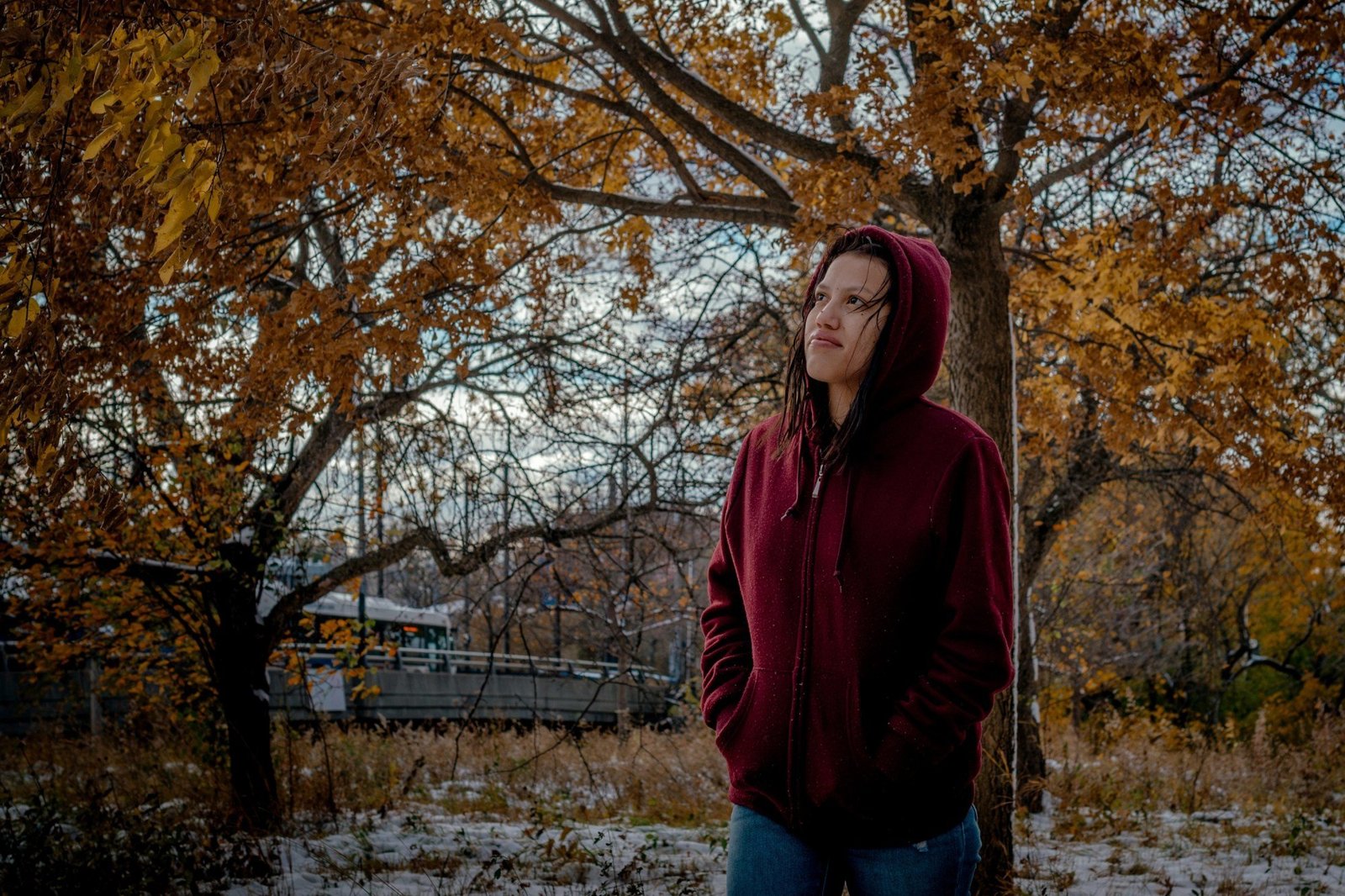
Primera and her chubby-cheeked daughters are staying in a homeless shelter. When we met — on the day of an early Chicago blizzard — none of them had winter coats. The girls stayed inside with me, watching “KPop Demon Hunters” on my phone while Primera stepped outside to get the photograph you see at the top of this article taken.
Primera, 20, said she rarely leaves the shelter, afraid of getting detained again. As she was on the night of the raid, she is terrified that she will be separated from her daughters and deported without them.
“I stay here, locked up with my daughters because all of those immigration agents are outside,” she told me.
When Andrade calls her from detention, a knot forms in the back of her throat. She said she wants to lift his spirits and assures him that everything is fine. Primera forced a smile as she told me this, but her eyes were shiny with tears.
She said federal officials have given her time to get her daughters’ birth certificates and passports so they can be returned to Venezuela together. Her two youngest daughters are U.S. citizens, and Primera said she is afraid to return.
“I would like to stay,” she said. “For my daughters’ future.”
