

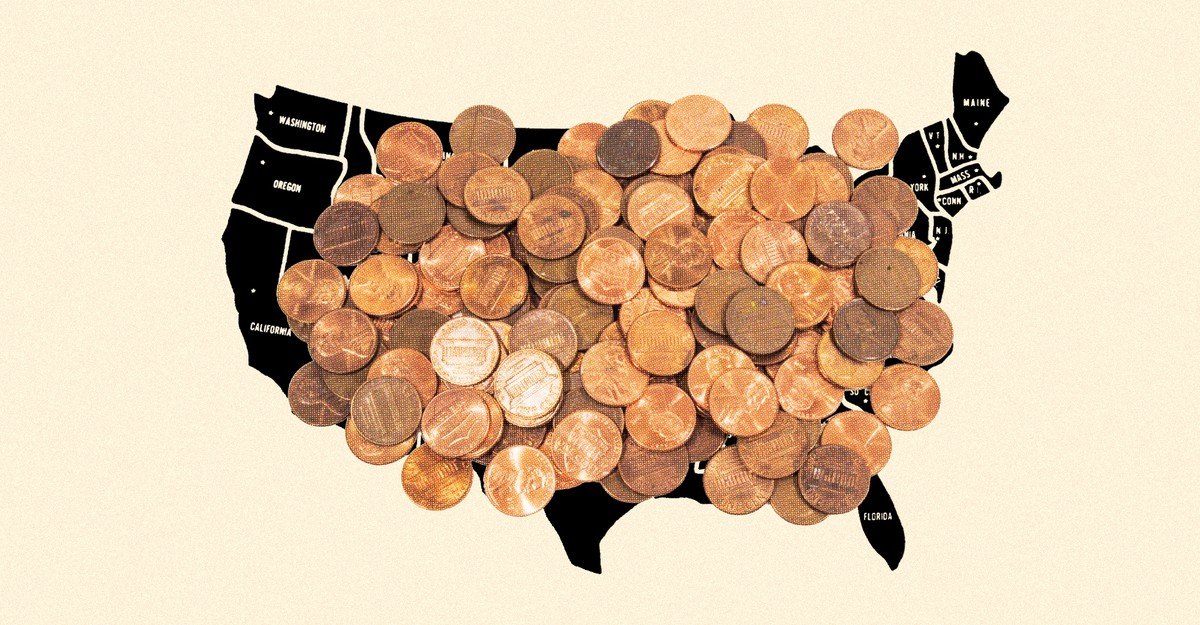
What, exactly, is the plan for all the pennies?
Many Americans—and many people who, though not American, enjoy watching from a safe distance as predictable fiascoes unfold in this theoretical superpower from week to week—find themselves now pondering one question. What is the United States going to do with all the pennies—all the pennies in take-a-penny-leave-a-penny trays, and cash registers, and couch cushions, and the coin purses of children, and Big Gulp cups full of pennies; all the pennies that are just lying around wherever—following the abrupt announcement that the country is no longer in the penny game and will stop minting them, effective immediately?
The answer appears to be nothing at all. There is no plan.
The U.S. Mint estimates that there are 300 billion pennies in circulation—which, if true, means that the Milky Way galaxy contains about three times more American pennies than stars. How, you ask, could the plan for 300,000,000,000 coins be “nothing”? The Mint, you say, issued a formal press release about striking the final cents. Surely, you insist, that implies some sort of strategy, or at least is evidence of logical human thought and action?
Wow—you are talking like a baby angel raised by puppies in a beachfront palace with no right angles, who has never attempted to wrench useful information out of a government agency’s public-affairs officer. I would give anything to spend 30 narcotic minutes in your gumdrop world. Let me take your round little face between my hands and squeeze it tight as I scream this:
That’s not how things work with pennies.
It is my miserable fate to possess more miscellaneous information about U.S. one-cent coins than, possibly, any other person on this planet. This is not a boast. The information I command is data no one without a neurodevelopmental disorder would ever yearn to know; it is a body of knowledge with no practical use for anyone. I contracted this condition last year, as I spent several months attempting to ascertain why, in the year 2024, one out of every two coins minted in the United States was a one-cent piece, even though virtually no one-cent pieces were ever spent in the nationwide conduction of commerce, and, on top of that, each cost more than three cents apiece to manufacture.
In search of the answer, I interviewed former directors of the Mint, members of Congress, professors of metallurgical engineering and of law, economists, charity workers, multiple manufacturers of those machines that transform regular pennies into souvenir smushed pennies, scrap-metal recyclers, historians, lobbyists, the CEO of Coinstar, coin collectors, sociologists, government auditors, and the paranoid goblins who perform the opaque work of the Federal Reserve. The initial draft of the story I filed for a popular New York City–based publication was 20,000 words long. (Sadly, all of the best parts everyone would have loved were cut by my psychotic editor, whose No. 1 passion in life was removing 13,000 perfect words from my first drafts; I’m not worried about him reading these words, because a low-class butcher like that doesn’t possess enough humanity to subscribe to The Atlantic—though, if you happen to know William, I would thank you not to send him a gift link to this article.) And what I learned was that there was no sane reason why.
The simplest way to say this is that everyone directly involved in making billions of pennies every year knew that it was pointless to do so, and also thought that it was legally impossible to stop. Specifically, they thought they were bound to make pennies until Congress issued a law ordering them to cease (which, everyone agreed, was unlikely to ever happen). This, I discovered months into my research, did not appear to be true.
I published my theory—that Title 31, Section 5111 of the Code of Laws of the United States of America empowers the secretary of the Treasury to order that no pennies be minted—last September. On a U.S. Mint webpage that appears to have been created earlier this week (simultaneously with the announcement that the final penny coins intended for circulation had been struck in Philadelphia), this long-overlooked section of the U.S. Code is cited as the legal justification for halting penny production.
Another thing I learned daily over the course of my reporting: No one cares about pennies. Finding people to speak with me about them was nearly impossible, even, as in the case of the U.S. Mint’s public-affairs officers, when it was ostensibly their job. (The Mint, which has annually unleashed billions of unwanted and unused pennies upon the nation, gave me the strong impression of being embarrassed to be associated with the coins in any way. Indeed, a retired Mint spokesperson confirmed this.)
There were logical reasons not to care: 300 billion pennies—all of them still and indefinitely legal currency—constitute approximately zero percent of the total money supply of the United States (0.0 percent if rounding to one decimal place). The millions of dollars the government loses by paying more than three cents to manufacture one-cent coins represents an infinitesimal fraction of 1 percent of the government’s several-trillion-dollar budget. And these days, most people barely encounter the coins. According to government reports, the large majority of the pennies that have ever been minted in this country either have undergone what is termed “disappearance” (yes, this is the official wording) or are “sitting” in Americans’ private homes.
The core problem with the pennies turned out to be a mostly psychological horror. In my article, I described this situation as “the dumbest thing I ever heard” and “the Perpetual Penny Paradox”—both terms I stand by a year later.
Most pennies produced by the U.S. Mint are given out as change but never spent; this creates an incessant demand for new pennies to replace them, so that cash transactions that necessitate pennies (i.e., any concluding with a sum whose final digit is 1, 2, 3, 4, 6, 7, 8 or 9) can be settled. Because these replacement pennies will themselves not be spent, they will need to be replaced with new pennies that will also not be spent, and so will have to be replaced with new pennies that will not be spent, which will have to be replaced by new pennies (that will not be spent, and so will have to be replaced). In other words, we keep minting pennies because no one uses the pennies we mint.
But the problem was not solely the theoretical terror of the infinite. These tokens are also a physical burden, adding 2.5 grams of weight apiece to Americans’ cup holders and winter-coat pockets and junk drawers. In a practical sense, penny coins are worthless. (Many people, who do not themselves purchase anything with pennies, assume that very poor people probably use them—disregarding the fact that they have never seen a poor person settling a bill with hundreds of pennies, which would take a very long time to amass, on top of being cumbersome to carry around; the sociologists I interviewed, who study extreme poverty, expressed skepticism that anyone lives off hordes of one-cent coins.) Effectively, they are trash—trash that Americans pay the government (via taxes) to manufacture, at a loss, and then foist back on us; millions of pounds of trash for which we, every time we have ever accepted a penny coin at checkout, have tacitly agreed to provide free private stowage, in perpetuity.
So we’ve stored the pennies—under the floor mats in our RAV4s, in our empty water-cooler jugs. We’ve had to. Mint officials told federal auditors in 2019 that, if even a fraction of the nation’s never-spent pennies were simultaneously spent or cashed in, the deluge of change would be “logistically unmanageable” for the federal government. For one thing, there would likely not be enough space to store them in our nation’s bank vaults.
That’s the first thing I thought of when I read the news that the Mint had produced its last pennies for circulation: What are they going to do about the vaults? I went to the Mint website and read its press release. Then I read through every item on the neatly formatted Penny FAQs page. Then I realized they weren’t going to do anything about the vaults, because there was no plan at all to do anything except stop making pennies.
This isn’t how it usually works when a smoothly running country elects to retire some portion of its currency. Canada, unsurprisingly, provides a seemingly perfect model: When the cost to manufacture Canadian pennies reached 1.6 cents apiece, in 2012, the government announced that it would cease production of the coins and gradually withdraw them from circulation. Simultaneously, the government debuted a robust public-information campaign, explaining to Canadians the logic behind its decision and publishing guidance (including little pictures) for how to round out cash transactions in the absence of pennies. To date, the Canadian Mint has recycled more than 15,000 tons of pennies, redeemed by the public for their face value. Recycling the metal from Canadian pennies (mainly copper and steel) helped offset the cost of trucking billions of unwanted pennies across the nation. And, of course, it kept the coins out of landfills.
But it’s unclear if anyone would bother recycling U.S. pennies, which, although copper-plated, are made mostly of zinc. Recycled zinc is worth only about a quarter of recycled copper; nearly 1 million tons of copper are recycled in the U.S. each year, versus only about 165,000 tons of zinc. On top of this, a Canadian Mint official told me, copper and zinc are “very hard” to separate.
The good news, which is also very bad news, is that smelting zinc—extracting it from rock—is what a professor from the Colorado School of Mines described to me as “a very unclean, toxic process.” The best-case scenario for recycling U.S. pennies, then, would perhaps be to find industrial manufacturers willing to pay for old penny material in exchange for avoiding the hassle, expense, and danger of harvesting fresh zinc. The worst-case scenario would seem to be that we have only just a few days ago stopped manufacturing billions and billions and billions of hazardously produced zinc disks with no practical use that are also unsellable as scrap.
Incredibly, the penny’s end seems poised to be more ignominious than even the phrase worst-case scenario might suggest. A scenario is a sketch of a possible future event; worst-case implies some sense of order and codification—that multiple scenarios have been considered, and ranked by degrees of badness. Worst-case scenario implies that someone is thinking, beyond the present moment, about what can and should be done; it implies an intention, or at least a wish, to avoid the worst-case scenario.
That option, like all others, appears to have been removed from the table. The tabletop, in fact, is entirely bare. The government has issued no guidance about how cash transactions calculated to the cent should work in what will soon be a cent-coin-less country (as soon as the final batch of pennies plunges out of circulation—which will happen with shocking speed). “We are not aware of any plans to issue rounding guidance,” Andrew Von Ah, the director of physical infrastructure for the Government Accountability Office, told me on Friday; in 2019, the GAO released a report in which an association representing the nation’s banks especially emphasized the need for public education and rounding guidance “before suspending the penny.” The GAO, Von Ah said, is likewise “not aware of any plan to remove pennies from circulation”—nor indeed “of any plan to mitigate any potential issues with penny suspension.”
So: No one is coming to collect all the useless pennies. And no one is explaining how to get along without them. The government, in other words, is treating the pennies the way it has for decades: by making them Americans’ problem.
But perhaps the most alarming thing Von Ah told me was not about the lack of planning for the penny’s sudden demise. It was about the possibility that our pointless cent might someday rise from the dead. “The Mint could decide to restart production of the penny in the future,” Von Ah said—or was this a warning?—“if it is determined there is a need to do so.”
