

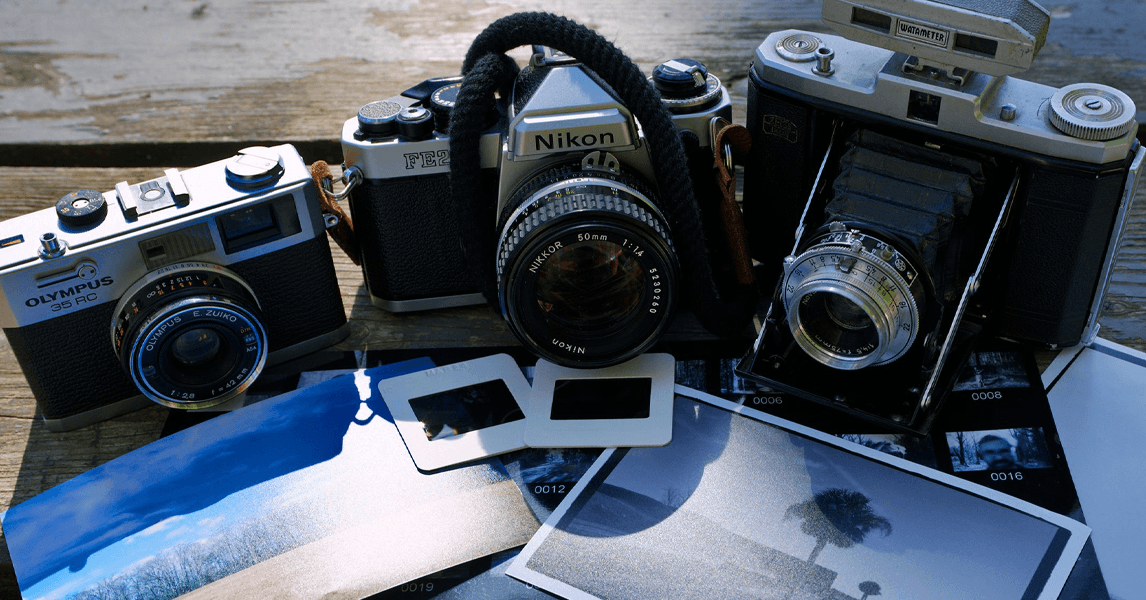
We’ll start with color film, which comes in two flavors, positive and negative.
Positive Film vs. Negative Film
Positive film records the image as you saw it when you pushed the shutter. It produces rich, saturated colors and tends to have strong contrast. It’s much less forgiving in my experience. You need to get the exposure right and there’s not much you can do about it after the fact if you don’t. I tend to avoid high-contrast scenes with positive film (or use graduated neutral-density filters to reduce contrast). Positive film is usually mounted as slides when you have it professionally developed.
Negative film records the opposite of what you saw. In black and white, everything is reversed, blacks are white, and whites are black so that when you shine light through it to print, the black areas hold back the light, making them lighter in the print, and light areas let more light through, rendering them dark in the print. The same is true of color negative film, but it tends to look more like a yellow-orange mess as a negative. Negative color film often has a softer look than color positive, with lower contrast, and higher dynamic range.
Which should you use? I suggest experimenting to see which you like the best. Below are a few film recommendations based on the type of images you want to make.
Best Film for Landscapes
Courtesy of B&H
Fujifilm
Fujichrome Velvia 50
Fujifilm’s Fujichrome Velvia 50 is ridiculously expensive at $35 per roll, but I’ve still yet to find any other color-positive film that looks as good as Velvia. Its color saturation is legendary (tending toward the red/magenta), and its neutral gray balance means you almost never get weird colors in shadows and highlights. The price means I don’t shoot it very often, but when I’m heading out into the wilderness, this is what I bring.
Courtesy of B&H
Kodak
Professional Ektachrome E100 Color Transparency Film
Kodak’s E100 is a new film for me, but I’ve shot a few rolls now, and I can say that it is very different from Velvia. There’s none of the Velvia warmth; colors are rather neutral with a mild green cast to the highlights. If you’re looking to shoot landscapes with a different look than the past 50 years of Velvia-influenced images, this is the film I’d recommend.
Courtesy of B&H
Kodak
Professional Ektar 100 Color Negative Film
Another newish one, Ektar 100 is the film stock that come closest to replicating what I think of as a digital look. Grain is very fine, and colors are extremely close to what my Sony digital sensor records: natural-looking color tending toward the cooler side. I’ll confess this isn’t my favorite, but the price is difficult to beat.
Best Film for Portraits
Courtesy of B&H
Kodak
Professional Portra 160 Color Negative Film
Portrait films need to handle skin tones well. My favorite, Fujifilm’s 160 Pro, has been discontinued, which leaves the ever-popular Kodak alternative. At $14 a roll, this is probably the best value in film, period. Porta 160 is a great film for portraits, rendering skin pretty much as it is most of the time. If you need something faster for shooting in low light, there’s also a 400-speed version and even an 800-speed version. I find that one to have too much grain for color portraits, but if that’s the look you want, it’s available.
Best Black-and-White Films
There’s a seemingly endless array of black-and-white films out there, including reissued versions of some of the most popular films from previous decades. This is a very biased list since “best” in this case is purely subjective. Again, experiment to figure out which you like.
Courtesy of B&H
Kodak
Professional Tri-X 400 Black and White Negative Film
Tri-X was launched in the 1940s and has been in continuous production ever since. It’s gone through a few changes over the years, the latest being a reengineering in 2011 that reduced the grain (which is when it got the TX designation). A favorite of photographers as diverse as Sebastiao Salgado, Vivian Maier, and Gary Winogrand, Tri-X is beloved for its versatility, with just the right amount of grain and contrast that give images a certain look and texture that nothing else matches. There are rich black shadows, great contrast, and enough grain without being too much. Tri-X is also dead simple to process if you do it yourself. If I could only shoot one film, this would be it.
Courtesy of B&H
Ilford HP5 Plus Black and White Negative Film
Another versatile film, Ilford’s HP5 has a wide exposure latitude, meaning it’ll do well in mixed and difficult lighting. It has less overall contrast than Tri-X, giving it a smoother look. It also pushes very well, without becoming overly grainy like Tri-X tends to when you push it. If you want a good all-around film with a smooth, even tonality, this is a good pick.
Courtesy of B&H
Kodak
Professional T-Max P3200 Black and White Negative Film
Let’s get something out of the way first. Kodak calls this a “multispeed” film; there’s no need to shoot it at 3200. I like to shoot it at 800 and process it at 1600. It took me a few years to realize what I was doing there was making my T-Max look more like Tri-X, but the point is, the T-Max 3200 is more versatile than the speed implies. That said, I tend to reach for this when shooting in the evenings or out at night.
Developing Film
There used to be a film development lab on every street corner. Or at least in those little kiosks in parking lots, but those days are gone. That said, there are plenty of professional labs out there with mail-order businesses and quick turnaround times. Most of them will be happy to scan your negatives as well, though this does add to the cost.
There are hundreds of good labs out there, and your best bet is to go to the photography store nearest you and talk to them. Building a relationship at your local photo shop will help you get better results, because they’ll know what you like and what you don’t and can help you push and pull and communicate with the lab as needed. That said, many camera stores have outsourced their development to big online services (the store nearest me sends film off to Nation’s lab), so make sure you ask where they’re developing.
