

As Reform UK soars in the polls, Britain’s migrant communities are facing an uncertain future.
The party has announced a swathe of hardline immigration policies, including its plans to abolish indefinite leave to remain – the right to settle permanently in the UK after five years of residence.
Nigel Farage has said non-UK citizens would have to continue to apply for visas, with new higher salary thresholds. Although Reform has not specified what those thresholds would be, it is reported they could be set at about £60,000 a year – far in excess of the £41,700 currently required for most skilled worker visas.
Skilled worker visas come with restrictions and can be cancelled if a person leaves their employer, or if their salary changes.
Nigel Farage said non-UK citizens would have to continue to apply for visas, with new higher salary thresholds, but has not specified what those thresholds would be. Photograph: Dan Kitwood/Getty Images
In addition, the Labour government’s plans to extend the indefinite leave to remain qualifying period to 10 years have been perceived as an attempt to claw back the support of voters who are considering backing Reform.
Here, some people who have chosen to make the UK their home tell the Guardian how the lives they have built are now in jeopardy.
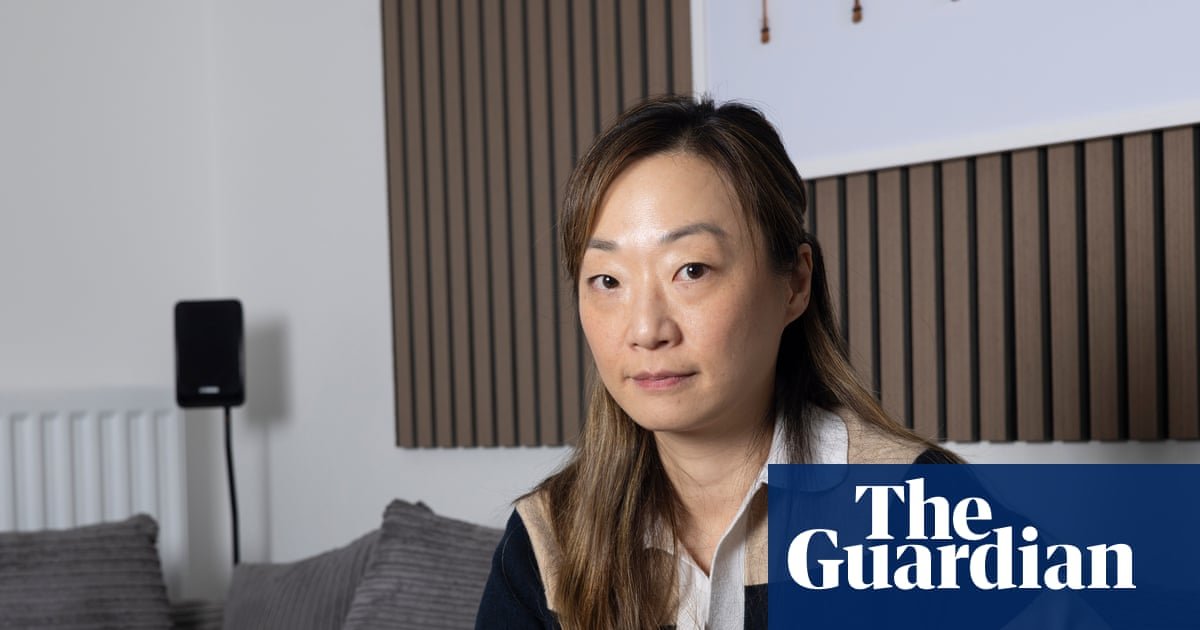
Jinnie Shin, 44, an emergency medicine doctor living in Bishop’s Stortford, Hertfordshire
Shin, originally from the US, came to the UK as a medical student in 2015. She had barely left medical school when the NHS was paralysed by Covid. As a newly qualified doctor at Croydon university hospital, south London, she found herself battling to save the lives of those floored by the virus – and comforting the dying as they said goodbye to their loved ones on video calls.
Five years on, Shin, from Boston, is now an emergency medicine registrar at the Princess Alexandra hospital in Harlow, Essex. Despite the sacrifices she has made for the NHS – she didn’t see her family for 18 months while working 12-hour shifts treating patients on ventilators – she wonders if she has a future in Britain.
Shin, 44, is now eligible for indefinite leave to remain. However, she has been left questioning whether it is worth paying the “enormous” costs – application fees start at about £3,000 – only for Reform to rescind settled status if they win the next general election.
She also worries that setting the salary thresholds for skilled worked visas at about £60,000 a year would devastate the NHS. A registrar beginning specialist training earns £52,656. The starting salary for a resident doctor – formerly known as a junior doctor – is £38,831.
“You are basically talking about culling [doctors] who will eventually become our registrars and consultants,” Shin said. “This sort of move would eliminate the foot soldiers of the NHS.”
Shin maintains that she was “fortunate” to be able to help the health service navigate the worst crisis in its history in her first year as a doctor, but feels the toll it took on her and other immigrants – about a fifth of the NHS workforce is from outside the UK – may be forgotten.
“It was terrifying,” she said. “I saw more death in the first two weeks than I have in my entire career thus far. As traumatised as many healthcare workers are, we do appreciate that we did a great service for people.
“Every day was the worst day of someone else’s life and that was our day, day in, day out. It was truly devastating. I was on my own without any family support.
“Some of us actually sacrificed our lives. Some of us have come out of it like we’ve been to war – because we really were at war with this virus. People are talking about us as if we’re a drain on resources.
“I have good friends who I see regularly. I have a partner, who is European, but has been settled in the UK for 20 years. We have a fantastic life here, in terms of what we have built for ourselves, but when we talk about our future here, we’re just not sure.”
Shin said she has also observed an uptick in “microaggressions” directed at some doctors of colour. The health secretary, Wes Streeting, recently said he was shocked at the “ugly” racism experienced by some NHS workers.
She added: “As someone who, every day, goes in and takes care of the people of the UK – some of these people, what if inside they’re thinking: I’d rather have a white, English, male doctor? It’s an uncomfortable situation to be in.
“I hate to think staying in the UK would be a bad decision, but it’s looking less and less like a good one. I would love to stay, because I’ve built my life here, but I don’t really feel that welcome any more.”
Sid Shyamsundar, 31, an engineer living in Bury, Greater Manchester
Shyamsundar was elated when he was offered his “dream job” as a human factors engineer, working to help enhance Britain’s defence capabilities amid increasing global instability. In 2021, he came to the UK from Pune, western India, on a skilled worker visa.
Sid Shyamsundar, an engineer from India, says uncertainty over visa rules has left him anxious about his future and life in Britain. Photograph: Christopher Thomond/The Guardian
He and his wife, a graphic designer, adore the life they have built in Bury, Greater Manchester, and want to buy their own home there. But with the future of Britain’s immigration system shrouded in uncertainty, they have put their plans on hold.
“2025 has been the hardest year I’ve had to face,” he said. “The reminders that your life may be temporary are a constant drain on your mental health. The big news announcements from all the parties take their toll. It’s always there in your mind that your way of life can be taken away from you. I haven’t slept very well in the last six months. It’s been difficult. It’s been an exercise in resilience. We’re socially, financially and even emotionally invested in the UK. We’ve almost had the rug pulled from under us.”
Shyamsundar should be eligible to apply for indefinite leave to remain next April, but is plagued by questions about whether this will guarantee a long-term future in the UK. He also lives with the threat of having his visa revoked should the rules change. He said he would not qualify for a skilled worker visa if Reform raised the salary threshold to about £60,000 a year.
“It doesn’t take away from what my job is – the people I want to keep safe, the pilots, ground crew, everybody,” he said. “But there is a lot of rhetoric around immigration. It can be demoralising when you focus on it, but as collective, we as defence workers, immigrants in defence and aerospace, make a difference.
“One of the biggest messages I try to deliver is that migrants are a net contributors. We have had a lot of chat that immigration is a drain on the economy. When you look at the hard data, there is a very different story.”
Shyamsundar said questions over his future in the UK often hit him at unexpected moments.
“It’s like a death by a thousand cuts – walking along in the autumn, seeing the leaves fall, and thinking, I might not be here next autumn,” he said. “That’s what really breaks your heart. It takes a toll on people.”
skip past newsletter promotion
Our morning email breaks down the key stories of the day, telling you what’s happening and why it matters
Privacy Notice: Newsletters may contain information about charities, online ads, and content funded by outside parties. If you do not have an account, we will create a guest account for you on theguardian.com to send you this newsletter. You can complete full registration at any time. For more information about how we use your data see our Privacy Policy. We use Google reCaptcha to protect our website and the Google Privacy Policy and Terms of Service apply.
after newsletter promotion
Douna Haj Ahmed, 34, a Syrian refugee working for a multiple sclerosis charity and living in Wembley, London
Douna Haj Ahmed, a Syrian refugee, says Reform’s plans to scrap indefinite leave to remain would ‘destroy’ her life and sense of stability. Photograph: Sean Smith/The Guardian
Haj Ahmed arrived in the UK on a scholarship in 2017, after living through years of war in Syria. Eight years later, Haj Ahmed – who works for a leading multiple sclerosis charity and says she has never claimed benefits – can’t imagine living anywhere but London.
“My integration is rooted in real human connection,” she said. “London now feels like home in every sense of the word. Each time I travel outside of the city, I feel the pull to return. When I return to London I’m pleased – I’m home.”
Haj Ahmed devotes her spare time to charity work. She has worked as a volunteer interpreter for refugees, given free tuition to A-level and GCSE students and provided companionship for dementia patients.
She and her husband, Abdullah al-Nofal, 37, have bought a house in Wembley, north-west London, and are in the process of applying for indefinite leave to remain, although they say their application has been complicated by recent regime change in Syria. Nofal says he was detained in Syria’s notorious al-Khatib prison – known as “hell on earth” because thousands were tortured there.
“Throughout these years, my husband and I have contributed to the economy and society without ever relying on the state,” Haj Ahmed, 34, said. “We have integrated fully into British society and British life. The relationships I have formed have become the foundation of my sense of belonging. I have embraced UK traditions, history and social norms.”
Haj Ahmed, who added that she has severe depression because of uncertainty over her immigration status, said Reform’s plans to scrap indefinite leave to remain would “destroy” her life.
“This policy undermines a sense of stability for us, which is essential to integration.” she said. “When people work, study and contribute for years, they deserve a clear and reliable pathway to permanence, not shifting rules which make belonging feel really conditional.
“I wanted to have children this year. We worked very hard to have a home here, so now we have a mortgage. We are reaching for stability but we don’t know where we’re going. The broader question is, what kind of country does the UK want to be? My story shows what refugees and immigrants can contribute when given the opportunity.”
Haj Ahmed said being deported to Syria would be unthinkable. Although the Assad regime fell late last year, concerns about violence and human rights violations persist. The country has also been targeted by Israeli drone strikes.
“I don’t have any other place to go,” she said. “I’m being treated as a number, a figure. It’s not my fault, what happened in my country. I ran away from death and the Assad regime.
“Many Syrians who visited Syria recently say they feel like strangers in a place they were born because the country has changed and so have we. Belonging is not just about geography, it’s about where your life is, where your friends are, where you feel safe, where you have a home.”
Sayali Wandhekar, 30, a designer living in Camden, London
Sayali Wandhekar: ‘I want to be here long term. But am I going to buy a house, settle here, have children here? It’s something I can’t plan for.’ Photograph: Sophia Evans/The Guardian
Sayali Wandhekar moved to London to study for a master’s degree in 2020. She loved it so much that, in 2022, she took a job as a designer in the corporate sector. However, the “shifting goalposts” on immigration rules mean she is now struggling to plan for the future.
Wandhekar, 30, hopes to apply for indefinite leave to remain when her skilled worker visa expires in 2027, unless the eligibility criteria changes before then.
“I don’t know what the system is going to look like,” she said. “How many years am I going to have to be on a skilled worker visa? I’ve come so close to getting ILR (indefinite leave to remain). In terms of mental health, it does create a lot of uncertainty.
“I want to be here long term. I’ve made a life here. I have a strong friend group. I have a proper life. But am I going to buy a house, settle here, have children here? It’s something I can’t plan for.”
Wandhekar says a “significant” number of her colleagues are “distressed” by the idea the salary threshold for a skilled worker visa could increase to about £60,000 a year. She added that a Reform victory in the next general election could force her to rethink her future in the country – and perhaps prompt her to return to her native Pune, in western India.
“[It] would definitely turn me towards considering other places I can move to, plus potentially moving back to India,” she said. “The last thing I want is to be on a skilled worker visa forever. It restricts my freedom.”
Wandhekar added that she feared the UK could suffer a brain drain if skilled workers were unable to settle in the country permanently.
“I have a friend group – most of them are on skilled worker visas,” she said. “If they were to scrap indefinite leave to remain, most, if not all of them will look for options outside of the country.
“I have friends who are engineers, in finance and consulting – highly skilled jobs. If they were to move back to other countries, then we are going to see fewer people in those workplaces. From a diversity perspective, you are going to miss out on international talent. How do you upscale people in the UK to take on those jobs?”
