

November 14, 2025
3 min read
Raccoons Are Showing Early Signs of Domestication
City-dwelling raccoons seem to be evolving a shorter snout—a telltale feature of our pets and other domesticated animals
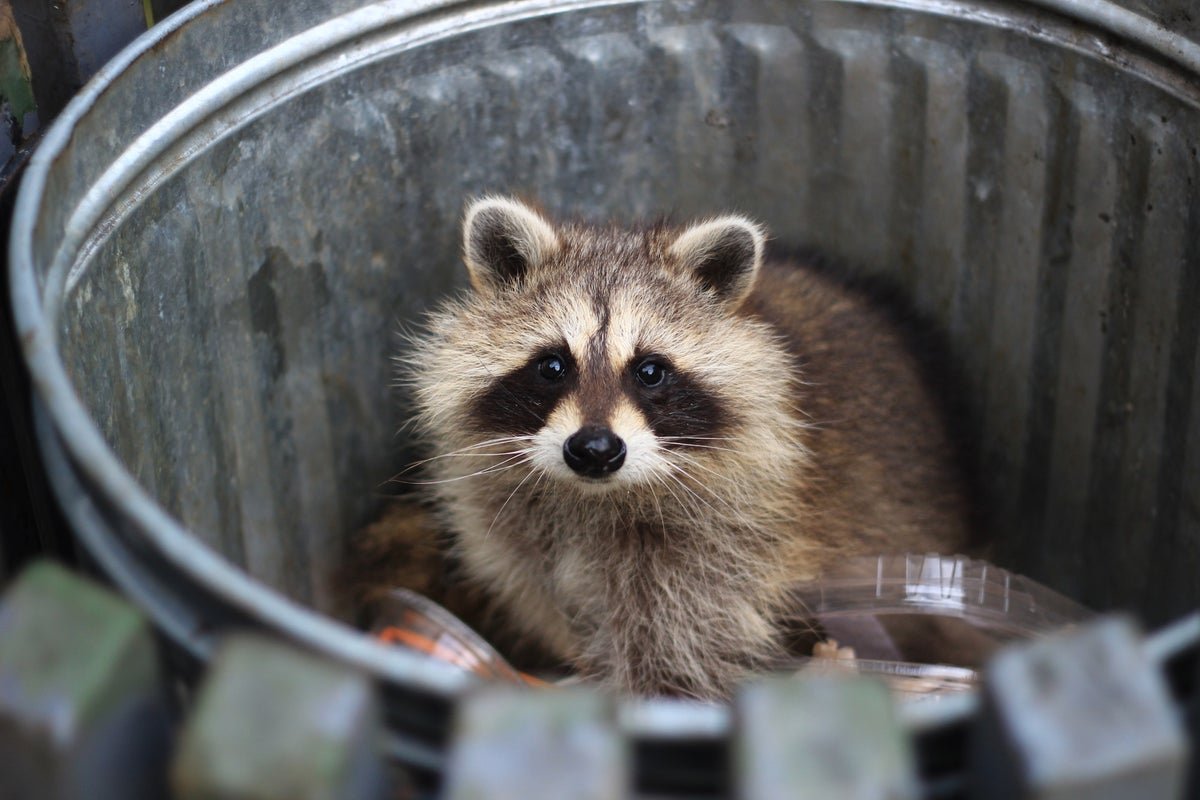
A raccoon in a trash can.
With dexterous childlike hands and cheeky “masks,” raccoons are North America’s ubiquitous backyard bandits. The critters are so comfortable in human environments, in fact, that a new study finds that raccoons living in urban areas are physically changing in response to life around humans—an early step in domestication.
The study lays out the case that the domestication process is often wrongly thought of as initiated by humans—with people capturing and selectively breeding wild animals. But the study authors claim that the process begins much earlier, when animals become habituated to human environments.
“One thing about us humans is that, wherever we go, we produce a lot of trash,” says the study’s co-author and University of Arkansas at Little Rock biologist Raffaela Lesch. Piles of human scraps offer a bottomless buffet to wildlife, and to access that bounty, animals need to be bold enough to rummage through human rubbish but not so bold as to become a threat to people. “If you have an animal that lives close to humans, you have to be well-behaved enough,” Lesch says. “That selection pressure is quite intense.”
On supporting science journalism
If you’re enjoying this article, consider supporting our award-winning journalism by subscribing. By purchasing a subscription you are helping to ensure the future of impactful stories about the discoveries and ideas shaping our world today.
Proto-dogs, for example, would have dug through human trash heaps, and cats were attracted to the mice that gathered around refuse. Over time, individual animals that had a reduced fight-or-flight response could feed more successfully around humans and pass their nonreactive behavior on to their offspring.
Oddly, tameness has also long been associated with traits such as a shorter face, a smaller head, floppy ears and white patches on fur—a pattern that Charles Darwin noted in the 1800s. The occurrence of these characteristics is known as domestication syndrome, but scientists didn’t have a comprehensive theory to explain how the traits were connected until 2014. That’s when a team of evolutionary biologists noticed that many of the physical traits that co-occur with domestication trace back to an important group of cells during embryonic development called neural crest cells. In early development, these form along an organism’s back and migrate to different parts of the body, where they become important for the development of different types of cells. The biologists hypothesized that mutations that hamper the proliferation and development of neural crest cells could later result in a shorter muzzle, a lack of cartilage in the ears, a loss of pigmentation in the coat and a dampened fear response—leading to a better chance of survival in proximity to humans.
Lesch says the neural crest cells are the most salient hypothesis scientists have to explain domestication syndrome right now, but they are still gathering and evaluating evidence for or against it. One piece of the puzzle would be seeing if domestication syndrome was observable in real time with wild animals. For the new study, she and 16 graduate and undergraduate students gathered nearly 20,000 photographs of raccoons across the contiguous U.S. from the community science platform iNaturalist. The team found that raccoons in urban environments had a snout that was 3.5 percent shorter than that of their rural cousins.
The findings fit with observations of urban foxes and mice and “indicate that once wild animals start spending time in the proximity of people, they become a little bit less afraid and perhaps even start showing physical signs of domestication syndrome,” says Adam Wilkins, a biologist at Humboldt University of Berlin, who first posited the neural crest cell explanation but was not involved in the new study.
Lesch would like to investigate further, perhaps trapping raccoons and comparing the genetics or stress hormones between urban and rural animals. She and her colleagues could also test if patterns hold true for other species such as armadillos and opossums. “I’d love to take those next steps and see if our trash pandas in our backyard are really friendlier than those out in the countryside,” she says.
It’s Time to Stand Up for Science
If you enjoyed this article, I’d like to ask for your support. Scientific American has served as an advocate for science and industry for 180 years, and right now may be the most critical moment in that two-century history.
I’ve been a Scientific American subscriber since I was 12 years old, and it helped shape the way I look at the world. SciAm always educates and delights me, and inspires a sense of awe for our vast, beautiful universe. I hope it does that for you, too.
If you subscribe to Scientific American, you help ensure that our coverage is centered on meaningful research and discovery; that we have the resources to report on the decisions that threaten labs across the U.S.; and that we support both budding and working scientists at a time when the value of science itself too often goes unrecognized.
In return, you get essential news, captivating podcasts, brilliant infographics, can’t-miss newsletters, must-watch videos, challenging games, and the science world’s best writing and reporting. You can even gift someone a subscription.
There has never been a more important time for us to stand up and show why science matters. I hope you’ll support us in that mission.
