

November 13, 2025
3 min read
Chinese Expedition Reveals Unexplored Section of Mysterious Arctic Ocean Ridge
Oceanographers hope to find otherworldly ecosystems at hydrothermal vents on the Arctic seafloor
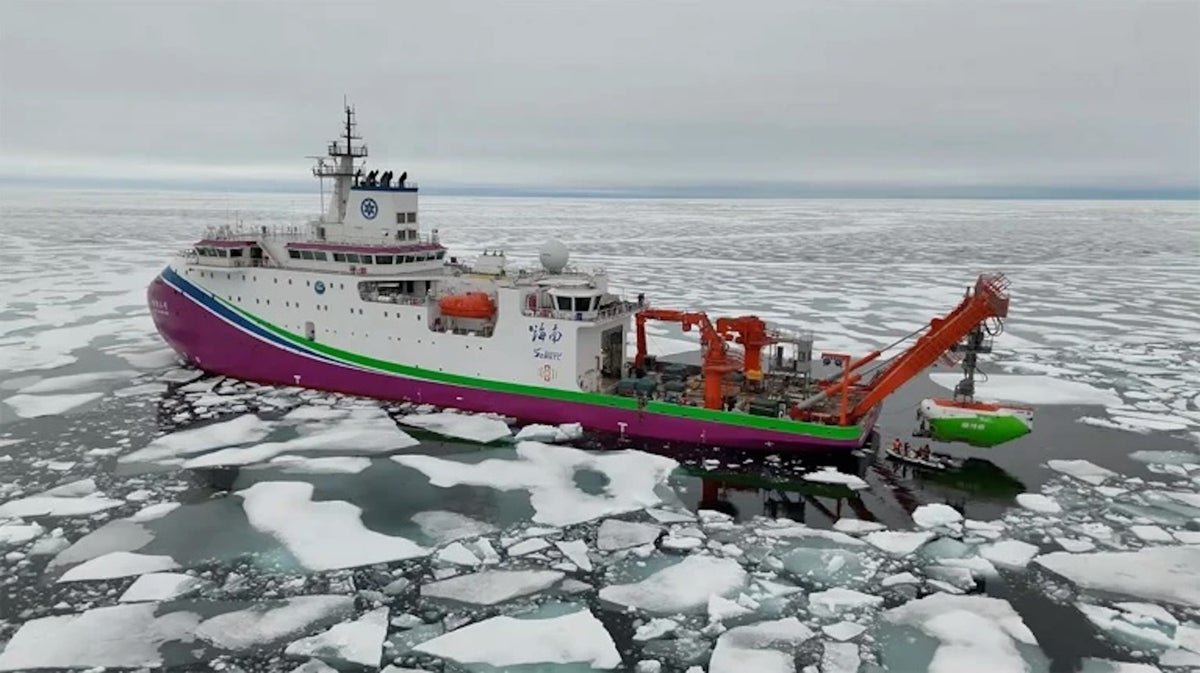
The submersible Fendouzhe being deployed off a Chinese icebreaker in the Arctic Ocean.
Courtesy of the Fendouzhe Research Team
Chinese scientists have become the first to visit one of Earth’s most remote and geologically intriguing realms: an underwater volcanic ridge in the Arctic Ocean.
The expedition, which concluded late last month, explored the eastern part of the Gakkel ridge — part of the global system of submerged mountain chains that play a key part in plate tectonics. A team of scientists took a submersible vessel beneath the Arctic sea ice and completed more than 40 dives, going as deep as 5,277 metres.
The analyses are far from complete, but this section of the Gakkel ridge might have hot-water vents that spew from the sea floor. Similar vents on the western, and better-explored, part of the ridge are home to bizarre ecosystems that thrive far from the reach of sunlight. They provide scientists with some of the best opportunities to understand how life might arise and evolve in icy oceans on worlds beyond Earth, such as on Jupiter’s ice-encrusted moon Europa.
On supporting science journalism
If you’re enjoying this article, consider supporting our award-winning journalism by subscribing. By purchasing a subscription you are helping to ensure the future of impactful stories about the discoveries and ideas shaping our world today.
Missing piece
Expedition scientists will spend the next few years studying the rocks, water and animals that they gathered during the submersible dives. “It’s the last piece of the puzzle” to understanding this unique Arctic environment, says Xiaoxia Huang, a marine geophysicist at the Institute of Deep-Sea Science and Engineering in Sanya, China, and the expedition’s chief scientist.
The Gakkel ridge stretches from off the coast of Greenland to Siberia. Volcanic eruptions along it create new sea-floor crust, which spreads away from the ridge at some of the slowest rates on the planet — slower than the rate at which fingernails grow. Yet, somehow that sluggish geology manages to produce enough heat and chemical energy to sustain hydrothermal vents on the sea floor.
In 2001, a US–German expedition discovered hydrothermal vents on the western part of the Gakkel ridge. Researchers have returned multiple times to that area to study the rich chemistry and biology of the deep, dark vent system.
But the eastern side of the ridge is more remote and challenging to explore. Russian scientists have conducted some surveys, but the latest Chinese expedition is the first intensive geological survey and diving expedition in the area, Huang says.
“It’s so hard to get there that anything anybody does is almost guaranteed to be exciting and different and new,” says Christopher German, a marine geochemist at the Woods Hole Oceanographic Institution in Massachusetts. “The Chinese expedition is poised to yield significant new insights,” adds Elmar Albers, a marine geoscientist at the Alfred Wegener Institute in Bremerhaven, Germany.
Risky expedition
The Chinese expedition, organized by the Ministry of Natural Resources and the Chinese Academy of Sciences, paired a deep-sea crewed submersible, named Fendouzhe, with an ice-breaker. It was the first time Fendouzhe, which has explored many parts of the oceans, including the Mariana Trench, has visited the Arctic region. Other expeditions have used remotely operated vehicles to explore the Gakkel Ridge, because of the dangers of the vehicle becoming trapped under floating sea ice.
Fendouzhe carried three people on board, usually two pilots and one scientist, and entered the ocean from the ship through a temporary clearing in the sea ice, Huang says. After descending and studying the sea floor, the submersible ascended and then paused 150–200 metres below the sea surface, and used a camera and a multi-beam sonar system to detect an opening in the ice above. At times, when an opening did not appear, the icebreaker created one by clearing some of the floating ice.
“To be honest, I was never afraid,” Huang says. “It’s really a privilege to have such an opportunity” to explore the sea floor in person, she says.
The dive sites were chosen to target geologically interesting areas, which included sea-mounts and cliffs. The researchers also studied fish and other marine creatures. Huang says it is “really fascinating how those animals survive” — both in the crushing pressure of the deep ocean and at shallower depths, in a realm that still remains dark for half of the year because of the extreme Arctic seasons.
Huang declined to provide details on possible hydrothermal vent discoveries, saying the data are still being analysed.
This article is reproduced with permission and was first published on November 12, 2025.
It’s Time to Stand Up for Science
If you enjoyed this article, I’d like to ask for your support. Scientific American has served as an advocate for science and industry for 180 years, and right now may be the most critical moment in that two-century history.
I’ve been a Scientific American subscriber since I was 12 years old, and it helped shape the way I look at the world. SciAm always educates and delights me, and inspires a sense of awe for our vast, beautiful universe. I hope it does that for you, too.
If you subscribe to Scientific American, you help ensure that our coverage is centered on meaningful research and discovery; that we have the resources to report on the decisions that threaten labs across the U.S.; and that we support both budding and working scientists at a time when the value of science itself too often goes unrecognized.
In return, you get essential news, captivating podcasts, brilliant infographics, can’t-miss newsletters, must-watch videos, challenging games, and the science world’s best writing and reporting. You can even gift someone a subscription.
There has never been a more important time for us to stand up and show why science matters. I hope you’ll support us in that mission.
