

Unlock the Editor’s Digest for free
Roula Khalaf, Editor of the FT, selects her favourite stories in this weekly newsletter.
Old cars, planes, tumbledown buildings and cans — one consequence of Britain being at the forefront of industrialisation is its huge quantities of scrap steel. The country is now the world’s largest exporter of scrap steel on a per capita basis, sending it to countries such as Turkey, Egypt, India and Pakistan.
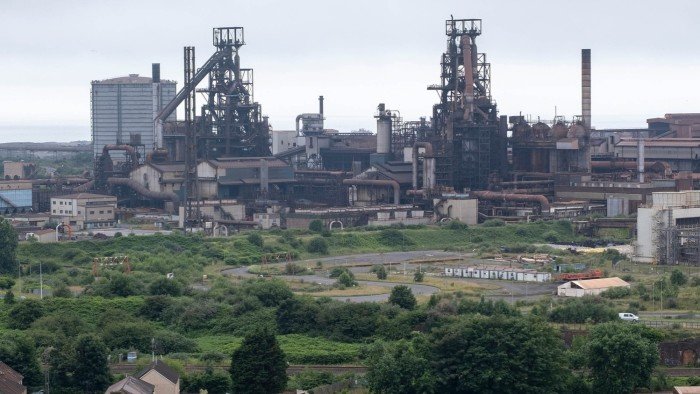
However, moves to increase the proportion of steel recycled domestically are under way. Tata Steel has closed its old, dirty blast furnaces in Port Talbot, south Wales, and is replacing them with a less-polluting electric arc furnace (EAF), which don’t require coal but use electricity to melt down scrap steel.
Similarly, British Steel, now under government control, is planning to replace its blast furnaces in Scunthorpe with EAFs. Both of Scunthorpe’s remaining blast furnaces were ageing, unprofitable and would have required substantial investment, adding impetus to the green transition.
The move away from blast furnaces is crucial to meeting emission reduction targets. The Port Talbot plant was the single biggest emitter of CO₂ in the UK and accounted for one-fifth of Wales’s greenhouse gas emissions, Tata says. Globally, the iron and steel industry is responsible for about 7 per cent of total global greenhouse gas emissions.
James Kelly, chief executive of the British Metals Recycling Association, believes recycling is the way forward. “Scrap-fed electric arc furnaces are the most sustainable and commercially viable technology to decarbonise steel production,” he says. “Unlike traditional blast furnaces, EAFs’ material mix can consist of 100 per cent scrap steel, supporting the circular economy.”
30-60%
Increased cost of steel production using green hydrogen in electric arc furnaces compared with blast furnaces
The transition will not be not cheap. Steelmaking using green hydrogen in EAFs emits far fewer greenhouse gases but costs 30-60 per cent more than conventional blast furnace production, according to Argus Media, a price reporting agency. Those costs weigh on an industry that is also struggling with a glut of Chinese steel, the new US and EU import tariffs and high energy prices, especially in the UK.
Tata Steel UK argues that EAFs will provide a way round these problems. The surplus of scrap metal in the UK will also help increase the UK’s self-sufficiency, meaning it will be able to produce around three-quarters of the raw steel needed, up from 18 per cent now, the company says. This, it argues, will reduce the “reliance on global imports and increasingly unstable supply chains”.
Modernisation is also helping. Nearly 90 per cent of the grades previously made in blast furnaces can now be produced in EAFs, Tata says. Almost a third of the world’s steel is made using EAFs.
Colin Richardson, steel analyst at commodity news agency Argus, says it is a “misnomer to suggest EAFs cannot produce the same grades as a blast furnace — for the most part they can, depending on the raw material mix used”.
The Port Talbot plant today after the closure of the last blast furnace © Mike Kemp/In Pictures via Getty Images
But if the switch to EAFs ensures the survival of UK steelmaking, it can’t entirely replace primary steelmaking — making steel from raw materials. Although the huge amount of scrap available in the UK will feed domestic steelmakers, there are unlikely to be sufficient supplies globally to meet world demand for steel. Primary steelmaking, therefore, will be needed globally towards 2050 and beyond, experts say.
Elsewhere in the world an increasing number of direct reduced iron (DRI) plants are being built. These produce primary rather than recycled steel, using iron and natural gas or gasified biomass. They still produce more emissions than EAFs but are popular in countries such as Saudi Arabia that have big supplies of natural gas. But DRI steel is unlikely to be produced in the UK because of the high energy costs, while it also still relies on mining primary ores, with all the associated environmental impact that brings.
It is a misnomer to suggest EAFs cannot produce the same grades as a blast furnace — for the most part they can, depending on the raw material mix used
Colin Richardson, analyst, Argus
There are other drawbacks to EAFs, not least that they require more electricity from the grid to produce the same volume of steel as a blast furnace. That makes industrial electricity prices particularly important, especially in the UK, where steelmakers pay up to 25 per cent more for electricity than rivals in France and Germany.
The average price of electricity for UK steelmakers for 2025-26 is £59.48/MWh, compared with £52.04/MWh in Germany and £47.76/MWh in France, according to UK Steel, a trade body. This indicates a price disparity of £7-£12/MWh, meaning the industry will pay 14-25 per cent more for its electricity than key European competitors.
Richardson adds that high energy costs mean EAFs are not a silver bullet for the industry. “The potential increase in green capacity elsewhere in the world, such as China, will also be a competitive threat,” he says.
