

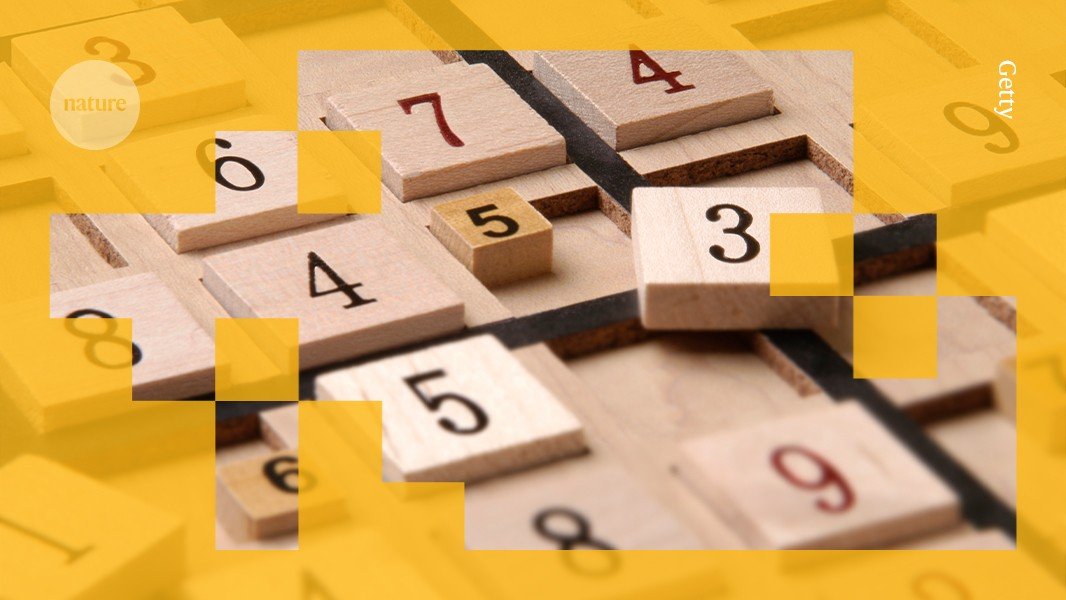
A Tiny Reasoning Model beat Large Language Models in solving logic puzzles, despite being trained on a much smaller dataset. Credit: Getty
A small-scale artificial-intelligence model that learns from only a limited pool of data is exciting researchers for its potential to boost reasoning abilities. The model, known as Tiny Recursive Model (TRM), outperformed some of the world’s best large language models (LLMs) at the Abstract and Reasoning Corpus for Artificial General Intelligence (ARC-AGI), a test involving visual logic puzzles that is designed to flummox most machines.
The model — detailed in a preprint on the arXiv server last month1 — is not readily comparable to an LLM. It is highly specialized, excelling only on the type of logic puzzles on which it is trained, such as sudokus and mazes, and it doesn’t ‘understand’ or generate language. But its ability to perform so well on so few resources — it is 10,000 times smaller than frontier LLMs — suggests a possible route for boosting this capability more widely in AI, say researchers.
“It’s fascinating research into other forms of reasoning that one day might get used in LLMs,” says Cong Lu, a machine-learning researcher formerly at the University of British Columbia in Vancouver, Canada. However, he cautions that the techniques might no longer be as effective if applied on a much larger scale. “Often techniques work very well at small model sizes and then just stop working,” at a bigger scale, he says.
A test of artificial intelligence
“The results are very significant in my opinion,” says François Chollet, co-founder of AI firm Ndea, who created the ARC-AGI test. Because such models need to be trained from scratch on each new problem, they are “relatively impractical”, but “I expect a lot more research to come out that will build on top of these results”, he adds.
The sole author of the paper — Alexia Jolicoeur-Martineau, an AI researcher at Samsung’s Advanced Institute of Technology in Montreal, Canada — says that her model shows that the idea that only massive models that cost millions of dollars to train can succeed at hard tasks “is a trap”. She has made the model’s code openly available on Github for anyone to download and modify. “Currently, there is too much focus on exploiting LLMs rather than devising and expanding new lines of direction,” she wrote on her blog.
Tiny model, big results
Most reasoning models are built on top of LLMs, which predict the next word in a sequence by tapping into billions of learned internal connections, known as parameters. They excel by memorizing patterns from billions of documents, which can trip them up when they come to unpredictable logic puzzles.
The TRM takes a different approach. Jolicoeur-Martineau was inspired by a technique known as the hierarchical reasoning model, developed by the AI firm Sapient Intelligence in Singapore. The hierarchical reasoning model improves its answer through multiple iterations and was published in a preprint in June2.
The TRM uses a similar approach, but uses just 7 million parameters, compared with 27 million for the hierarchical model and billions or trillions for LLMs. For each puzzle type the algorithm learns, such as a sudoku, Jolicoeur-Martineau trained a brain-inspired architecture known as a neural network on around 1,000 examples, formatted as a string of numbers.
How AI agents will change research: a scientist’s guide
During training, the model guesses the solution and then compares it with the correct answer, before refining its guess and repeating the process. In this way, it learns strategies to improve its guesses. The model then takes a similar approach to solve unseen puzzles of the same type, successively refining its answer up to 16 times before generating a response.
