

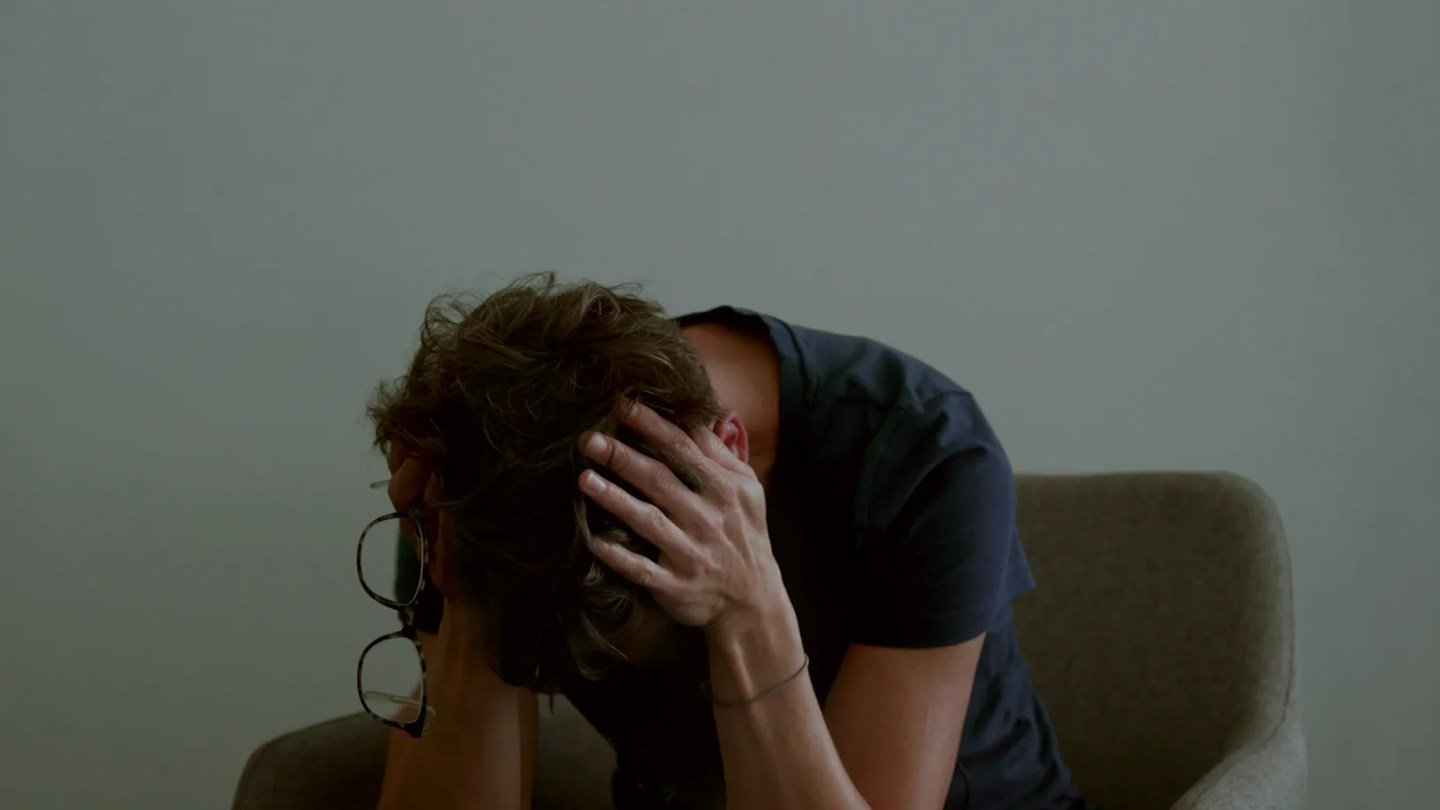
The human mind is a world full of surprises and secrets. If you need any proof, just watch Maasja Ooms’ (Alicia, Punks, Jason) documentary My Word Against Mine, which world premieres in the Lumious program of this year’s International Documentary Film Festival Amsterdam (IDFA) on Friday.
One of the surprising things an expert mentions in the documentary, produced by Willemijn Cerutti for Cerutti Film, is that one in 10 people hears voices. Ooms, who also handled the cinematography, introduces us to five such people living with this phenomenon. One of them hears a single voice, another hears 19. Some voices want to protect, others are out to berate – or even kill.
My Word Against Mine unfolds in a therapeutic setting, with a psychiatrist off-screen leading conversations with patients about their voices and, yes, even with the voices. After all, he wants to use new methods to find out who they are, what they want, and where they came from. Or as the IDFA website notes: “We witness how this revolutionary approach allows the patients to gain a greater insight into their own minds and acceptance of what goes on inside them.”
The film will be released in the Netherlands on March 26, with CinemaDelicatessen serving as the distributor.
IDFA 2025 runs Nov. 13-23. Among the scheduled My Word Against Min screenings at the fest is a special Nov. 20 screening (at 3:15 p.m. local time at Tuschinski 1, which will be followed by a Q&A and a meet-and-greet.
In an email interview, Ooms told THR about My Word Against Mine, stigma, what she learned from making the film, what viewers can take away from it, and the impact campaign she is planning.
What drew you to this topic and inspired you to make this fascinating documentary?
The human mind fascinates me endlessly. The head houses everything: emotions, thoughts, willpower, creativity, consciousness, dreams, trauma, inner criticism. Sometimes also voices that sound out loud. In my latest documentary, I dive into the world of voice hearers and the psychiatrist who works with them in a radically new way.
It all started with a book that was sitting on the bookshelf that I didn’t dare touch: The Philosophy of Madness by Wouter Kusters. I was afraid that it would grip me in such a way that I wouldn’t be able to escape the madness myself. That was actually the initial spark.
With that question, I went to Jim van Os, the prominent psychiatrist in the Netherlands, whom I already knew from an earlier film. I asked him if you can make yourself go crazy. His answer wasn’t very reassuring: “Everyone is psychosis-sensitive. There can always be a trigger, a stressful moment or a major event.” We talked further, and that’s when he brought up the recovery movement.
Can you tell me a bit more about that?
I dove into the subject and discovered that more and more psychiatrists are questioning traditional diagnoses. German psychiatrist Franz Ruppert says: “In every physical symptom, there is a piece of personal history.” Scottish psychiatrist Ronald David Laing went even further: “Insanity is a perfectly rational adjustment to an insane world.” What mainstream psychiatry views as illness would, according to him, be an understandable response to a dysfunctional society.
Dutch psychiatrist Jim van Os is even more explicit: “If we were honest, we psychiatrists would take off our white coats; there is little to nothing proven in mental health science. Schizophrenia doesn’t exist.” He advocates for humanizing psychiatry, returning to the human story: “The ordinary person on the street understands this, but today’s psychiatrist has completely lost sight of it.”
Is this therapeutic approach we see on screen a Dutch innovation or particularly prominent in the Netherlands?
Dirk Corstens is one of the pioneers, at least in the Netherlands. I don’t actually know what happens elsewhere, but his approach is unique. There are increasingly more voice clinics popping up, but they also do variations of things. I also hear here and there that people are engaging with voices in conversation. I see it with care institutions that are slowly picking it up and doing it in their own way. But I do believe that this psychiatrist is one of the first.
It’s not yet a prominent therapeutic tool, but there could very well be a surge because it apparently occurs frequently. Voice hearing occurs in 10 percent of the population, of which three percent become so disrupted that people really seek help. But they very often end up in closed wards, get a handful of pills, and don’t feel heard or understood.
During my research, I met people who told me what echoes inside their heads. Punishing voices. Hostile voices. Crying children. A man who stood with a drill to his head to make a hole, hoping the voices could escape. A boy who had cut off his finger on the voices’ orders. A woman whose voices drowned out everything, so she could no longer hear what others were saying to her.
They’re also very anxious, and anxiety medication does help with that anxiety, but, as I understand it, never actually with the voices themselves. The side effect: complete indifference – unbearable for most.
I love how much I feel I learned about the human mind, but still know probably only a very small bit. What did you learn about our minds?
What I learned about the mind from making this film is that everything really does seem to be a survival mechanism. When you dive in like that, you actually see that mental disruption arises from insecurity and stress. That’s become my lens, also towards this film. There’s no magic or another world that people are in. It’s just an overflow of stress – whether that’s trauma or terrible other events, which are always traumatic, probably.
Usually we have control over our inner life, but very often we don’t at all. You can’t sleep because of repeating thoughts or re-experiences that keep imposing themselves. Emotions become too overwhelming. That inner critic tears you down to the core. Or that voice whispers that you’re not worthy of this life.
Are you sick if you hear things others don’t hear? That’s the question that occupied me. Hearing voices means, in most cases, losing control over your inner world. Feeling that you’re no longer in charge of that voice. Are you going crazy then? You’re careful not to tell others. Voices that sound out loud… people will think that’s insane. But why, actually?
Why do we stigmatize people who hear voices like this? Should you be ashamed when something inside you increasingly wants to take control, wants to control you or even threaten you? Are you truly crazy when something stirs within you that you can’t do anything about?
I even think ADD or ADHD all relates to some kind of survival mechanism. I found that quite sobering and also very educational. It’s certainly known, but you really see it here: if you don’t do anything about it, the system continues to exist. A system is just a system that keeps doing what it does. You can really only give it a turn yourself. I think that’s also a beautiful discovery – that it never actually turns around by itself, but that you really have to work with it.
Jim believes that psychiatrists need to take off their white coats and that care should consist much more of peer experts. People who have experienced it themselves are also much more convincing to someone with a problem, and they also have more knowledge than a doctor who is also just groping in the dark. Because it’s not really a hard science what’s happening in the head, even though it is a science.
That’s how we came to Marius Romme, a psychiatrist who took a different path in the 1980s by listening to people’s complaints. A woman had said to him: “You listen to the voice of God, but not to the voice in me or from me.” Romme then said: “Okay, I’m interested.” He then spoke to many people who hear voices through a TV broadcast. From that experiential expertise, he began to inventory what those voices say – against the prevailing ideas. At the university in psychiatry, they were taught that you should never engage with that voice, because then people become psychotic. But he discovered something different: people felt heard, they found it nice to share things, and he started categorizing everything.
The psychiatrist I met worked with Marius for thirty years and learned a lot from him. He added something to that voice interview: namely, by also inviting that voice. He’s actually a pioneer in that, although it is a technique that already exists – Voice Dialogue.
Then I came into contact with psychiatrist Dirk Corstens. For 30 years, he has been working with voice hearers, and during his sessions, he actually engages in conversation with the voices themselves. A fascinating methodology in which he searches for the possible secret the voice harbors. This can be transformative for the voice hearer. Who is that voice, actually? What does it want and what does it say? Could that voice – if taken seriously – perhaps have something to tell you? Something that helps you understand why it’s there? Would the voice be willing to reveal that?
What was the hardest part of telling this story in terms of filming and editing this project?
The loss of someone was truly terrible. Brigitte – it was enormously empathetic with her, but also laughing. It was fun, until it capsized. All at once, there was a suicide attempt, and unfortunately, a successful attempt. That was terrible, really chilling to think about how it all happened.
And the finishing of the film: lots of technical bad luck at the end. But the process itself was fascinating and intriguing from A to Z. The process with everyone was very beautiful, very close with some, a little less with others. Really special to be so close and then map it out.
Filming first and then with the editor Sander Vos – that was also just a very special process to figure out how to make a film from therapy sessions. So it was also a quest in which I received a lot of help from Sander.
What went into the decision to include Brigitte in the film but not mention her suicide?
I thought about that a lot and tried it, too, to mention it in the film. Brigitte wanted nothing more than to tell her story. She insisted that it had to be told. And, the sad thing about her is… the suicide happened because she couldn’t overcome a voice. It turned out there was a fourth voice. The suicide isn’t in the film because then the film would only be about that. So in the editing, you have to weigh things up in terms of the strength of the stories. It happened long after the period when I was filming. Not that it matters, but it didn’t happen during the sessions when I was filming with Brigitte. I had already stopped filming for a while, and we just had a really nice relationship, and she kept me informed that she was being tormented by this new voice. And then she took sleeping pills, and I and the producer tried but couldn’t stop it. And the psychiatrist ultimately said you have to respect someone’s choice, and that’s true, of course. I know that and I do. And I understand it too. In a way, it’s also a relief for her, but tragic.
Were there any special rules the therapists and patients needed to allow a camera to be present? And how many hours of material did you film?
I think 70 or 80 hours, because during each therapy session, the camera was basically just running non-stop. That adds up quickly. I filmed a lot of sessions. Sometimes the sessions were also very long – three and a half hours – sometimes shorter. Some characters didn’t make it into the film, so that was a lot of plowing through and selecting.
Were there restrictions? Well, I’ve always felt that it’s very important that people have complete say in what can and cannot be in the film. So I have my own restrictions, but I give people freedom. That can, of course, only work with such a subject. We actually took good notes after each session and put in an email what was not for the film and for others’ ears.
I was allowed to follow this process closely and make a film about it, with the permission of the people involved. They too had a mission: to prove they’re not crazy, and thus break free from a terrible isolation.
What’s beautiful is that all these people also have a mission somewhere. You could also say it’s a kind of self-sacrifice. In any case, they see the importance of insight into what it is to hear voices. They see the importance of that so much, because they themselves become enormously isolated and walk around for years, decades, twenty years with the secret they have. So they have enormous interest in the stigma being reduced or disappearing, of course, preferably.
But yes, let’s be realistic – at least that the taboo opens up. That’s very nice when people have that wish for themselves. That’s actually ideal – then you make a film together with the same goal.
What is your hope for the reaction the film causes in viewers?
First of all, awe. As much awe as I have for the protagonists. What they do is incredibly strong. And that you realize that, in a certain way, it’s also about yourself. I mean, we all have an inner voice, or perhaps an inner critic. In any case, for the majority of people, it can go pretty wild in the head. You also have people on the other side: megalomania, only chest-thumping. But there are many people with a voice that belittles them. So it’s also very recognizable.
You can call it schizophrenia, but you can also think: it’s a gray scale. We all know the inner critic, but when it starts to sound out loud and takes you over like that, then that’s the other side of the axis, of the gray scale, of black and white. I thought it was nice how the psychiatrist once said that the difference between one extreme or the other is: if you have an inner critic and you still have the feeling that you’re the boss of it, that you have control over it, that you can just think “well, get rid of it, nonsense!” – that’s actually the difference.
When you need help, it means you no longer have control over it yourself. Then you actually just need another person, a listening ear, to arrive at a story together and also often dig up things from the past. I think the recognizability is the most beautiful thing – if people experience with the film that it’s also about them.
The intensive conversations and the intriguing manifestation of the voices gave me an insight of great significance: voices want the right to exist and have a reason for existing. I saw with my own eyes how the powerful words of Franz Ruppert gained meaning: “Truth heals delusion.”
What’s next for you?
A pause. Rest. And then: taking the film to the cinema – March 26, 2026. With my producer Willemijn Cerutti, we are setting up an impact campaign. So we’re going to execute all kinds of side programs, bring in speakers, and also give voice to the people from the film and the psychiatrist,
Willemijn.
The impact campaign aims to transform how both mental health professionals and the broader public understand and respond to voice hearing. For professionals within mental healthcare, the goal is to shift away from immediate medicalization toward a more humanized, listening-based approach – encouraging clinicians to pause, sit down with patients and their families, and ask, “How is it for you to work with this person? What moves you? What do you find difficult?” rather than defaulting to medication and diagnoses.
For families and the general public, the campaign seeks to break the stigma by normalizing voice hearing as a human experience that affects ten percent of the population, helping loved ones understand that voices are not automatically a sign of illness but often meaningful responses to trauma and stress that deserve to be heard rather than silenced. By fostering dialogue between these two groups and centering the voices of those with lived experience, the campaign aspires to prevent the kind of isolation and dismissal depicted in the film, where doors close and people are declared “untreatable,” and instead create space for connection, understanding, and genuine recovery.
Following seven impact gatherings, the collective insights and commitments will be presented to key stakeholders, including policy makers, mental health institutions, and advocacy organizations, during Mental Health Week in early June, translating the dialogue into concrete action and systemic change.
