

November 5, 2025
3 min read
Archaeologists Uncover a Monumental Ancient Maya Map of the Cosmos
Archaeologists have uncovered evidence of a ritual-based site that may have been built long before the rise of Maya rulers
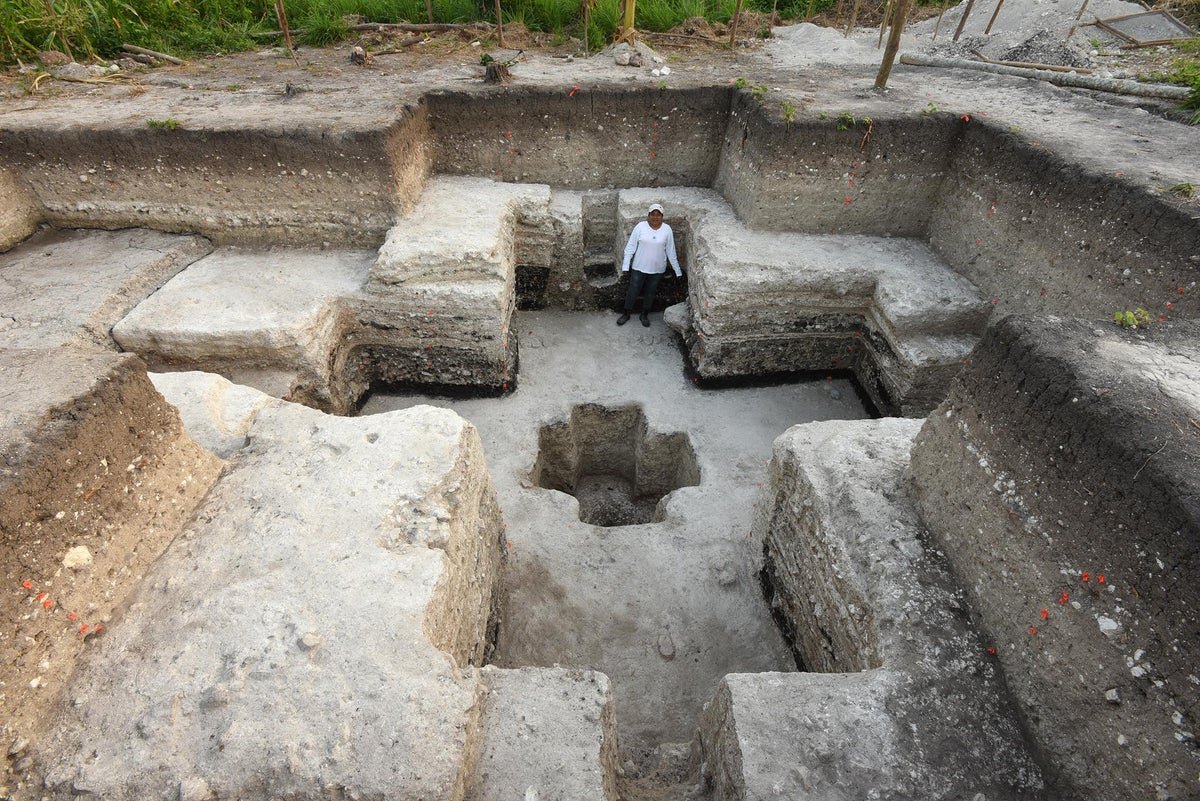
A cross-shaped pit found at the Aguada Fénix site in Mexico after excavation.
Finding the oldest Maya site ever documented was only the beginning of archaeologist Takeshi Inomata’s discoveries. After locating the Aguada Fénix site buried in the jungle of southern Mexico in 2017, Inomata and his team began digging downward and uncovered a massive cross-shaped pit.
Inside the pit were pigments of blue azurite to the north, green malachite to the east and yellow ochre to the south, as well as marine shells interspersed with axe-shaped clay offerings to the west, says Inomata, a researcher at the University of Arizona. Later the team realized that the cross-shaped pit was aligned with giant canals that extended toward the four cardinal directions.
The cross and the canals, Inomata says, form a cosmogram—a monumental map of the universe etched into the landscape. Cosmograms were used by Mesoamerican civilizations to represent their understanding and cultural relationship with the cosmos. Inomata says that his and his colleagues’ findings, published on Wednesday in Science Advances, challenge long-held assumptions about the social order of the ancient Maya and the reasons behind their architectural achievements.
On supporting science journalism
If you’re enjoying this article, consider supporting our award-winning journalism by subscribing. By purchasing a subscription you are helping to ensure the future of impactful stories about the discoveries and ideas shaping our world today.
Researchers Takeshi Inomata and Melina García Hernández excavate the cross-shaped pit with pigments marking the four cardinal directions.
For decades, archaeologists theorized that the monumental architecture built by the Maya civilization, such as pyramids and other ceremonial centers, arose after ancient Maya hierarchy began to emerge around 350 B.C.E. and was the product of powerful rulers who commanded labor and controlled resources. (This social scale consisted of four distinct classes, with slaves and commoners in the two lowest tiers and priests and nobility at the top.) Earlier Maya communities, by contrast, were assumed to live in small villages with modest ceremonial structures.
Aguada Fénix covers a nearly nine-by-7.5-kilometer area, making it one of the largest ancient constructions in all of Mesoamerica. After its discovery in 2017, the team found that the site dated from between 1000 and 800 B.C.E., long before Maya hierarchies had developed. “The question was ‘Why was it built?’” Inomata says.
To find answers, he and his team combined lidar (light detection and ranging) technology with excavations conducted between 2020 and 2024. From above, they found a pattern of raised causeways, carved corridors and canals that formed nested crosses, all oriented along north-south and east-west axes. At the center of this pattern lay a rectangular plateau and a plaza consisting of structures arranged in what is called an E Group, a ceremonial layout found across Mesoamerica and associated with astronomical observations. Beneath it, the team found the cross with the colored pigments. Radiocarbon dating placed the year of the ritual deposit as around 900 B.C.E.
The researchers also documented a network of canals and a dam that extended westward from the main plateau; these features were likely designed to channel water from a nearby lake. Though the hydraulic system appears unfinished, its monumental scale suggests an extraordinary level of coordination for its construction, Inomata says.
Because the canals served no practical purpose, the archaeologists thought they might have been built for ritual use. The team also found no palaces, royal tombs or elite residences at the site. Along with the evidence found inside the pit, this suggests that Aguada Fénix may have been a gathering place where dispersed communities came together seasonally for rituals, ceremonies and feasts. Instead of orders from a ruling class, “religion was very important and motivated people to do this huge work,” Inomata says.
Within the archaeological community, there is broad debate about what defines a cosmogram, says archaeologist Oswaldo Chinchilla of Yale University, who was not involved with the research. Some archaeologists, including Chinchilla, believe “the term has been somewhat overused,” he says, because it has often been applied to precolonization sites with limited evidence. The case of Aguada Fénix is different, however, given that “the evidence is strong.”
The use of pigments and the alignment of ceremonial centers with the sunrise and sunset are elements that are strongly tied to Maya religion and cosmology, something that endures today among Maya communities that still live in Mexico and Central America, Chinchilla says.
Pigments of blue azurite, green malachite and yellow ochre respectively mark north, east and south, and marine shells and axe-shaped clay offerings mark west.
“Based on what we know of Mesoamerican science and religion, the cruciform pit would have anchored everything to the cosmos,” says archaeologist David Stuart of the University of Texas at Austin, who also was not involved with the study. “It helped to make it a sacred space for the community that built it.”
Like Inomata and Chinchilla, Stuart proposes that the underground offerings placed around the pit “work as a metaphorical planting, activating the space, which amounted to a cosmic stage,” perhaps for communal gatherings and performances.
For Inomata, the new evidence is a reminder that social hierarchies are not always necessary when a goal serves the common good, such as by allowing for collective ritual. “This is a remarkable achievement of the [Maya] people who still live there,” he says.
It’s Time to Stand Up for Science
If you enjoyed this article, I’d like to ask for your support. Scientific American has served as an advocate for science and industry for 180 years, and right now may be the most critical moment in that two-century history.
I’ve been a Scientific American subscriber since I was 12 years old, and it helped shape the way I look at the world. SciAm always educates and delights me, and inspires a sense of awe for our vast, beautiful universe. I hope it does that for you, too.
If you subscribe to Scientific American, you help ensure that our coverage is centered on meaningful research and discovery; that we have the resources to report on the decisions that threaten labs across the U.S.; and that we support both budding and working scientists at a time when the value of science itself too often goes unrecognized.
In return, you get essential news, captivating podcasts, brilliant infographics, can’t-miss newsletters, must-watch videos, challenging games, and the science world’s best writing and reporting. You can even gift someone a subscription.
There has never been a more important time for us to stand up and show why science matters. I hope you’ll support us in that mission.
