

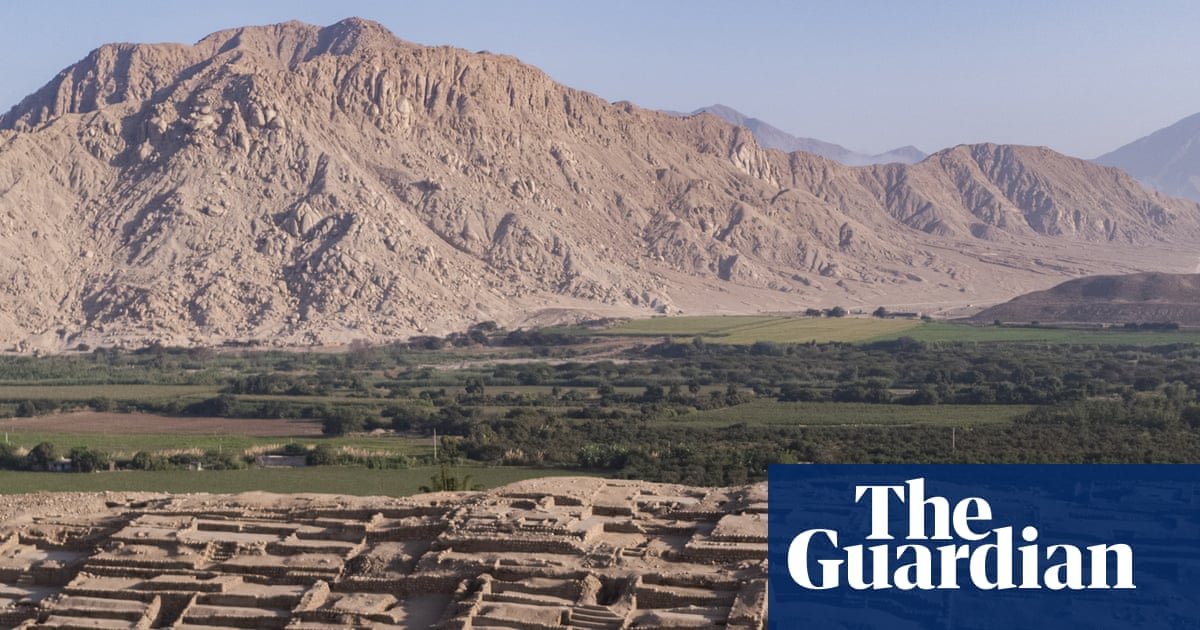
Archaeologists in Peru have found new evidence showing how the oldest known civilization in the Americas adapted and survived a climate catastrophe without resorting to violence.
A team led by the renowned Peruvian archaeologist Ruth Shady, 78, concluded that about 4,200 years ago, severe drought forced the population to leave the ancient city of Caral, and resettle nearby.
In the new settlements, they left intriguing friezes depicting victims of a famine with messages for future generations, Shady said.
“They left behind all this evidence so that people would not forget that the climate change was very severe, causing a crisis in Caral’s society and its civilization, and they did not want people to forget what caused it,” she said at one of sites where she was examining a temple pyramid.
Experts say the people of Caral took their decorative architectural style with them to new settlements. Photograph: Caral Archaeological Zone
One of the sites where the people of Caral made a new home was Vichama, to its west, on the arid Pacific coast, where the inhabitants survived by fishing in the sea and farming in the Huaura River valley.
The other settlement, dating from the same period between 1800 and 1500BC, was Peñico, 10 miles east of Caral, nestled in the same valley of the Supe River. It was established around the same time that early civilizations in the Middle East and Asia were developing.
Archaeologists say the people of Caral took with them their sophisticated decorative techniques of temple pyramids and sunken circular plazas to the new cities, which also featured new imagery telling their survival story to future generations.
One such set of images was discovered at Vichama on the walls of a temple on top of a raised platform in the desert. It is formed of three-dimensional mural reliefs that depict emaciated corpses with sunken bellies and protruding ribs; on a second wall above and set back there are pregnant women, ritual dancers and a pair of large fish.
Above both, on a higher wall, is an almost cartoonish design which shows the face of a toad emerging with human hands being struck in the head by a lightning bolt.
“After the deaths, the empty stomachs, a toad appears, emerging from the Earth with lightning striking its head, as if announcing the arrival of water,” said Shady.
Dr Ruth Shady speaks to visitors at the Vichama archaeological site. Photograph: Dan Collyns/The Guardian
The drought which afflicted Caral may have been part of a putative mega drought, known as 4.2ka, which some archaeologists believe forced people to abandon thriving cities in Mesopotamia and the Indus Valley and farther afield. It may have brought about the collapse of many ancient civilisations.
Archaeologists have found up to 18 structures, including residential complexes, in Peñico that strongly resemble the architectural style in the older city of Caral, which was founded about 800 years earlier.
“What stands out most is the organisation and the layout of the settlement, the structure and design of their buildings,” said Mauro Ordoñez, the chief archaeologist at Peñico. “For the era, it tells us that the organisation was based on a political-ideological structure and there is an absence of objects that leave evidence of violence.”
Peñico appears to have been a strategic hub between the coast, the Andean Cordillera and the Amazon beyond. Archaeologists have found the skeletons of monkeys and macaws that would have been brought over the mountains from the jungle, as well as ceramics depicting them. The colourful and charismatic animals may well have been used in ceremonies by shamans or leaders to denote status.
Unfired clay artefacts depict men and women of status with red painted faces and styled hair, indicating gender parity. Seashells from Ecuador’s tropical coast show a “constant relationship” with people from the north, as well as the south, east and west.
Food remnants show bones of fish from the Pacific Ocean, cotton, fruit and vegetables such as sweet potato, avocado, maize, squash and chili pepper. Trade appears to have thrived in open-air markets – much as they do in modern Peru – said Ordoñez.
Sculpted reliefs of the pututu, a conch shell trumpet still used in Andean religious ceremonies, adorn the walls of the central plaza. They were symbols of authority, said Ordoñez, and continue to symbolize Andean identity and resistance.
Friezes left behind in the new settlements carried a message for future generations to “not forget” what had caused the climate catastrophe in Caral, Shady says. Photograph: Dan Collyns/The Guardian
Shady’s discovery of Caral and its 32 monumental buildings rewrote the history books. Her findings astonished her fellow archaeologists by showing that the Americas also had a society that was contemporaneous with the first great civilizations in Mesopotamia, Egypt, India and China.
Now, evidence is growing that, faced with a climate crisis, the civilization did not disappear but adapted and moved. Predating the Inca, the Maya and the Aztecs by millennia, these civilisations had complex trade systems, gender equality and apparently coexisted in peace.
Shady believes Peruvians can learn much from their ancestors about “living in harmony with nature”.
Tatiana Abad, the chief archaeologist at Vichama, says the legacy of the Spanish conquest continues to affect Peruvians. “[The Spanish] considered that this was not a civilization, that it was an uncivilized society, but the latest research shows that neither writing nor the wheel were necessary to achieve a complex society.”
Vichama and its evocative imagery is testament to that. Another temple frieze shows snakes, also associated with water, entwined around the faces of the dead. Beneath them is a smiling, almost comical being that looks like a cross between an octopus and a video game space invader.
Shady believes the anthropomorphic image represents a joyous seed promising future harvests, an end to the famine and the triumph of life after a climate crisis.
