

November 2, 2025
2 min read
First-Ever Footage Shows Killer Whales Attacking Great White Shark Nursery
An orca pod has been spotted for the first time repeatedly targeting and flipping young great white sharks onto their backs to paralyze and dismember them
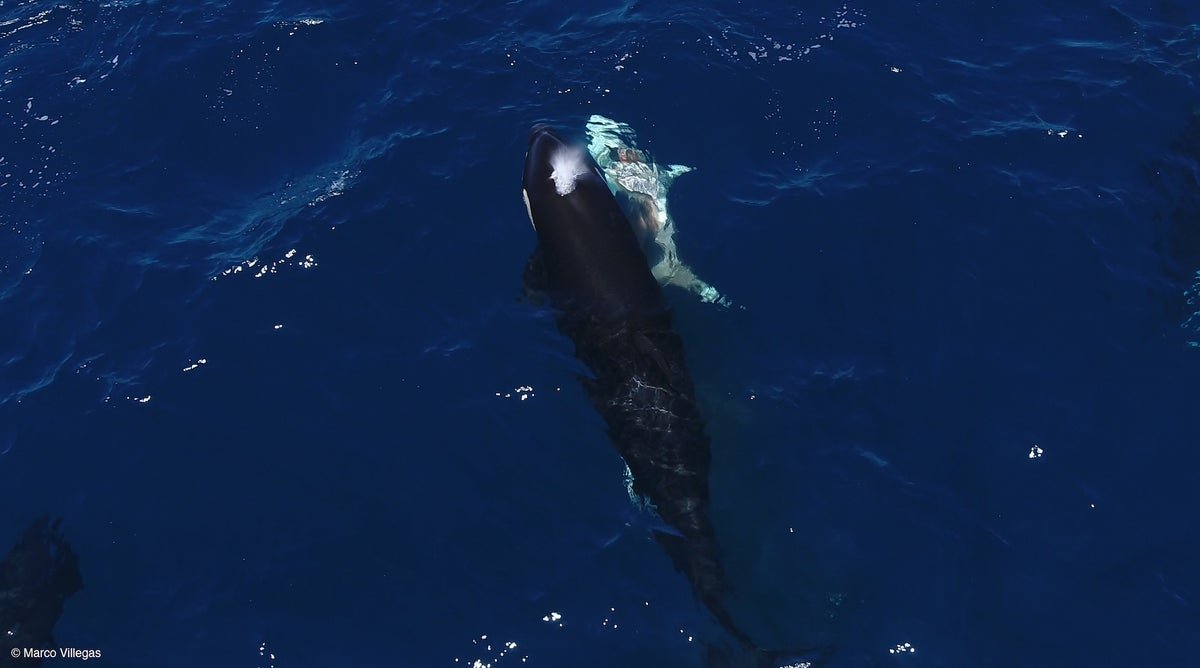
An orca swims next to a shark with a visible wound.
Orcas, or “killer whales,” are not known for their amiable demeanor. The famous bullies attack boats and pester other animals for reasons that sometimes aren’t entirely clear. Now, for the first time, they’ve been spotted repeatedly targeting young great white sharks in a shark nursery, according to a new paper published in Frontiers in Marine Science.
Researchers watched two hunts via drone while monitoring orcas in the Gulf of California. Newly released footage from August 2020 shows the first clash, during which five orcas teamed up to go great white shark tipping. After shoving a shark up to the surface, the orcas rolled it onto its back.
At that point, the battle was already won. Flipping a shark upside down induces a paralyzing state called tonic immobility, similar to a case of the twisties for a gymnast; it throws off the shark’s spatial awareness and disrupts the connection between the animal’s mind and body.
On supporting science journalism
If you’re enjoying this article, consider supporting our award-winning journalism by subscribing. By purchasing a subscription you are helping to ensure the future of impactful stories about the discoveries and ideas shaping our world today.
An orca strikes a shark in the belly.
The orcas then repeated the process with another young great white shark. In both cases, they went to all of that trouble mainly for each shark’s liver because the organ is loaded with nutrients and energy.
Two years later, in August 2022, the researchers saw a repeat: five orcas flipped over a young great white shark and ate its liver.
The observations were detailed enough that researchers could identify and track individual orcas by their dorsal fin, confirming that the same group—known as the Moctezuma pod, after its best-known member—was behind both attacks.
“This behavior is a testament to orcas’ advanced intelligence, strategic thinking, and sophisticated social learning, as the hunting techniques are passed down through generations within their pods,” said marine biologist Erick Higuera Rivas, who led the new paper, in a recent press release.
While scientists had previously seen orcas attack great whites, the killer whales mainly targeted adults, both for a larger meal and to get rid of competition for the same prey. The newly reported sightings represent the first direct evidence of orcas hunting down young great whites specifically. The researchers say the strange behavior may be linked to climate-change-induced warming waters, which seem to be pushing shark nurseries into the orca pod’s hunting grounds.
Aerial footage of orcas hunting juvenile white sharks in the Gulf of California, México. Credit: Erick Higuera and Marco Villegas
Because baby sharks are on their own from day one, their nurseries are really more like orphanages––there are no adults around to guard the little ones as they mature. That generally works fine because the animals have so few predators. But now that they’ve moved into dangerous waters, they may be forced to relocate once again.
“Nursery areas are where young sharks spend time growing and learning to forage, so displacing them from those habitats can be disruptive,” says Alison Towner, a marine biologist at Rhodes University in South Africa, who specializes in orca predation of sharks but wasn’t involved in the new study. “If the pressure is occasional, the impact may be limited. But if it becomes repeated, it could force juveniles into less suitable or riskier areas” and ultimately disrupt the entire ecosystem.
It’s Time to Stand Up for Science
If you enjoyed this article, I’d like to ask for your support. Scientific American has served as an advocate for science and industry for 180 years, and right now may be the most critical moment in that two-century history.
I’ve been a Scientific American subscriber since I was 12 years old, and it helped shape the way I look at the world. SciAm always educates and delights me, and inspires a sense of awe for our vast, beautiful universe. I hope it does that for you, too.
If you subscribe to Scientific American, you help ensure that our coverage is centered on meaningful research and discovery; that we have the resources to report on the decisions that threaten labs across the U.S.; and that we support both budding and working scientists at a time when the value of science itself too often goes unrecognized.
In return, you get essential news, captivating podcasts, brilliant infographics, can’t-miss newsletters, must-watch videos, challenging games, and the science world’s best writing and reporting. You can even gift someone a subscription.
There has never been a more important time for us to stand up and show why science matters. I hope you’ll support us in that mission.
