

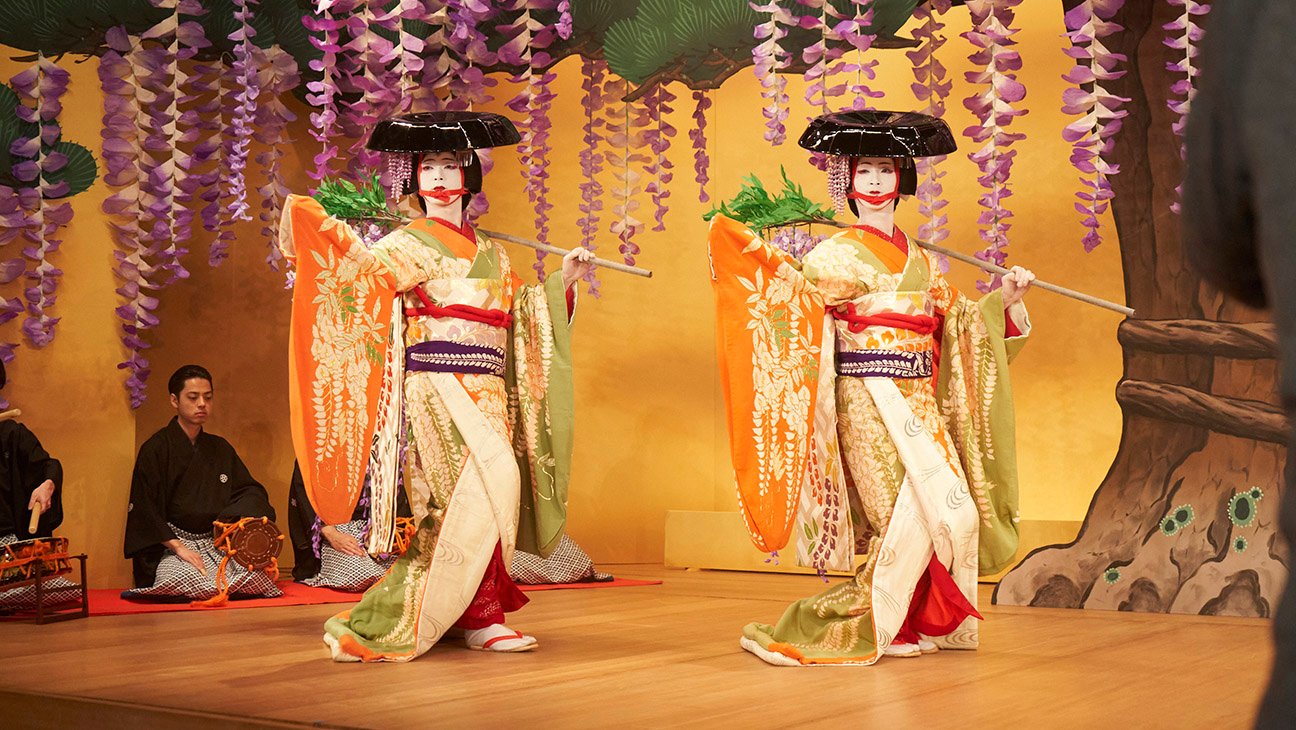
Kokuho, which takes its title and its novelistic sweep from a recent work of fiction about the rarefied world of kabuki, begins in the mid-1960s and ends 50 years later. Steeped in modern Japanese history without explicating it, director Sang-il Lee’s feature is propelled by operatic intensity and visual poetry. It unfolds over three mostly riveting hours, with only occasional jagged lapses in narrative momentum. Through its twinned stories of aspiring actors — one born into the kabuki tradition, one an outsider determined to climb its ranks — the movie blends backstage melodrama, succession saga and making-of-an-artist dynamics. At the center of its superb cast, Ryo Yoshizawa and Ryusei Yokohama deliver exquisitely layered performances that interweave offstage characterization and onstage theatricality.
After the crime drama Villain (2010) and murder mystery Rage (2016), Kokuho is Lee’s third adaptation of a novel by Shuichi Yoshida. Japan’s official submission to the Oscars’ international feature category, the film took its stateside bow at AFI Fest before it begins a limited-release run in mid-November.
Kokuho
The Bottom Line
Transporting and operatic.
Release date: Friday, Nov. 14 (Los Angeles); Friday, Nov. 21 (New York)
Cast: Ryo Yoshizawa, Ryusei Yokohama, Ken Watanabe, Min Tanaka, Soya Kurokawa, Keitatsu Koshiyama, Mitsuki Takahata, Nana Mori, Shinobu Terajima
Director: Sang-il Lee
Screenwriter: Satoko Okudera; based on the novel by Shuichi Yoshida
2 hours 55 minutes
Working from a screenplay by Satoko Okudera, Lee focuses on onnagatas — the male actors who have played female roles in kabuki since 17th-century shoguns forbade women from performing. Within the story, there’s no questioning of this tradition, feminist or otherwise — there’s only its pursuit and the esteem in which the onnagatas’ artistry is held.
The double-edged sword that Kokuho examines is about character trajectory, not social conventions. Its title is a term that means “national treasure.” When one character refers to an onnagata this way and says, “He’ll leave nothing except his art when he dies,” he means it as a sad commentary. But Lee and Okudera also mean it as the highest compliment. Even as the movie acknowledges the vanity of actors — “greedy creatures,” by one character’s estimation — it pays tribute to their hard work and how much of themselves they give, at least to their audiences. Strangers, of course, are easy.
Before Yoshizawa and Yokohama step into the central roles at about the 40-minute point, the main characters are teenagers, exceptionally well played by Soya Kurokawa and Keitatsu Koshiyama. The film opens with a rare snowfall in Nagasaki, and its haunting allure becomes a motif of the film, lightly used and effective. During a New Year’s banquet held by a yakuza (Masatoshi Nagase), a visiting kabuki actor, the renowned Hanjiro Hanai (Ken Watanabe, who starred in Rage as well as Lee’s 2013 remake of Unforgiven), perceives notable talent in his host’s son, 14-year-old Kikuo (Kurokawa), who performs a female kabuki role with energy and commitment.
A year later, after Kikuo’s father has been murdered and the boy has tried and failed (offscreen) to avenge him, his stepmother (Emma Miyazawa), in hopes of putting him on a path away from crime, sends him to Osaka to apprentice with Hanai, who is part of a lineage of kabuki actors known as the House of Tanba-ya and now heads the bloodline. Hanai’s skeptical but accommodating wife, Sachiko (Shinobu Terajima), agrees to essentially adopt Kikuo and help train him. (In a heartbreaking aside, the boy notes that his birth mother died from “A-bomb disease.”)
Sachiko’s son, Shunsuke (Koshiyama), is the same age as Kikuo and they have similar physiques, with the notable difference that Kikuo’s back is covered with a yakuza tattoo depicting a fierce eagle-owl. Their sibling rivalry is instant, but so is their partnership and mutual encouragement as they train together under the exacting tutelage of Hanai.
His methods, physically rough and verbally insulting, wouldn’t pass muster today, and raise a few eyebrows in 1965, but Kikuo, blossoming under the attention and disregarding the bruises, considers him an “amazing” teacher. Hanjiro Hanai gives him the stage name Toichiro Hanai, placing the orphaned yakuza’s son in his kabuki lineage as Sachiko looks on with concern. Whether Kikuo is a kabuki natural or merely more ambitious than Shunsuke — or, as Sachiko later declares, a “filthy thief” — his mentor recognizes courage as well as ability in him. But the path is hardly a smooth one.
Sounding a note of warning is a famous elderly onnagata, Mangiku (a compelling Min Tanaka), who tells Kikuo that his beauty might get in the way of his art. Watching Mangiku onstage is an epiphany for Kikuo, marking the end of the first section of the drama, which then jumps to 1972. Kikuo and Shunsuke — now played, respectively, by Yoshizawa and Yokohama — are young adults who have trained together as onnagatas. In pieces like Wisteria Maiden (title cards provide concise plot descriptions), bedecked in classic makeup and intricate costumes, they move with the discipline and symmetry of synchronized swimmers. Over Hanai’s objections, the House of Tanba-ya’s corporate benefactor (Kyusaku Shimada) books them into a large theater, and soon their onnagata-duo novelty has given them a kind of boy-band heartthrob popularity.
But they’re not exactly moving in unison offstage; Shunsuke is more attuned to the publicity game and the need for patrons. And he’s increasingly aware that he might not have the innate talent of his stage partner.
Even Kikuo’s girlfriend, Harue (Mitsuki Takahata), understands that she’s no match for his all-consuming devotion to his art. When she and Shunsuke, seated separately in the audience, watch Kikuo perform the lead female role in Love Suicide, they know they’re witnessing something cathartic and life-changing for him. This sequence, with its onstage vengeance, despair and keening dialogue, and its offstage look at how Kikuo’s triumph affects the two people closest to him, is one of the most powerful in the movie. It’s potently scripted (“I want to be a real actor, not a pretend one,” Shunsuke confesses tearfully), and the deft editing is by Tsuyoshi Imai.
Production designer Yohei Taneda (Kill Bill: Vol. 1, When Marnie Was There) creates not just a broad variety of lived-in spaces within an extensive range of periods, but also the stylized, vibrant artifice of the kabuki stage sets. Likewise, Kumiko Ogawa’s costumes include character-defining garments as well as elaborate getups for the plays, some of which are constructed for suspenseful onstage costume changes. The lensing by Sofian El Fani (Blue Is the Warmest Color) captures the play of textures and light, with special attention to close-ups of the kabuki actors, their faces revealing so much through the mask-like makeup. Moving between orchestral swoons and more restrained, stripped-down instrumentation, Marihiko Hara’s score is in sync with the heightened lyricism of the story.
As it moves through the decades, the narrative is sometimes overheated, and the characters’ twists and turns in the second half can be more jarring than gripping. But there’s nothing predictable about the paths of Kikuo and Shunsuke — or that of any of the characters, a case in point being the way a businessman (Takahiro Miura) who at first treats Kikuo with disdain becomes an ally.
As their characters each face struggles, triumphs and reversals, the two leads never falter. Playing a man so driven that he barely knows the child he had with a geisha (Ai Mikami) and later embarks on a possibly opportunistic romance with the daughter (Nana Mori) of an established actor (Ganjiro Nakamura, also the kabuki adviser for the movie), Yoshizawa is neither hissable nor pandering, but offers something far more interesting and enigmatic.
As Kikuo’s mentor and Shunsuke’s father, Watanabe brings gravitas to a character no less flawed, and just as persuasive. Encouraging Kikuo to embrace art over his criminal legacy, he tells him that mastering kabuki can be his “sweet revenge.” Maybe, in a sense, this is a crime saga after all, a story of codes of honor and loyalty. Above all, it’s one of fevered beauty. The onnagata performances are played with power and elegance by Yoshizawa and Yokohama; their characters are brothers-in-art in the man’s world of kabuki, embodying a ritualistic idea of womanhood that’s otherworldly. The actors they portray are all the more fascinating for being merely human.
