

In 1986, the appeal of “(You Gotta) Fight for Your Right (To Party!)” was delightfully uncomplicated. The Beastie Boys had turned the simple art of rebelling against authority figures—teachers, parents, anyone who seemed like a teacher or a parent—into a rallying cry. One specific moment captured the group’s insouciant defiance better than any other: when, in the song, the Beasties start blasting their favorite music loud enough to upset their parents, a purposely abrasive form of protest that all kids could mimic themselves.
My own daughter is 9 years old, but something tells me that when she’s a teenager, I won’t be banging on her door demanding that she turn the music down. Chances are I’ll have to ask her what she’s listening to if I want to find out. In the nearly 40 years since the Beastie Boys crashed the charts, the culture of listening has become far more insular. In 2024, about 455 million headphones were sold worldwide, a 59 percent increase over 2014. According to a recent report, 78 percent of streaming consumers now listen to music through headphones or earbuds. Ride public transit or visit a gym and you’ll find yourself sharing a physical space with people who are plugged into their headphones, blissfully disconnected from their surroundings. Fittingly, a popular single this summer was Addison Rae’s “Headphones On”—a song that luxuriates in sealing yourself off from the outside world.
Headphone listening—the act of playing a highly personalized soundtrack wherever we go—is a surprisingly radical invention, and we’re only beginning to contend with its implications. The visible barrier it creates between the listener and everyone else is obvious. Less obvious is the invisible barrier: The more time we spend in our own musical echo chambers, the less likely we are to share a collective cultural experience. The power of music has long been its ability to soundtrack a generation—to evoke emotion, as well as summon a specific time and place. Headphone listening not only isolates the listener; it shrinks music’s cultural footprint.
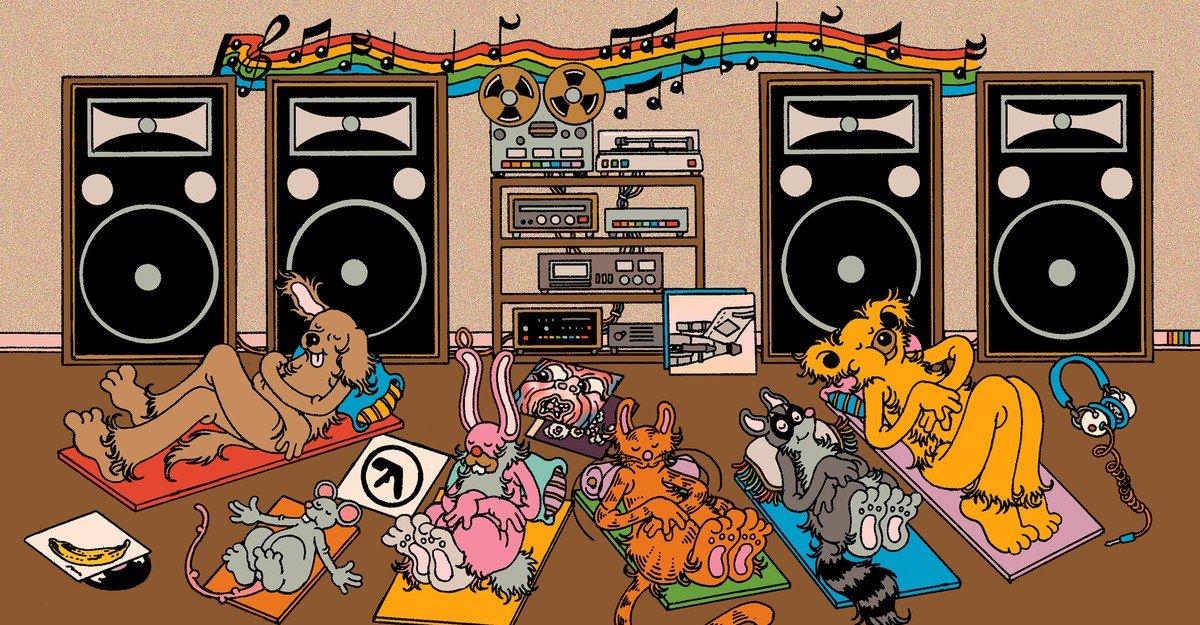
It’s hard to imagine now, but at the height of the vinyl era, in the 1960s and ’70s, people gathered for album-listening parties. My father remembers being invited to friends’ homes on the day a new Beatles album dropped, so they could hear it from start to finish together. In subsequent decades, those group rituals became rarer as genres splintered and people’s tastes diversified. The MTV era replaced Baby Boomer monoculture with a constellation of genres that listeners built their identities around: punk, hip-hop, metal. Still, plenty of opportunities for shared listening remained. I grew up in the ’90s, and like lots of kids in my generation, I was introduced to many artists through unexpected encounters in public or semipublic settings. In high school, the TVs in the student center were often tuned to MTV; in college, I listened to many albums for the first time in a friend’s dorm room.
I also borrowed albums to play alone on headphones, but that was a different experience from today. Private listening was relatively rare, a way to deepen your connection with a specific piece of art. Corded headphones tethered you to the stereo, limiting your sessions. And while the Walkman and Discman allowed for on-the-go privacy, even their most ardent defenders would admit that these devices were clunky compromises. If you wanted to listen to multiple artists or albums on a Discman, you had to lug around a CD wallet—a far cry from our modern, effortless portability.
Now the balance has shifted. Music hasn’t disappeared from our social lives, but it is more often consumed privately than communally. This revolution is less a rupture than a culmination of a long shift—from music as a unifying force to music as an individual pursuit. Headphones transform music from something you might once have blasted through speakers—in a car, a dorm, a living room—into something almost entirely confined.
This shift is further enabled by the platforms where most modern fans do their listening. The core promise of streaming services such as Spotify is that you can access nearly the entire history of recorded music at virtually no cost. That abundance is real, but the platforms are designed to keep us moving, not lingering. Even the word streaming suggests a frictionless drift from one song to the next. Breadth is prioritized over depth; the goal is to strengthen loyalty to the platform, not devotion to an artist or album. Listeners are encouraged to hop around tracks on a playlist, not live with an artist’s work long enough to let it shape them. I’m confident I would have stumbled upon the Cure’s Disintegration had I grown up in the headphone era, but I’m less certain I would have listened long enough for it to leave a lasting impression.
When that kind of listening behavior scales up across an entire population, and audiences are spread thin, the cultural conversation quiets. Music is everywhere, but it’s less important. In just the past decade, late-night shows’ bookings—a reliable rite of passage for musical artists on the edge of a breakthrough—have dropped significantly, to barely 200 performances in 2023. Legacy publications such as NME, once devoted almost entirely to music, have expanded their areas of coverage to survive the era of atomized taste. The live-music industry—now dominated by an exhausting array of festivals with absurdly long artist lineups—reflects the haphazard, algorithmically reinforced tastes built by the culture of headphones.
Music isn’t losing ground just to isolationist listening habits but also to the broader explosion of competing entertainments—on-demand TV and film, immersive gaming platforms, social media. Consider how a general-interest publication such as Entertainment Weekly—which debuted in 1990 with k.d. lang on its cover—featured no musical artists on any of its 22 digital covers last year, choosing instead to focus entirely on screen culture. Taken together, these changes raise a disquieting possibility: What if pop music is well on its way to not being popular in any real sense?
And yet, there are signs of a countercurrent, with some newer listening options hinting at a more cohesive alternative. Music-themed cruises—serving metalheads, emo fans, jam-band devotees—are flourishing, offering not only the spectacle of floating concerts but also the chance to share a physically enclosed, specifically curated experience with fellow fans (when done right, at least). Similarly, some music influencers have begun piloting live-listening and album-playback sessions on Twitch—an attempt to transplant a cherished artifact of the analogue era into the digital world. These experiments point to a hunger for musical experiences that are deeper and more communal.
Recently, my wife and I made our own modest attempt to bridge the divide: buying our daughter a small stereo. Weeks later, I realized that I still hadn’t heard any sound from her room. When I asked why, she looked embarrassed: “Daddy, I didn’t want you to hear anyone say a bad word.” Not exactly the defense of headphone listening I expected—but a reminder that music has always lived in the tension between the private and the public, the songs we guard closely and the ones we blast without apology. I can only hope she’ll come to appreciate that both have their place.
