

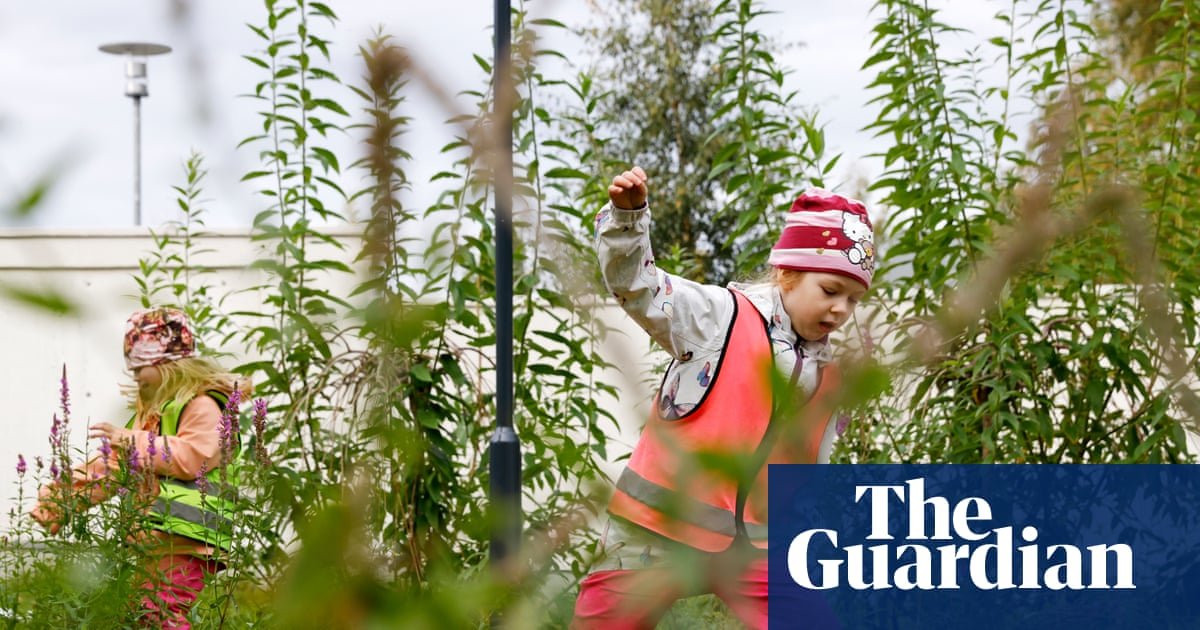
Aurora Nikula, 5, is having a normal day at her nursery. She is making a cake out of sand and mud, adding in make-believe carrots, potatoes and meat. “It’s overcooked,” she says as she splashes water in, then adds another dollop of sand. “More sugar, it tastes better,” she says. A handful of mud goes in, and the dish evolves into a chocolate cake.
Aki Sinkkonen, a principal scientist with the Natural Resources Institute Finland, is watching. He’s also very interested in Aurora’s cake, but for different reasons. “Perfect,” he says, admiring the way she is mixing soil, sand and leaves and then putting it on her face. “She’s really getting her hands in it.”
To a hygiene-conscious kindergarten, this could be a problem, but at Humpula daycare centre in Lahti, north of Helsinki, children are encouraged to get muddy. Across Finland, 43 daycare centres have been awarded a total of €1m (£830,000) to rewild yards and to increase children’s exposure to the microscopic biodiversity – such as bacteria and fungi – that lives in nature.
We already know that access to the outdoors is important for children and their development. But this study goes one step further. It is part of a growing body of research linking two layers of biodiversity. There is the outer layer – the more familiar vision of biodiversity, made up of soil, water, plants, animals and microbial life, that lives in the forest, playground (or any other environment). And then there is the inner layer: the biodiversity that lives within and upon the human body, including the gut, skin and airways.
Increasingly, scientists are learning that our health is intimately linked to our surroundings, and to the ecological health of the world around us. The first 1,000 days of human life – when the brain and body are most rapidly developing – are considered particularly crucial.
Saija Kilkki, an early-childhood educator, at Humpula, with Aurora Nikula (left) and Eevi Paronen (right)
Putting the children in charge
This kindergarten has been exploring that relationship through a novel experiment – including digging up a piece of the forest floor, and seeing how exposure to it changes children’s health. In autumn, the daycare centre – which has 180 children and 50 staff – looks much like an allotment run by children.
The compost is fed with old leaves and weeds, and then used to grow beetroots, carrots, cucumbers and potatoes, courgettes and chillies. Now parsley is the only thing left – winter is drawing in and everything else has been eaten. The children, however, remain outside.
The plants, dead wood and soil in the daycare centre have all been specially selected for their rich micro-biodiversity. They have also dug up and imported a giant live carpet of forest floor, 20-40cm deep and 10 metres square. It has blueberries, lingonberries and moss growing on it, to encourage the children to forage, find bugs and learn about nature.
“This area has not been forested for 200 years so this is a substitute,” says Sinkkonen. In a wetland area they can balance on rocks and play among a different selection of plants. Five years ago, it was a gravel car park.
This kindergarten was included in a two-year study looking at how biodiversity enhancements affect the microbial composition of children’s skin, saliva and faeces. The study was the first of its kind. Blood samples were taken to look at immune defences, and a short questionnaire about infectious diseases was filled out every three months. In total, 75 children aged between three and five across 10 urban daycare centres took part in the study. It compared “rewilded” daycare centres such as this with others covered in asphalt, sand, gravel and plastic mats.
A year later, it found children playing in the green kindergartens had less disease-causing bacteria – such as Streptococcus – on their skin, and stronger immune defences. Their gut microbiota showed reduced levels of Clostridium bacteria – associated with inflammatory bowel disease, colitis and infections such as sepsis and botulism. Within 28 days it found an increase in cells in the blood – called T regulatory cells – that protect the body from autoimmune diseases. Other research showed that in just two weeks children’s immune system regulation could be improved by playing in a sandpit enriched with garden soil.
The human body contains trillions of bacteria, viruses and fungi, which are essential to how we function. Research shows external micro-biodiversity (such as bacteria and fungi) is transferred into the body through touch or ingestion.
Even breathing counts: the air has its own microbiome, which is associated with tree and plant species in the surrounding area. Soil – home to 90% of the world’s fungi – also feeds the microbiome in the air.
Scientists think one of the reasons so many people now have allergies is because they were not exposed to microbes that occur naturally in the environment at a young age. The “old friends” hypothesis says humans evolved alongside microbes in air, plants and soil. The body can exchange useful microbes (bacteria and fungi, for example) with the natural world to stay healthy.
Marja Roslund, a scientist at the Natural Resources Institute Finland, says: “It’s good for national health. Immune diseases are expensive. Even a small reduction in the burden of these diseases is good for national health and the economy.”
Previous research found that early exposure to green space was linked to a healthy immune system, but it was unclear if this was causation or correlation. The Finland study suggests it could be causal. An Australian study published last year corroborated the findings, showing children playing with a range of different soils had better gut health and a stronger immune system.
Moving the inside out
The interest in bringing dirt and nature into nurseries is spreading. In Helsinki, Poutapilvi-Puimuri daycare centre is being redesigned with the help of a €30,000 (£25,000) government grant. It currently looks like a building site with a couple of diggers at work, but soon there will be trees, flowers, rocks, planters, sandpits and a grass area for games. “We told the architects we want nature in it,” says Marjo Välimäki-Saari, the centre’s director.
“We’re moving the action from inside to outside. We want to show the children nature so they learn about it,” says Välimäki-Saari.
The kindergartens provide more evidence of just how crucial healthy ecosystems are to human health. As biodiversity, habitats and wild species are lost around the planet, there are huge potential repercussions for human wellbeing. Increasing on site biodiversity can be a win-win for children’s health and the environment.
The University of Sheffield has done research on installing green barriers around school playgrounds to prevent air pollution from harming children’s health. Based on that study, Hunter’s Bar infant school in Sheffield created a 70-metre-long hedge of plants and shrubs that wraps around the playground, which is close to a busy road. Nitrogen dioxide (NO2) concentrations in the playground were reduced by 13% six months after planting, and further decreases are expected as the hedge matures.
Marjo Välimäki-Saari, the head of Poutapilvi-Puimuri daycare centre, helps Mikael (right) and Eero look for apples
“More and more people are saying they want to make these daycares in their towns,” says Roslund. Visitors from Norway, Iceland and Denmark have come to see how they could replicate the Finnish model at home. “I don’t want to see rubber mats in any kindergartens,” says Sinkkonen.
Find more age of extinction coverage here, and follow the biodiversity reporters Phoebe Weston and Patrick Greenfield in the Guardian app for more nature coverage
