

October 28, 2025
3 min read
What’s Behind This Luxury ‘Cat Poo’ Coffee’s Unique Flavor
Civets enrich coffee beans they eat and excrete with two fatty acids often used in dairy products, study finds
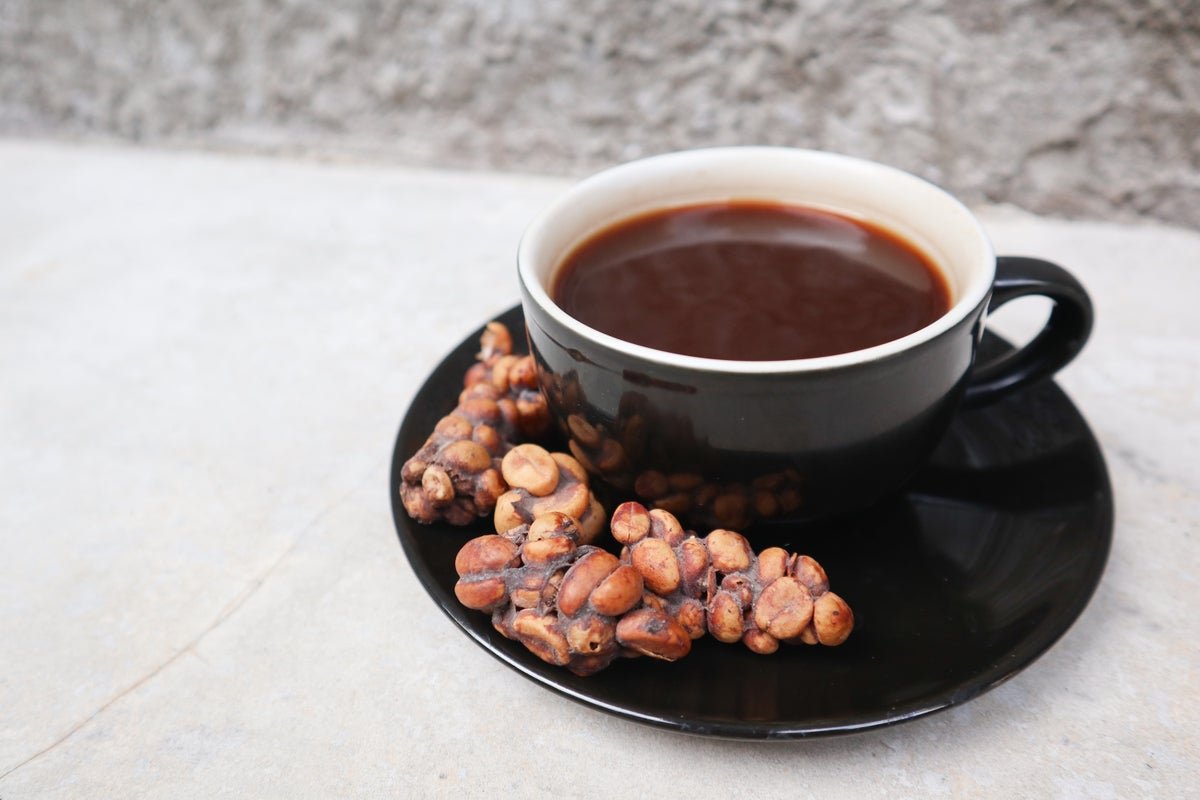
When civet cats eat coffee beans, they excrete them in clumps (shown) that can later be processed to make a pricey drink.
It has been described as nutty, chocolatey, earthy and even fishy: a wildly expensive coffee that can sell for more than 100 times the price of regular brews, made from beans eaten and excreted by civet ‘cats’.
Scientists have long wondered what lies behind civet coffee’s unique flavour. A team now says that the digested beans contain high levels of two compounds commonly used as flavouring agents in dairy products — and these might contribute to the coffee’s distinctive taste.
Civet coffee is produced across Asia. Called Kopi Luwak in its origin country of Indonesia, it grabbed international attention after being featured in the 2007 film The Bucket List. Asian palm civets (Paradoxurus hermaphroditus) eat the fruit or cherries of coffee shrubs, and the seeds (commonly called beans) can be picked from their scat. These are then roasted to make coffee with a unique flavour; the resulting beans can cost more than US$1,300 per kilogram, and the coffee up to $75 per cup.
On supporting science journalism
If you’re enjoying this article, consider supporting our award-winning journalism by subscribing. By purchasing a subscription you are helping to ensure the future of impactful stories about the discoveries and ideas shaping our world today.
These high prices drive civet-coffee tourism and incentivize farms that use caged civets to produce the brew. Several groups, including the UK-based charity The Civet Project, have highlighted serious animal-welfare concerns around these farms, noting that they might also foster viruses with the potential to cause pandemics.
Zoologist Palatty Allesh Sinu at the Central University of Kerala in India, and ecologist colleagues took a close look at the beans picked from civet poo across the Indian district of Kodagu, where the civets are wild. The team undertook the study not only to get a better handle on what makes civet coffee tasty, but also to promote animal welfare. “Once we know the enzymes involved in digestion and fermentation, we may be able to artificially make civet coffee” and leave the animals out of it, Sinu says.
Coffee chemistry
Previous research has focused on what gives civet coffee its sought-after flavour, as well as how best to tell the real thing from fraudulent products. A 2004 study found civet-processed beans to be pitted and brittle from exposure to gastric juices. And a 2019 paper found that roasted civet beans are lower in protein and higher in fat than are regular roasted beans.
The latest work, published today in Scientific Reports, compares unroasted coffee beans harvested from 68 civet scat samples with those picked straight from the plant, to see what the civets’ digestive systems do to the beans.
An analysis using a gas-chromatography-mass spectrometry instrument found one notable difference: a higher concentration of caprylic acid and capric acid in the civet-processed beans. These fatty acids are known for their goat-like flavour in dairy products. The difference, the team says, is probably caused by digestion and fermentation in the civet guts, with Gluconobacter gut bacteria and their enzymes playing a key role.
Although fatty acids might influence the taste of civet coffee, says Melanie-Jayne Howes, a biological chemist at London’s Royal Botanic Gardens, Kew, there are plenty of other compounds and factors at play, too. These could be explored with other techniques and experiments. “The chemistry of coffee flavour is incredibly complex,” says Howes, who published a paper on the topic earlier this year.
The team notes that wild civets selectively eat bigger and riper coffee cherries, which also might affect the taste of the final product.
The latest work was done on Robusta coffee beans, because this is the variety grown in the researchers’ region. “A study is needed on Arabica coffee too,” Sinu says, because that is the variety more often used to make commercial civet coffee. Further work could also look at how roasting the beans alters the fat compounds the team found.
This article is reproduced with permission and was first published on October 23, 2025.
It’s Time to Stand Up for Science
If you enjoyed this article, I’d like to ask for your support. Scientific American has served as an advocate for science and industry for 180 years, and right now may be the most critical moment in that two-century history.
I’ve been a Scientific American subscriber since I was 12 years old, and it helped shape the way I look at the world. SciAm always educates and delights me, and inspires a sense of awe for our vast, beautiful universe. I hope it does that for you, too.
If you subscribe to Scientific American, you help ensure that our coverage is centered on meaningful research and discovery; that we have the resources to report on the decisions that threaten labs across the U.S.; and that we support both budding and working scientists at a time when the value of science itself too often goes unrecognized.
In return, you get essential news, captivating podcasts, brilliant infographics, can’t-miss newsletters, must-watch videos, challenging games, and the science world’s best writing and reporting. You can even gift someone a subscription.
There has never been a more important time for us to stand up and show why science matters. I hope you’ll support us in that mission.
