

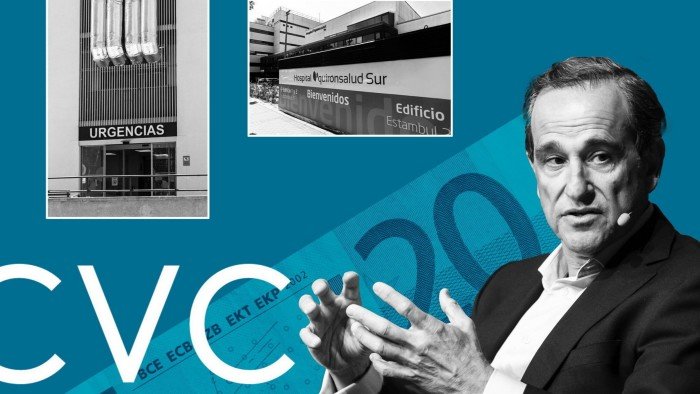
A CVC executive who is one of Spain’s most powerful yet discreet dealmakers has been dragged into the spotlight by a tax probe into a multibillion-euro healthcare deal.
Javier de Jaime Guijarro, a CVC heavyweight with personal wealth of at least €500mn, is being investigated by a Spanish court over allegations of tax fraud that threaten to rock Spain’s private equity sector.
Public prosecutors claim de Jaime and CVC defrauded the Spanish state out of more than €350mn through his categorisation of investment profits as capital gains rather than income and the group’s use of overseas holding companies, according to court documents seen by the Financial Times.
The allegations centre on practices that are core to private equity around the world but are less well known in Spain, where buyout groups are regularly labelled “vulture funds”, including by the Socialist-led government.
De Jaime, who joined CVC in 1997, is one of the group’s most important dealmakers globally. When the company went public last year he owned more than €500mn of its shares, a personal stake exceeded only by CVC’s three founders and chief executive Rob Lucas.
De Jaime has been a driving force behind CVC’s investments in Spain’s top football division La Liga © Josep Lago/AFP via Getty Images
The Spaniard, a managing partner who oversees buyout activity in his home country and Italy, is a power broker behind several high-profile brands. He was a driving force behind CVC’s investments in Spain’s top football division La Liga, power utility Naturgy, and Deoleo, the underperforming owner of olive oil brands including Bertolli and Carbonell.
De Jaime’s tax woes started after CVC secured a mammoth windfall from its sale eight years ago of hospital chain Quirónsalud in one of Spain’s most successful private equity exits.
The health venture began in 1998 when CVC paid $85mn including debt to acquire a small Spanish healthcare chain called Recoletas. It later sold it then bought it back, renaming it as IDC Salud then merging it with private hospital group Quirón and others.
When CVC sold Quirónsalud to German hospitals group Fresenius Helios in 2017 it received €5.76bn and reported profits of almost €2.9bn, according to a person familiar with the matter.
If CVC followed the standard incentive structure in private equity, the firm and its executives would have shared 20 per cent of the €2.9bn, with the rest going to its fund investors.
De Jaime is likely to have pocketed tens of millions personally, according to a CVC incentive structure previously revealed by the FT.
When CVC sold Quirónsalud to German hospitals group Fresenius Helios in 2017 it received €5.76bn © Eduardo Parra/Europa Press via Getty Images
Spain’s tax authority opened a probe into the transaction in 2021. Its findings were then passed to public prosecutors, who drew up allegations that underpinned a judge’s decision to open an investigation at Spain’s National High Court last month.
De Jaime is accused of committing four offences in his personal tax returns between 2015 and 2018, according to the judge’s court order. CVC is accused of 13 tax crimes. The investigating judge will decide whether the case will go to trial once the probe is complete.
“The exact nature and circumstances of such acts, and the persons involved, have not yet been fully determined,” the judge wrote.
But as a head-on challenge to some of private equity’s central practices, some say the CVC case could destabilise the sector in Spain.
“Certainly this is something viewed with concern by the private equity industry,” said one leading Spanish buyouts lawyer. “If CVC is unsuccessful, it creates or draws a line as to how others and the market generally will plan to set up their [investments] going forward, which would put Spain at a disadvantage.”
According to a person close to public prosecutors, a key strand of the case concerns “carried interest”, a share of post-sale investment profits paid to buyout executives such as de Jaime.
The authorities acknowledge that de Jaime declared all of his carried interest and paid tax on it, according to the person familiar with the matter.
In many countries, recipients of carried interest benefit from a tax break that enables them to pay less by classifying it as a capital gain rather than employment income.
CVC has invested in Deoleo, the underperforming owner of olive oil brands including Bertolli © Darryl Brooks/Alamy
De Jaime declared some of his carried interest as employment income and some as investment income, a decision the Spanish tax authority said was wrong, according to the person.
Private equity lawyers say the tax treatment of carried interest was a grey area in Spain at the time of CVC’s exit. The top tax rate on capital gains in Spain is currently 30 per cent, whereas the top rate on employment income, which varies by region, can rise as high as 50 per cent.
One lawyer said that only in 2023 did reforms to the rules make clear that all carried interest should be treated as employment income. However, they added that only half of the gain is now taxed, meaning an effective tax rate on carried interest of about 25 per cent depending on the region.
The other key part of the CVC case centres on its use of holding companies outside Spain.
Quirónsalud was held by a Dutch vehicle that was in turn owned by two Luxembourg entities. CVC declared tax in the Netherlands but paid none in Spain due to a double taxation treaty between the two countries, according to the person familiar with the case.
The Spanish tax authority has argued that the holding structure for the hospitals group should be ignored, which would mean the CVC fund based in Luxembourg was liable to pay income tax in Spain for receiving income from the sale of a Spanish company, albeit as a non-resident.
A tax adviser said there was not usually a significant tax advantage to be gained from using Dutch over Spanish holding entities. The adviser said the Spanish authorities were also pursuing other private equity firms over the structure of their transactions.
The use of Luxembourg holding entities was common, lawyers said, because lenders to private equity portfolio companies often required them as the country’s laws ensured strong protection of their rights.
The CVC transaction contained another twist: above the Luxembourg entities were funds in the Cayman Islands, the person familiar with the case said, a reputed tax haven.
De Jaime and CVC declined to comment. However, the firm said last year in a prospectus ahead of its initial public offering that the fund in question “vigorously” disputed the case against it, and that the firm believed the likelihood the tax authority would “ultimately prevail is low”.
If the judicial investigation leads to formal charges, the firm and de Jaime face the possibility of having to explain their practices in the uncomfortable surroundings of a courtroom.
