

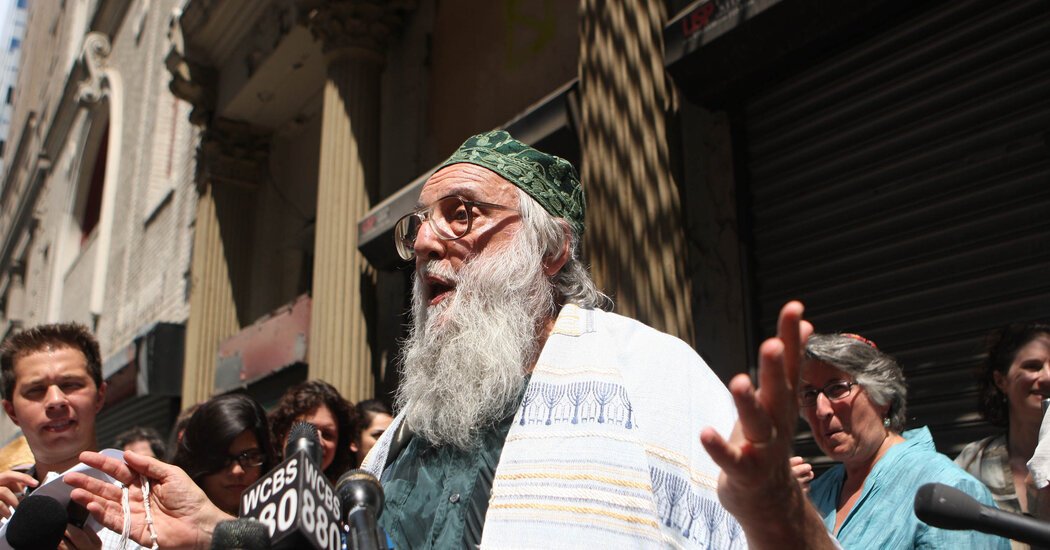
Rabbi Arthur Waskow, an influential leader of the Jewish Renewal movement that sought to make worship more spirited, participatory and egalitarian and who called on followers to work actively for social justice, peace and environmental preservation, died on Monday at his home in Philadelphia. He was 92.
The cause was chronic respiratory failure, said his daughter, Shoshana Elkin Waskow.
Rabbi Waskow, who was bar mitzvahed but did not grow up in an especially observant home, was ordained a rabbi in 1995 at 62 and never occupied a synagogue pulpit. Through more than two dozen books he wrote or published and two organizations he helped found, he had a profound impact on the intellectual and political life of liberal Jewish congregations in the United States.
Notable at demonstrations with his bearish physique and, with age, the wispy white beard of a Hasidic sage, he was arrested 27 times over six decades. He was taken into custody for acts like protesting racial segregation at an amusement park near Baltimore, obstructing an entrance to the Pentagon during the Vietnam War, and blocking access to an Immigration and Customs Enforcement building to highlight what he called the Trump administration’s mistreatment of migrant women.
Rabbi Waskow taught at the Reconstructionist Rabbinical College in Wyncote, Pa., from 1982 to 1989, among other colleges and universities, and had a founding role in Aleph, an umbrella organization for Jewish Renewal congregations. He started the Philadelphia-based Shalom Center in 1983 to galvanize action by Jews to protect the environment, foster peace and prevent nuclear war.
Raised in a politically progressive, working-class household in Baltimore, Rabbi Waskow earned a doctorate in American history and worked for a liberal think tank, the Institute for Policy Studies in Washington, while immersing himself in frontline activism nationally in the 1960s.
More than any other event, the assassination of the Rev. Dr. Martin Luther King Jr. in 1968 and the government’s armed response to the urban riots that followed led Rabbi Waskow to explore his faith more seriously. He wrote what he called the “Freedom Seder,” a revision of the traditional Passover Haggadah text about the exodus of enslaved Jews from Egypt.
“Freedom Seder” — which tied the battle for civil rights and other liberation movements to the struggle of the Jewish people as depicted in Scripture — was published by the crusading, radical-left magazine Ramparts.
Rabbi Waskow’s Haggadah may seem conventional by contemporary standards, with many similarly themed booklets gracing Seder tables, but in 1969 it chagrined an Orthodox rabbinical association by citing words of righteous anger by Dr. King, Gandhi and Eldridge Cleaver, a leader of the Black Panthers.
In his eulogy for Rabbi Waskow, his friend Rabbi Mordechai Liebling called “Freedom Seder” “not just a ritual innovation” but “a spiritual earthquake.
“It showed us that Judaism is not a museum of memory but a living covenant of action — that ‘Let My People Go’ means all people, in every generation,” Rabbi Liebling said.
According to a reminiscence in the Jewish publication The Forward by Rabbi Jay Michaelson, Rabbi Waskow delivered a Yom Kippur sermon in 1969 at a Washington synagogue in which he called on congregants to atone not just for their personal sins but also, as citizens, for “paying soldiers to burn Vietnamese babies alive” and “paying and applauding policemen who gas, shoot and beat Black People.”
In the counterculture zeitgeist of the late 1960s, Rabbi Waskow was a champion of the Havurah movement, which featured small, intimate prayer groups that tailored Jewish worship to their own needs, often without the shepherding of a rabbi.
Later, as the Havurah movement blossomed into Jewish Renewal with eclectic rituals often borrowed from Hasidism, Buddhism and other cultures, a Shabbat service might include a period of meditation, a yoga breathing exercise, resonant drumming to a traditional liturgical song, the singing of a Black spiritual like “Down by the Riverside,” or a Hebrew prayer sung to a melody like “We Shall Overcome.”
Rabbi Waskow was an early proponent of gay marriage, equality of women in all aspects of Jewish life, and the right of Palestinians for their own homeland.
In 1982, when news surfaced that a Christian militia in Lebanon aligned with the Israeli defense forces had massacred at least 1,300 Palestinians in the Sabra and Shatila refugee camps in Beirut, Rabbi Waskow, who was reportedly at a retreat center near Baltimore, channeled his fury by chanting The Philadelphia Inquirer’s account of the massacre as a supplement to the Torah reading.
In part because his mother had had tuberculosis, Rabbi Waskow spent considerable time in recent decades focused on the health of the planet.
To illustrate the interdependence of humans and their environment, said Keshira haLev Fife, a faculty member at the Shalom Center, Rabbi Waskow often pointed out that “each time we inhale, we’re receiving breath from the trees, and each time we exhale we’re reciprocating.” He often referred to God as the “breath of all life.”
David G. Aftergood, a psychiatrist in Westchester County, N.Y., recounted a meaningful encounter with Rabbi Waskow in the late 1990s at the Elat Chayyim Center for Jewish Spirituality in northwestern Connecticut, where Rabbi Waskow was teaching.
Dr. Aftergood confided to Rabbi Waskow that he had forsaken the Orthodoxy he had grown up with, that he was exploring other traditions such as kabbalah and Buddhism, and that he was feeling uneasy about his relationship to the Jewish mainstream. Rabbi Waskow replied, referring to a prayer shawl: “What is the holiest part of a tallit? It’s the fringes. Those that are on the fringes in a committed way bring a sacred aspect to Judaism.”
“It was such an act of kindness to me,” Dr. Aftergood said. “It was so affirming and validating. It really helped me.”
Arthur Irwin Waskow, the older of two sons, was born on Oct. 12, 1933, in Baltimore. His father, Henry, was a public-school history teacher who became a founder and president of the Baltimore Teachers Union. His mother, Hannah (Osnowitz) Waskow, was a volunteer with Americans for Democratic Action, the liberal advocacy organization, and strove to register Black voters.
Arthur Waskow graduated from Johns Hopkins University in 1954 with a bachelor’s degree in American history and completed his doctorate in 1963 at the University of Wisconsin.
In 1970, after serving as an alternate delegate at the 1968 Democratic National Convention in Chicago, he testified as a defense witness in the rowdy trial of Abbie Hoffman, Jerry Rubin and the rest of the so-called Chicago Seven far-left activists on charges of inciting riots near the convention to disrupt the proceedings. (The defendants were found guilty of crossing state borders with the intent of inciting a riot, but the convictions were overturned on appeal.)
Rabbi Waskow left the Institute for Policy Studies in 1977 to start the Public Resource Center, where he spent five years on a government-funded research project focused on renewable energy and conservation.
He and his first wife, Irene Elkin, had two children before divorcing. In 1986, he married Rabbi Phyllis Berman and, as a nod to their shared commitment to environmentalism, both took the middle name Ocean.
In addition to his wife and daughter, he is survived by a son, David; two stepchildren, Josh Sher and Morissa Wiser; and five grandchildren.
As a result of Mr. Waskow’s engagement with the Havurah movement and his leadership of the Shalom Center, friends and colleagues suggested that he seek ordination as a rabbi. He had already immersed himself in the study of the Torah and Talmud as a teacher at the Reconstructionist seminary.
He assembled a bet din — a Jewish court of three judges — headed by Zalman Schachter-Shalomi, a seminal figure in the Renewal movement, and was ordained as a rabbi.
Rabbi Waskow’s books included “Godwrestling” (1978) and “Down-to-Earth Judaism: Food, Money, Sex, and the Rest of Life” (1995).
As he passed 90, Rabbi Waskow had a Zoom conversation last year with another nonagenarian, the feminist Gloria Steinem, telling her how he felt that with time running out there was still much — perhaps too much — to be done. He took comfort in the words of a Talmudic sage.
“One of the rabbis said, ‘I’m not going to finish the work, but that doesn’t mean I can quit,’” he explained on the call with Ms. Steinem. “As long as we can continue to change the world, transform the world with more equality, more justice, more joy, more love, we’ll keep on doing it.”
