

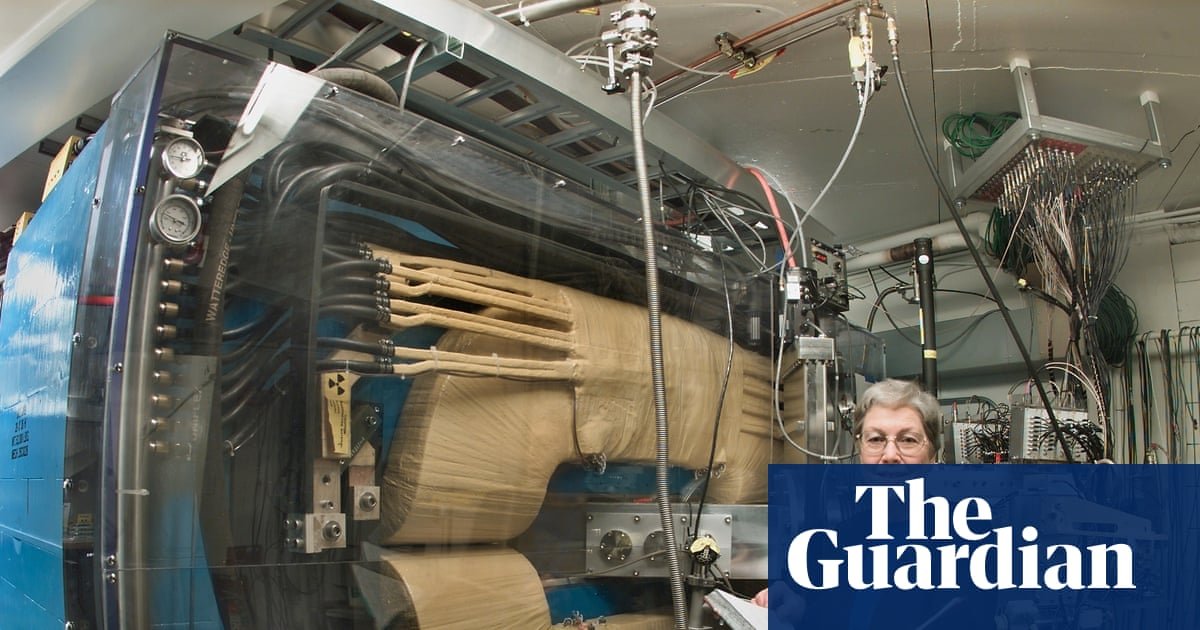
Darleane Hoffman’s research into superheavy radioactive elements at the University of California’s Lawrence Berkeley National Laboratory (LBNL) and, prior to that, at Los Alamos National Laboratory in New Mexico, enhanced and extensively revised our knowledge of those elements and, consequently, our understanding of nuclear fission. Her success led, in 2002, to Discover magazine declaring her one of the 50 most important women in science.
Hoffman, who has died aged 98, explored the chemical and nuclear properties of transuranic elements – those heavier than uranium. All are radioactively unstable. Most have a short half-life: existing for only a brief period before decaying, sometimes mere milliseconds. This makes them difficult to study, but, during the 1950s, Hoffman realised that characterising their properties could help us better comprehend the emerging science of nuclear fission, which involved splitting the atoms of these heavy elements to release the large amounts of energy necessary to power the first generation of commercial nuclear reactors.
Uranium’s atomic number is 92. This refers to the number of protons in each nucleus of its atoms. Generally, the higher the number, the heavier the element. For decades chemists believed transuranic elements (those with atomic numbers greater than 92) could not occur in nature, only laboratories. However, in 1971, Hoffman discovered plutonium-244, atomic number 94, in rocks at the atomic weapons test site in Nevada. Plutonium, as with many other elements, exists in slightly different forms and the number 244 refers to the specific type, or isotope, of the element.
“For years it was assumed uranium-238, with a half-life of 4.5bn years, was the heaviest naturally occurring radioactive isotope,” Hoffman explained. “Discovering plutonium-244 at the test site led us to speculate whether it could also have been created naturally under conditions similar to a nuclear weapons test.”
The last time such conditions occurred naturally in our solar system was about 5bn years ago during nucleosynthesis, the astrophysical process that creates new atomic nuclei, and hence new and different chemical elements. The search was on for ancient rocks that might contain such elements, and a formation was located at Mountain Pass Mine in California. Later that year, writing in Nature, Hoffman confirmed the presence of plutonium in the formation. Glenn Seaborg, winner of the 1951 Nobel prize in chemistry for his discovery of transuranic elements in the laboratory, called her work “an experimental tour de force”.
Born in Terril, Iowa, Darleane was the daughter of Elverna (nee Clute), a homemaker, and Carl Christian, a maths teacher. She had a younger brother, Sherril.
Schooled locally, she was academically gifted enough to be offered a place at Iowa State College (now University) in 1944. She was inspired by her chemistry lecturer Nellie Naylor and a fascination with Marie Curie, the French chemist who discovered the elements polonium and radium.
Hoffman in the lab in 1950. Photograph: University of California/Lawrence Berkeley National Laboratory
Hoffman often said nuclear science was in large part started by women such as Curie, mainly because “it wasn’t an established field. It had, as yet, no male hierarchy, so was easier to break into.”
She graduated in 1948 and stayed at Iowa to earn a PhD in nuclear chemistry in 1951, the year she married Marvin Hoffman, a fellow student.
The following year both began working at Los Alamos, where their children, Maureane and Daryl, were born. After a brief delay, because the human resources department refused to believe a woman could be a chemist, Hoffman continued searching for new isotopes of heavy elements in samples from Nevada. The heaviest she detected was fermium-257, atomic number 100. This led to her second significant discovery.
While at home with flu, she began reviewing data her team had collected on fermium. She noticed something strange. The fermium nucleus wasn’t always splitting in a way that was consistent with the existing hypothesis. Most nuclei split, as expected, into two unequal parts, but some split into two equal-mass fragments defying conventional theory. Although her observations were initially dismissed by the American Physical Society, colleagues validated the results. It was a major breakthrough in our knowledge of nuclear fission.
Impressed with her work, in 1978, Seaborg invited her to work with him at LBNL. Although she maintained links with Los Alamos, becoming the first woman to lead a scientific department there as head of the nuclear chemistry division, when Seaborg retired he recommended Hoffman to replace him.
At LBNL she continued to discover and characterise heavy elements. She worked her way up through the atomic numbers to hassium, atomic number 108, in addition to helping to verify the existence of even heavier elements. Her team also confirmed the 1974 discovery of element 106, naming it seaborgium in honour of Seaborg, who first identified it in his laboratory (although precedence was also claimed by Soviet scientists, without evidence). Her final posting was as director of the Seaborg Institute for Transactinium Science at LBNL between 1991 and 1996.
Her research led to advances in subjects as diverse as the use of radioisotopes in medicine – allowing us to study internal structures of the human body and therapies to destroy cancerous cells – to safer nuclear-reactor designs and techniques for detecting nuclear-weapons proliferation. She formulated safety protocols for nuclear waste management and, similarly, became involved in investigations into nuclear-weapons test sites, checking for radioactive leakage. “There are many practical issues my work can address,” she said, “and many discoveries yet to be made.”
A fellow of the American Physical Society, among many awards she received the National Medal of Science from President Bill Clinton in 1997 and in 2000 was granted the Priestley medal, the American Chemical Society’s highest award.
Her husband died in 2019. Her two children and three grandchildren survive her.
Darleane Christian Hoffman, nuclear chemist, born 8 November 1926; died 4 September 2025
